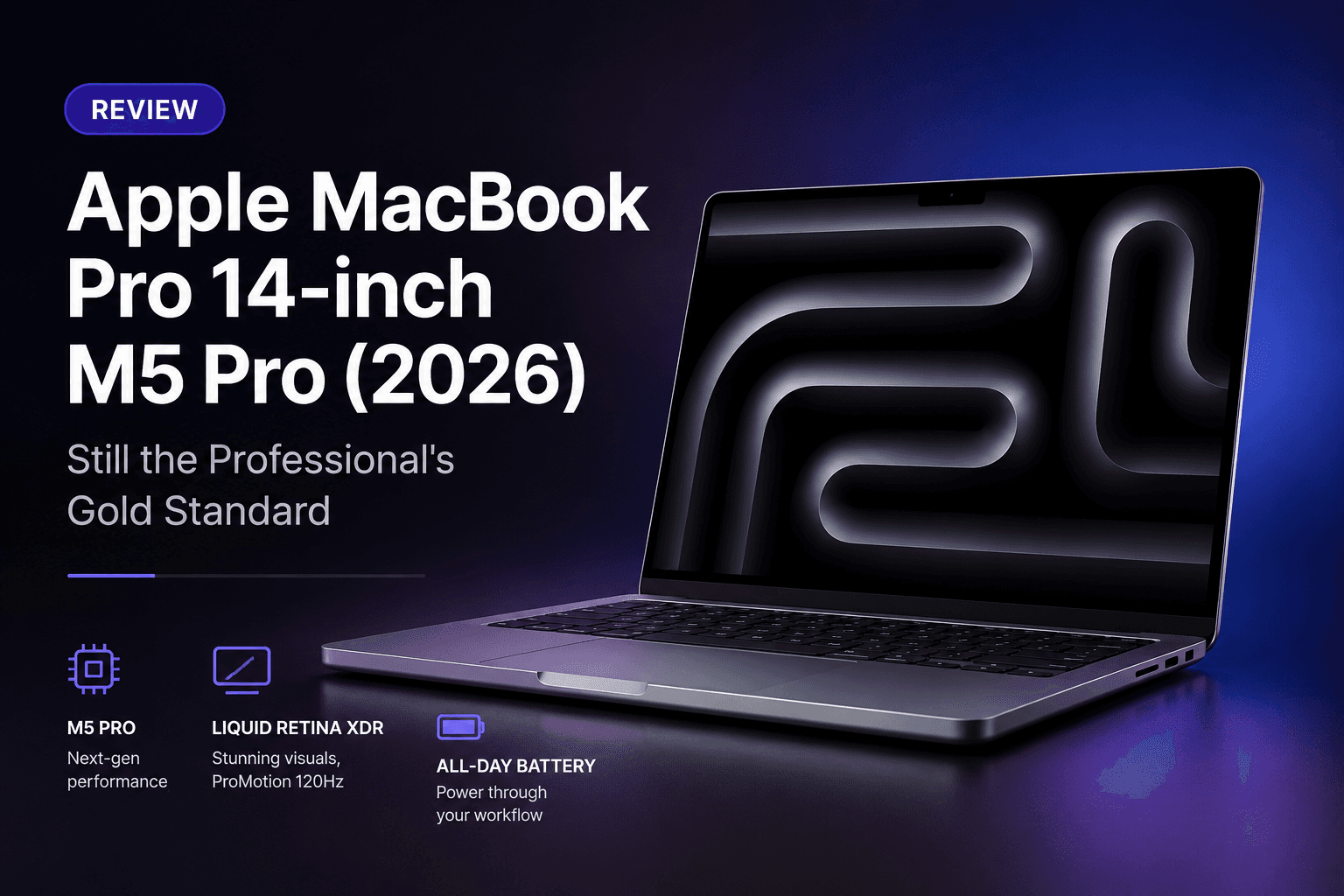
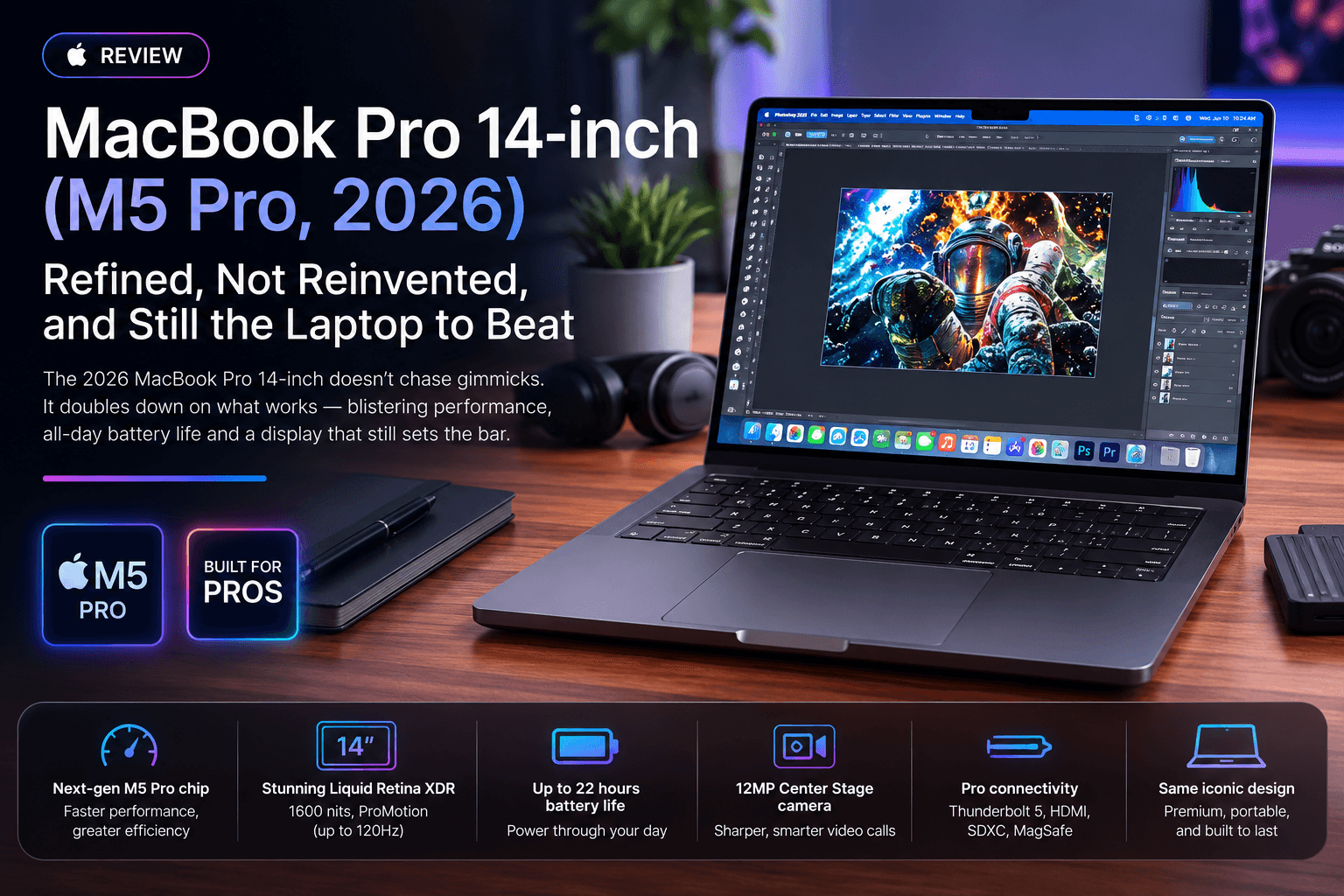
MacBook Pro 14-inch (M5 Pro, 2026) Review: Refined, Not Reinvented, and Still the Laptop to Beat.
Apple's 2026 MacBook Pro lineup brings the M5 Pro and M5 Max chips, faster storage, Wi-Fi 7, and a new Center Stage webcam to a design that otherwise stays the same. It's an iterative upgrade rather than a redesign, but for professionals still on Intel or M1/M2 hardware, it's a genuinely compelling one.
Interested in this item?
Get the best verified price using our affiliate link below.
Apple's MacBook Pro has settled into a familiar rhythm: keep the design that already works, and let a new chip do the heavy lifting. The 2026 refresh, built around the M5 Pro and M5 Max silicon, follows that pattern closely. There's no chassis redesign, no new port layout, and no dramatic visual shift from the M4 generation. What you get instead is a substantial jump in raw performance, meaningful gains in AI workloads, and a handful of smaller quality-of-life additions that, together, make a strong case for anyone still running older hardware — while giving recent M4 owners considerably less reason to upgrade.
This is Apple refining a proven formula rather than reinventing it — and for a laptop already considered the professional gold standard, that's arguably the right call.
Design & Build Quality
The unibody aluminum chassis carries over unchanged, and in a market where competitors are constantly chasing thinner, lighter designs, Apple has stuck with its existing form factor in favor of preserving thermal headroom and battery capacity. That's a defensible trade-off: the MacBook Pro remains sturdy, well-built, and comfortable for long working sessions, with a keyboard that continues to hold up well for marathon coding or writing sessions. It won't turn heads the way a genuinely new design would, but it also isn't asking anyone to compromise on the durability and reliability the line is known for.
Display
Both the 14-inch and 16-inch models retain their Liquid Retina XDR panels, with the larger model offering a 3,456 x 2,234 resolution. The display quality itself remains a strength of the lineup — bright, color-accurate, and well suited to color-critical creative work — and testing across multiple review outlets continues to rate it near the top of the category. Apple hasn't changed the panel technology this generation, so if you're coming from an M3 or M4 model, don't expect a visible difference here; the upgrade case rests almost entirely on what's happening inside the chassis.
Performance
This is where the 2026 MacBook Pro earns its upgrade credentials. In Geekbench 6 CPU testing, the 18-core M5 Pro delivered a 56% improvement in multi-core performance over the standard M5 chip, and outpaced Intel's Core Ultra 9 385H — found in competing Windows laptops like the Asus Zenbook Duo — by roughly 62%. Stepping up to the M5 Max chip pushes things further still, with Apple positioning it as the tool of choice for 8K rendering, complex software compilation, and local AI model inference, aided by up to 36GB of unified memory and storage configurations reaching 4TB. For anyone doing genuinely demanding creative or development work, that's a meaningful, measurable jump rather than a marketing number.
AI & Neural Engine
Apple is leaning hard into on-device AI capability this generation. The company claims the M5 Max can train AI models up to three times faster than the M4 Max, and as much as 12 times faster than the original M1 Max, thanks to Neural Accelerators that support AI training workloads rather than just inference. In practical testing, the M5 Pro chip handled a range of local models — including releases from Meta, Mistral, and DeepSeek — without issue, a capability that matters increasingly for developers and researchers who want to experiment with local large language models without relying on cloud compute. It's a genuine differentiator, even if it's a niche one for the average buyer.
Battery Life
Despite the substantial performance increase, battery life hasn't suffered. The 16-inch M5 Pro model lasted just under 20 hours in a standardized video rundown test with the display set to a moderate brightness and wireless radios disabled — an impressive result for a laptop capable of handling such demanding workloads. Real-world use, particularly with sustained heavy compute tasks, will naturally bring that figure down, but for typical day-to-day work — writing, browsing, video calls, light editing — the MacBook Pro should comfortably outlast a full working day without needing to hunt for an outlet.
Connectivity & Extras
Wi-Fi 7 arrives on the MacBook Pro for the first time this generation, a welcome addition for anyone with compatible networking hardware, alongside Thunderbolt 5 ports for faster external storage and display connections. Apple has also upgraded the webcam to a new 12MP Center Stage sensor that adds auto-framing and tracks your position as you move — a small but genuinely useful improvement for anyone spending significant time on video calls. Beyond these additions, though, the port selection and overall I/O layout remain unchanged from the previous generation.
Pricing & Configuration
Apple's 2026 lineup has grown more layered, and consequently more confusing, than in past years. The entry point is the 14-inch M5 Pro configuration (15-core CPU, 16-core GPU, 24GB RAM, 1TB SSD), starting around £2,199, while the base 16-inch model climbs to roughly £2,699. Fully specced configurations with the M5 Max chip, additional RAM, and larger SSDs push well beyond £4,000. It's a wide spread that requires buyers to think carefully about which chip tier and memory configuration actually matches their workload, rather than defaulting to the top-end option.
Who Should Buy It
This upgrade makes the most sense for professionals still using Intel-based MacBooks or early Apple Silicon models like the M1 or M2 — the combined leap in CPU, GPU, and AI performance, along with improved battery life and Wi-Fi 7, adds up to a substantial, easily justified upgrade. Developers, researchers, and anyone experimenting with local AI model training will find real, practical value in the M5 Pro and M5 Max's neural processing capabilities. Recent M4 MacBook Pro owners, on the other hand, will find the improvements real but comparatively modest, and are better served waiting for a future generation.
Final Verdict
The 2026 MacBook Pro doesn't try to reinvent what already works, and that restraint pays off. Apple has taken a laptop widely regarded as the standard for creative and technical professionals and made it meaningfully faster, more AI-capable, and just as reliable on battery, without disrupting the design and ergonomics people already trust. It's an iterative update rather than a landmark one, but for the audience it's built for, iteration executed this well is exactly what's needed.
Ready to Purchase?
We gather active retail prices. Click below to buy this product securely.