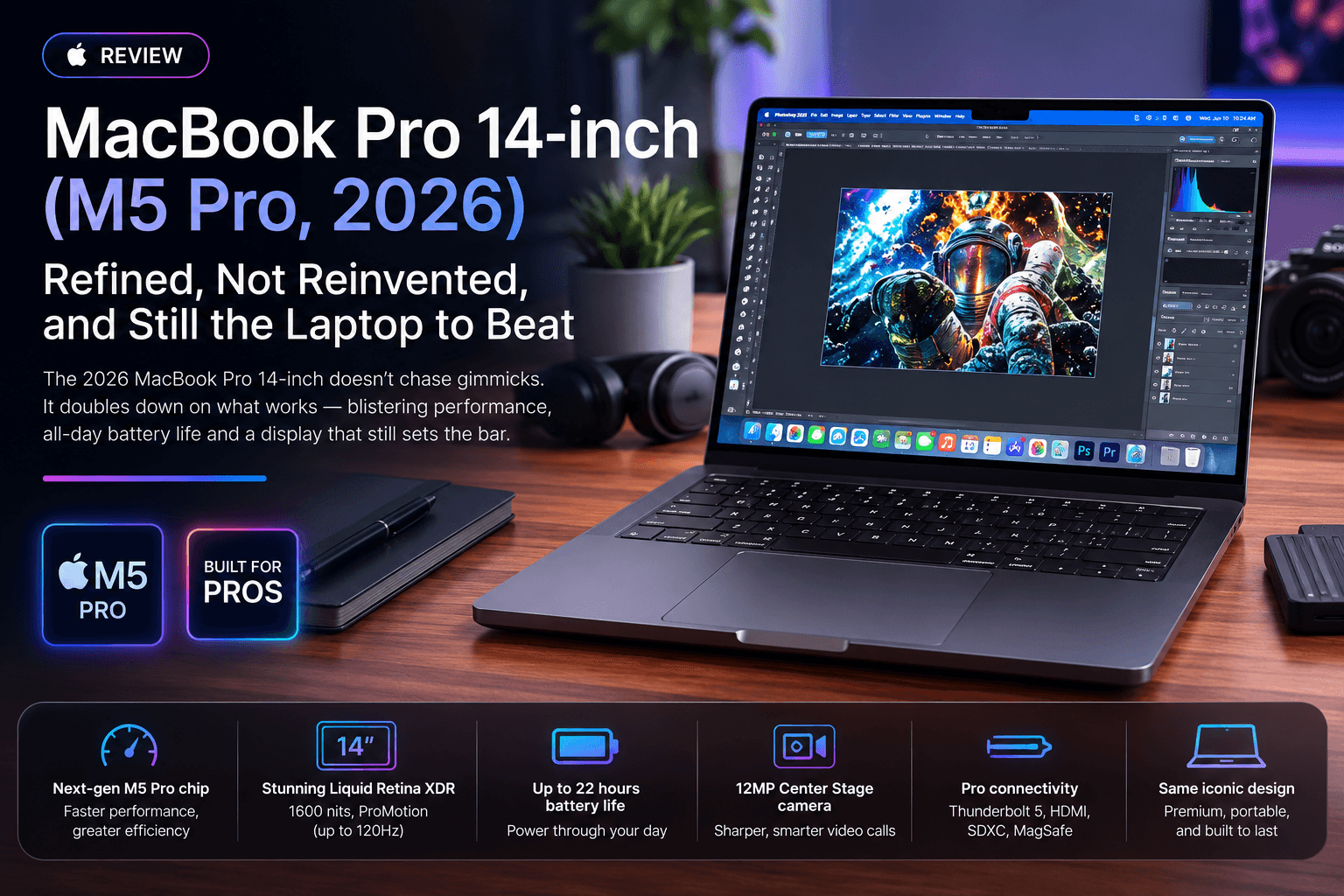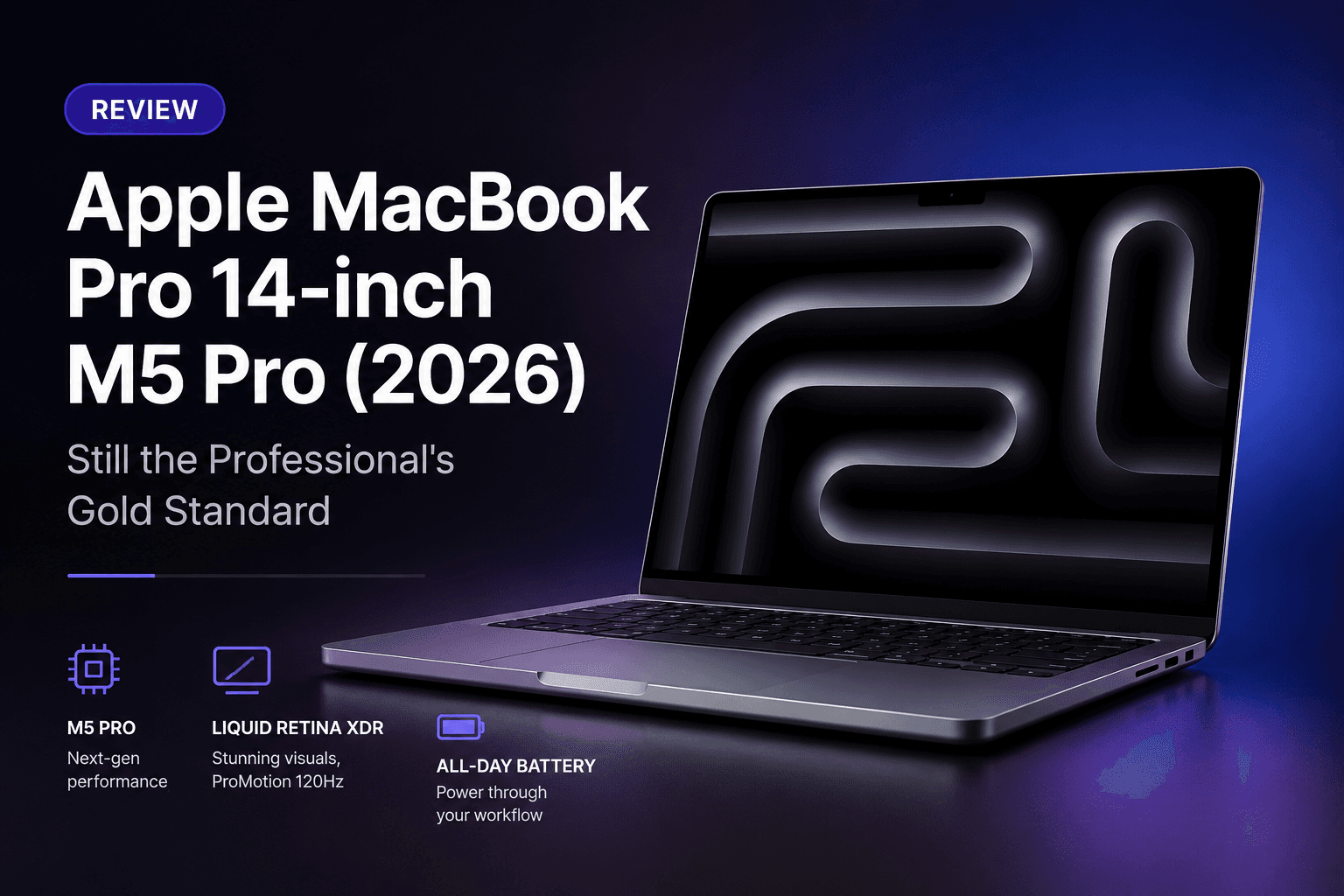
Apple MacBook Pro 16 (M4 Max) Review: The Undisputed King of Mobile Workstations.
Apple's latest 16-inch MacBook Pro leverages the monstrous M4 Max chip, a glare-killing nano-texture display option, and Thunderbolt 5 to deliver an uncompromising, battery-defying workstation for serious professionals.
A
Admin
Lead Editorial Analyst
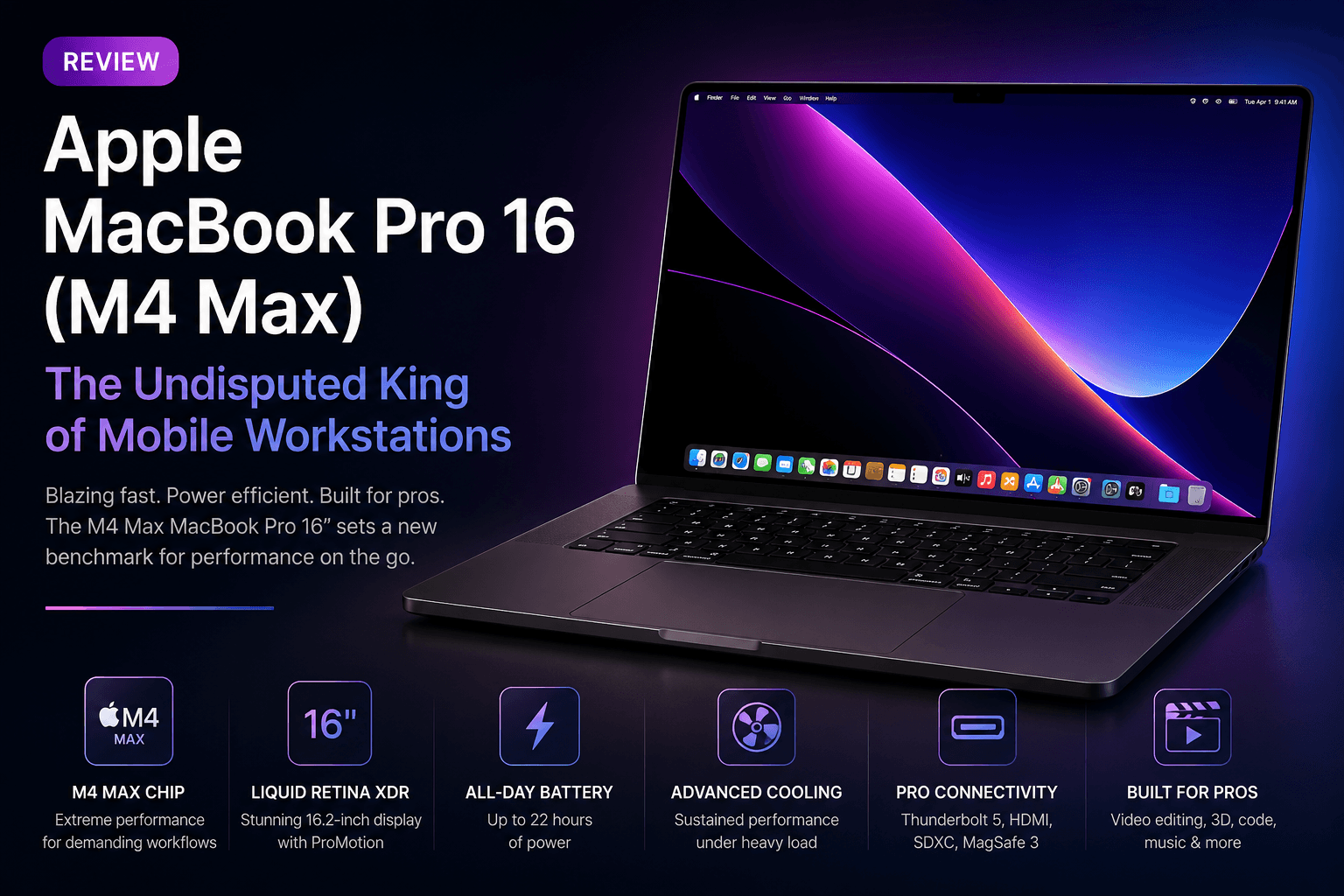
For the past few generations, Apple's 16-inch MacBook Pro has reigned as the undisputed king of mobile workstations, combining desktop-class performance with battery life that borders on witchcraft. With the introduction of the M4 Max architecture, Apple hasn't reinvented its flagship laptop, but rather sharpened it to a lethal edge. The latest 16-inch MacBook Pro (starting at $2,499, though soaring well past $4,000 for our M4 Max review unit) represents the culmination of Apple Silicon's relentless march forward. It takes an already flawless chassis and upgrades the internal silicon, enhances the display with a highly anticipated nano-texture option, and finally introduces next-generation Thunderbolt 5 connectivity. This is not a casual upgrade for anyone holding an M3 model, but for professionals still clinging to Intel-based MacBooks or early M1 workstations, the M4 Max iteration is a generational leap that redefines what a portable computer can achieve.The Apple MacBook Pro 16 with the M4 Max chip solidifies its position as the ultimate mobile workstation, pairing unrivaled multi-core performance with the stunning new nano-texture display and future-proof Thunderbolt 5 connectivity.Design and Build Quality: If It Ain't BrokeFrom a purely aesthetic standpoint, the exterior of the 16-inch MacBook Pro remains completely unchanged. It retains the same flat-edged, industrial aluminum chassis that Apple reintroduced in 2021. Weighing in at 4.7 pounds (2.14 kg) and measuring 0.66 inches thick, this is undoubtedly a dense, substantial machine. It demands space in your backpack and a sturdy desk to rest on. The build quality, however, remains peerless. The unibody aluminum enclosure exhibits zero flex, the hinge opens effortlessly with a single finger, and the Space Black finish—now improved with an anodized seal—does an admirable job of repelling oily fingerprints compared to older models.The Magic Keyboard is as comfortable and tactile as ever, featuring full-height function keys and a responsive Touch ID sensor. The massive Force Touch trackpad continues to embarrass every Windows OEM on the market; its precision, palm rejection, and haptic feedback are genuinely flawless. One minor complaint remains: the display notch housing the webcam is still present, and Apple still hasn't integrated FaceID. The webcam itself, however, has been significantly upgraded to a 12-megapixel Center Stage camera that provides phenomenally sharp video for conference calls and includes Desk View capabilities.Display: The Nano-Texture Game ChangerApple's 16.2-inch Liquid Retina XDR display has always been stunning, utilizing mini-LED technology to deliver exceptional contrast and perfect inky blacks. The panel pushes a crisp 3456 x 2234 resolution and supports ProMotion variable refresh rates up to 120Hz. However, the headline feature for this generation is the optional nano-texture display coating. Previously reserved for Apple's standalone Pro Display XDR and Studio Display, this microscopic etching scatters ambient light, practically eliminating screen glare.In real-world usage, the nano-texture glass is a revelation for creatives and professionals. Whether you are editing video in a brightly lit studio with overhead fluorescent lights or working on a patio under direct sunlight, the display remains perfectly legible. Brightness levels have also seen a bump, peaking at an astonishing 1,600 nits for HDR content and 1,000 nits for standard SDR brightness in outdoor conditions. While the nano-texture finish commands a $150 premium and slightly softens the absolute sharpness of text compared to glossy glass, the trade-off is absolutely worth it for anyone who frequently works in challenging lighting environments.Performance: M4 Max is UntouchableThe beating heart of our review unit is the top-tier Apple M4 Max chip, configured with a 16-core CPU, a monstrous 40-core GPU, and 48GB of unified memory. Built on the second generation of a 3-nanometer process, this silicon is absurdly fast. When exporting a 30-minute 4K ProRes video sequence in Final Cut Pro, the MacBook Pro completed the task in a fraction of the time it took a top-spec Intel-based desktop workstation. In 3D rendering applications like Blender and Maxon Cinema 4D, the M4 Max demonstrates multi-core dominance, easily outpacing even the most aggressive Nvidia RTX 40-series equipped gaming laptops while drawing significantly less power.What is perhaps more impressive than the raw numbers is the thermal efficiency. Under extreme synthetic workloads, it takes minutes for the internal fans to even become audible. During standard productivity tasks—handling 50+ Chrome tabs, running Slack, editing RAW photos in Lightroom, and streaming Spotify—the laptop remains entirely silent and physically cool to the touch. Crucially, the M4 Max does not heavily throttle its performance when unplugged. You get the exact same rendering speed on battery power as you do when plugged into the wall, a feat no high-end Windows laptop can currently replicate.Ports and Connectivity: Enter Thunderbolt 5Apple's port redemption arc is fully complete. The right side of the device houses a full-size SDXC card reader (a godsend for photographers), an HDMI 2.1 port capable of driving an 8K display, and a USB-C port. The left side features the MagSafe 3 charging port, a 3.5mm high-impedance headphone jack, and two additional USB-C ports.The major upgrade here is that the M4 Pro and M4 Max models now support Thunderbolt 5. Delivering massive bidirectional bandwidth up to 120Gbps, Thunderbolt 5 allows data scientists and video editors to transfer massive files to external NVMe arrays at blistering speeds, effectively matching internal SSD performance. Oddly, Apple decided to stick with Wi-Fi 6E instead of adopting the newer Wi-Fi 7 standard. While Wi-Fi 6E provides plenty of bandwidth for most users, omitting Wi-Fi 7 on a device that costs several thousand dollars feels like a strange compromise for a laptop designed to last half a decade.Battery Life: Defying PhysicsHistorically, choosing a 16-inch high-performance workstation meant accepting terrible battery life. The M4 Max shatters this paradigm entirely. Packed with a massive 100-watt-hour battery—the maximum capacity legally allowed on a commercial flight—the 16-inch MacBook Pro delivers staggering endurance. In our standardized web surfing test with the display set to 150 nits of brightness, the device lasted an astonishing 21 hours and 15 minutes.Even under heavy, realistic workloads involving Adobe Premiere Pro editing, Slack communication, and constant web browsing, we comfortably achieved a full 12-hour workday with nearly 30 percent battery remaining by evening. You can genuinely leave the 140W fast charger at home for weekend trips. When you do need to juice up, MagSafe 3 fast-charging brings the laptop from dead to 50 percent in just 30 minutes.Software Experience: macOS Sequoia and Apple IntelligenceShipping with macOS Sequoia, the software experience is as refined as you would expect. The highlight of this release is Apple Intelligence, which brings on-device generative AI tools deeply integrated into the operating system. Features like advanced writing tools, smart summarization in Mail and Safari, and context-aware Siri requests execute instantly thanks to the M4 Max's massively upgraded 16-core Neural Engine. Because this processing happens locally, data privacy is maintained without needing constant cloud server pings. The iPhone Mirroring feature also works flawlessly, allowing you to seamlessly control your iOS device directly from the Mac's desktop while your phone remains locked in your pocket.Competitive LandscapeDell XPS 16Dell's flagship XPS 16 boasts a stunning futuristic design, an OLED touch screen, and the latest Intel Core Ultra processors paired with Nvidia RTX graphics. While it is undeniably gorgeous and highly capable for creative work, it simply cannot touch the MacBook Pro 16 when it comes to battery endurance, acoustic performance under load, and trackpad usability. Furthermore, the XPS 16's controversial invisible trackpad and capacitive function row remain polarizing design choices.Asus ProArt Studiobook 16Aimed directly at creative professionals, the Asus ProArt offers brilliant features like the physical Asus Dial for granular timeline scrubbing in Premiere Pro, as well as an incredible 120Hz OLED panel. While its GPU performance matches or occasionally beats the Mac in heavily optimized 3D ray-tracing, the ProArt is significantly heavier, louder, and must be plugged into a wall outlet to unleash its full performance, making it a workstation in name but not a true mobile solution.Who Should Buy It?Video Editors & 3D Animators: The M4 Max chip renders complex timelines and 3D models with desktop-class speed, saving hours of downtime every week.Outdoor Professionals: Photographers and on-set directors will find the new nano-texture display coating absolutely transformative for outdoor color-grading and review.Data Scientists & Developers: With up to 128GB of unified memory and massive multi-core compute, this machine allows local compilation of massive codebases and running local Large Language Models (LLMs) with ease.Final VerdictThe Apple MacBook Pro 16 featuring the M4 Max chip is arguably the most perfect laptop ever constructed for demanding professionals. It checks virtually every box a power user could ask for: uncompromising performance on or off battery power, a class-leading anti-glare display, future-proof Thunderbolt 5 connectivity, a sublime typing experience, and battery life that defies basic logic. The primary barrier to entry, as always, is the staggering price tag, compounded by Apple's exorbitant fees for RAM and storage upgrades. Additionally, the lack of Wi-Fi 7 and the persistent display notch remain minor annoyances. However, if your livelihood depends on raw computing speed, stability, and mobile reliability, this machine isn't just an expense; it is a critical investment that will seamlessly carry your workflow deep into the next decade.