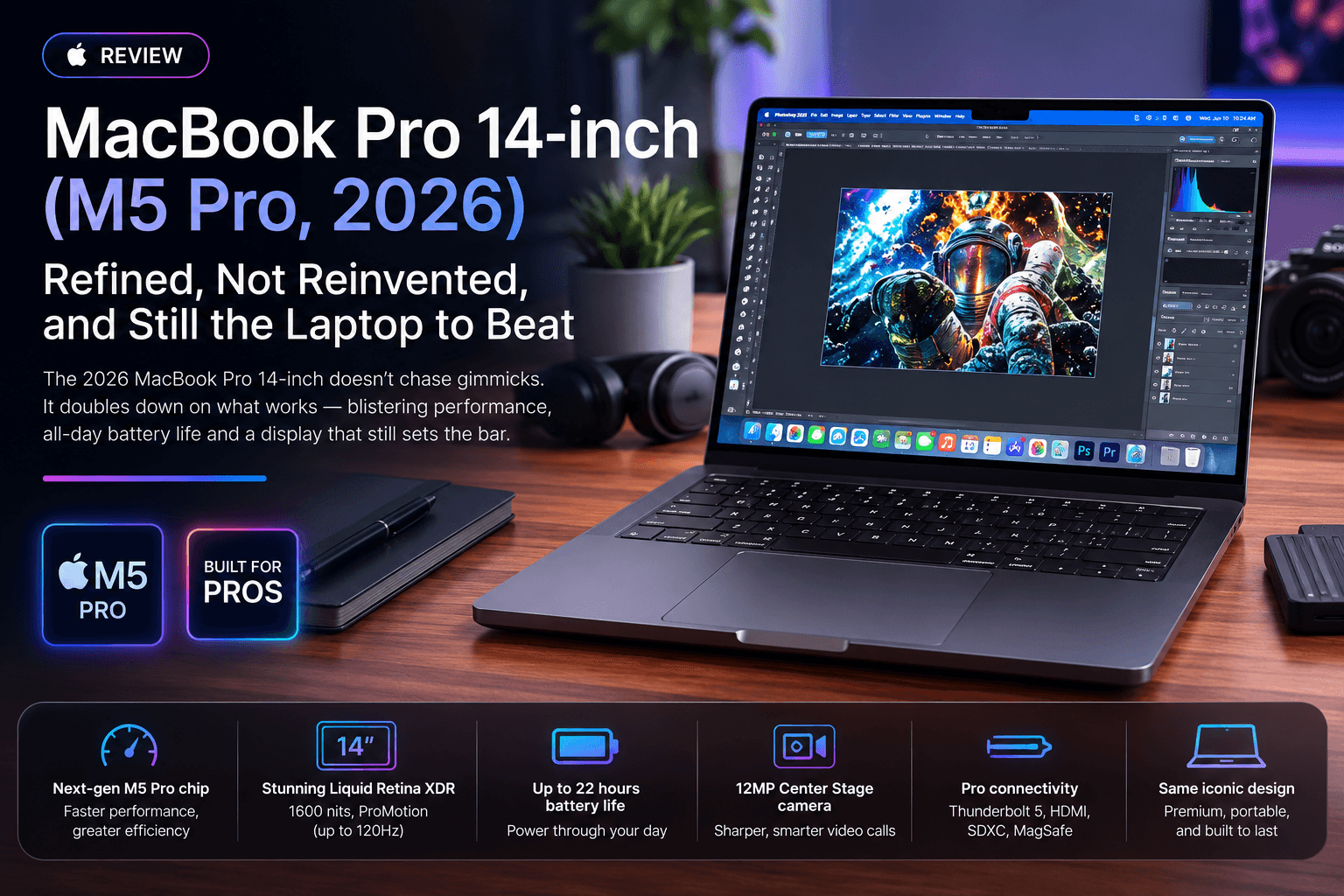
Apple MacBook Pro 14-inch M5 Pro (2026) Review: Still the Professional's Gold Standard.
Apple's MacBook Pro 14-inch with the M5 Pro chip arrives in March 2026 with meaningful CPU, GPU, and AI performance gains, Wi-Fi 7, and faster storage — all in the same chassis professionals have trusted for years. At $2,199, it remains the benchmark for portable creative workstations, though it's a refinement rather than a revolution.
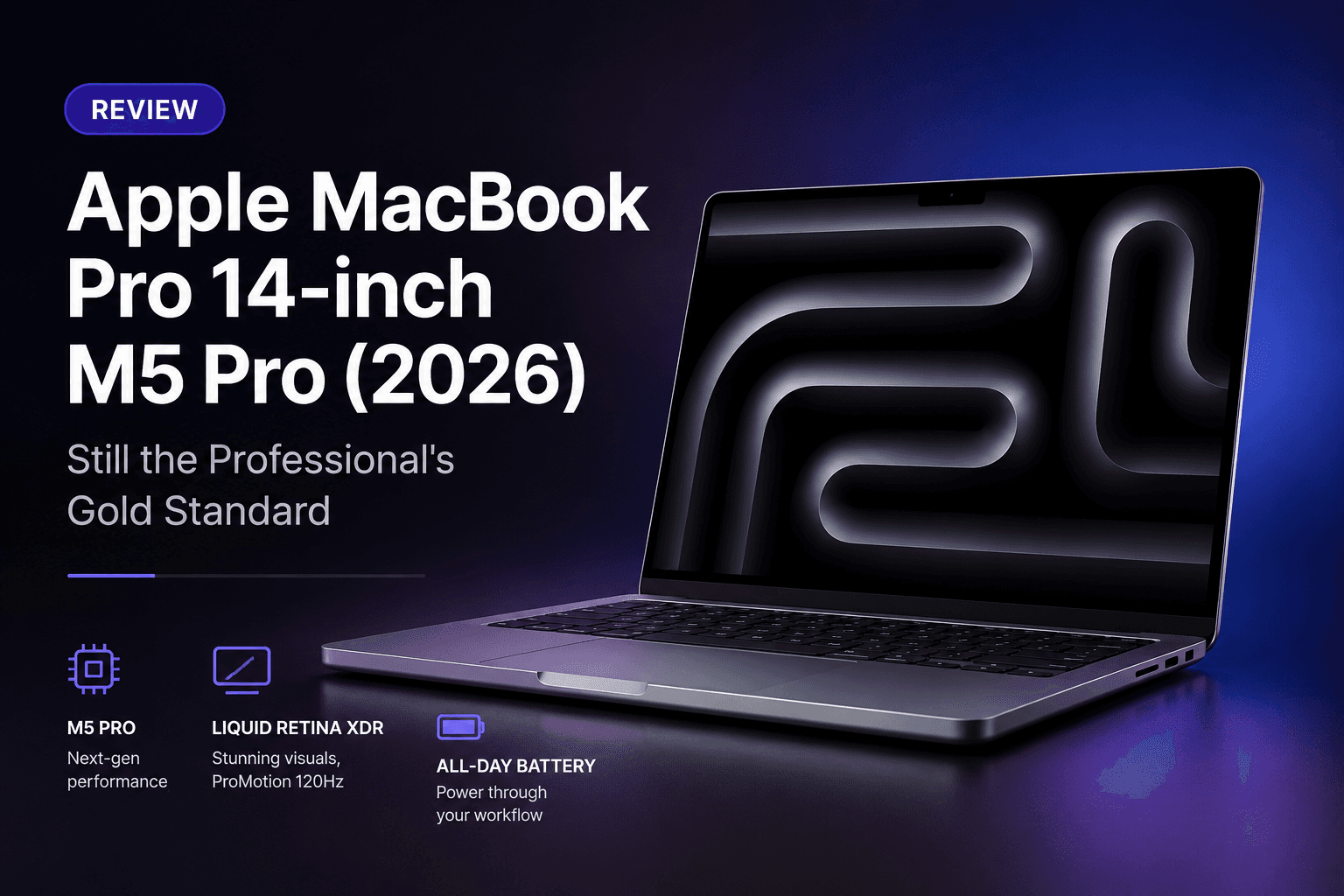
Apple MacBook Pro 14-inch M5 Pro — At a Glance
Starting price: $2,199 (M5 Pro, 24GB RAM, 1TB SSD) | Available: March 11, 2026 | OS: macOS Tahoe
The MacBook Pro with M5 Pro doesn't need to reinvent itself. It simply needs to stay ahead — and it does. For creative professionals and power users, there is still nothing quite like it on the market.
Introduction
Apple announced the MacBook Pro with M5 Pro and M5 Max on March 2, 2026, launching them to market just nine days later. In many ways, this release follows the pattern Apple has refined since the M1 era: take a chip architecture that already leads the industry, push it meaningfully forward on performance and efficiency, and deliver it inside a chassis that has proven its worth with millions of professionals. The result is a laptop that reviewers almost universally describe as the best portable workstation available — and almost equally agree is an iterative rather than transformative update. That tension defines the MacBook Pro M5 Pro experience entirely. If you are on an M3 or older machine, this upgrade is compelling. If you bought an M4 Pro last year, the calculus is closer. And if you are a Windows user eyeing the Apple ecosystem for the first time, this machine may well close the deal.
Design & Build Quality
There is no new design here, and that is not a criticism. The MacBook Pro 14-inch retains the same Space Black and Silver anodized aluminum unibody chassis that debuted with the M3 generation. It measures 31.5 × 22.1 × 1.55 cm and weighs a highly portable 1.55kg (3.5 lbs) — remarkable for the performance it contains. The build quality is exceptional: rigid, precisely machined, and with no flex anywhere across the lid or keyboard deck. Apple's large Force Touch trackpad remains the best in the laptop industry, and the full-size backlit Magic Keyboard with Touch ID continues to be a pleasure to type on for extended sessions. The notch at the top of the display houses a 12MP Center Stage webcam — a notable upgrade from past models and now capable of crisp video calls in challenging lighting. There are no compromises in build. The only criticism, often repeated by reviewers, is that right-to-repair options are limited: the battery is user-replaceable but RAM, SSD, and the processor are all soldered to the board, which remains a long-term concern for a machine at this price point. For those investing $2,200 or more in a laptop, the sustainability and repairability argument is increasingly hard to dismiss.
Display
The 14.2-inch Liquid Retina XDR display carries over from the M4 generation with no hardware changes — and it remains one of the finest laptop screens available anywhere. Running at a native resolution of 3024×1964 pixels at 254 ppi, the Mini-LED panel delivers up to 1,000 nits of sustained full-screen brightness and an eye-watering 1,600 nits for HDR highlights, with a 1,000,000:1 contrast ratio. ProMotion adaptive refresh technology dynamically scales from 24Hz to 120Hz based on on-screen content, conserving battery during document work while keeping scrolling and animation silky smooth. Color accuracy is exceptional out of the box, covering the full P3 wide color gamut, which is why colorists, photographers, and video editors reach for the MacBook Pro above almost any other laptop. An optional nano-texture matte glass can be added at additional cost for studio use in highly reflective environments. One note: this is still a Mini-LED panel, not OLED. Apple is widely expected to move the MacBook Pro to an OLED display in a future redesign, possibly later in 2026 or in 2027. For now, the existing display is outstanding — though those who have used modern OLED-based Windows ultrabooks will notice slightly lower black levels.
Performance
The M5 Pro chip is the centerpiece of this update, and it is genuinely impressive. Built on TSMC's 3nm process, the M5 Pro in the 14-inch model ships with up to an 18-core CPU (6 super cores and 12 performance cores) and a 20-core GPU — reclassified from the efficiency-and-performance architecture of the M4 Pro. Apple claims approximately 30% faster CPU performance for pro workloads over the M4 Pro generation, and up to 2.5 times the multithreaded performance of the M1 Pro. AI performance is the headline for this generation: Apple claims up to 4 times the on-device AI performance compared to the M4 Pro, thanks to a Neural Accelerator integrated into each GPU core. This is not purely a benchmark number — AI-accelerated tasks like photo enhancement, background removal in Final Cut Pro, and local large-language-model inference are meaningfully faster. The M5 Max variant, available as a build-to-order option even in the 14-inch, extends this further: Apple claims it can train AI models up to three times faster than the M4 Max, bringing tasks once reserved for desktop workstations into a laptop form factor. Storage speeds have also been doubled from the previous generation. Day-to-day performance is effortless — large Lightroom catalogs, 4K and 8K ProRes timelines, and complex multi-application workflows that would cause thermal throttling on Windows competitors run quietly and without hesitation.
Battery Life
Battery life is one of the MacBook Pro's most consistent strengths, and the M5 Pro continues that tradition. Apple rates the 14-inch M5 Pro for up to 24 hours of video streaming — the longest ever claimed for a Mac. Real-world productivity use across extended workdays confirms the machine comfortably lasts a full working day without reaching for a charger in most professional scenarios. Reviewers note that battery life does take a meaningful hit under sustained compute-heavy workloads like video rendering or sustained gaming, which is expected given the performance on tap. The laptop ships with MagSafe 3 charging support at up to 96W for the base M5 Pro configuration, capable of reaching approximately 50% charge in around 30 minutes. The 16-inch models support 140W charging. Apple has also maintained USB-C charging compatibility, so any high-wattage USB-C PD charger works in a pinch — a practical advantage for professionals who travel.
Connectivity & Software
One of the major additions this generation is Wi-Fi 7 and Bluetooth 6, enabled by Apple's new N1 wireless networking chip. This closes a long-standing criticism of MacBook Pros, which were limited to Wi-Fi 6E in the M4 generation. Thunderbolt 5 ports are included, supporting up to 120 Gbps data transfer speeds — a meaningful upgrade for professionals working with fast external NVMe storage, high-resolution capture cards, or multi-monitor setups. The full port array — three Thunderbolt 5 ports, HDMI 2.1, SDXC card slot, and 3.5mm headphone jack — means most users can work entirely without a hub or dock, which remains a significant practical advantage over ultrabooks. On the software side, macOS Tahoe introduces a refined Liquid Glass design language and improved Spotlight functionality. Apple Intelligence features — on-device AI writing tools, image generation via Image Playground, and deeper Siri integration — continue to mature, though the broader ecosystem of AI-powered features is still catching up to the ambition of the underlying hardware.
Competition
The MacBook Pro M5 Pro's closest Windows rival is the Samsung Galaxy Book6 Ultra, which brings Intel Core Ultra Series 3 processing and an Nvidia RTX 5000-series GPU to a 16-inch AMOLED chassis. The Galaxy Book6 Ultra offers a visually superior OLED display with deeper blacks and more vibrant colors, and its discrete GPU outperforms Apple's integrated graphics for GPU-accelerated 3D rendering and gaming. However, it cannot match the MacBook Pro's battery life, thermal efficiency, or software ecosystem cohesion. Dell's XPS 16 (2026) is another premium alternative, offering an OLED display option and strong creative performance. For those who need raw, discrete GPU horsepower above all else — game developers, real-time 3D artists, AI researchers working with CUDA — Windows alternatives like the Lenovo ThinkPad P16 or ASUS ROG Strix SCAR 16 provide workstation-grade GPU performance that the MacBook Pro's integrated graphics cannot rival at any price. The MacBook Pro wins on efficiency, thermals, display quality for color work, and the depth of its software ecosystem for Apple-native creative workflows. Windows wins on GPU flexibility, repairability, and software breadth for certain enterprise and gaming workloads.
For M1 or M2 MacBook Pro owners, the upgrade to M5 Pro is compelling on every front — performance, AI acceleration, Wi-Fi 7, and storage speeds all take meaningful leaps. For M4 Pro owners, patience may be rewarded by the OLED redesign rumored for late 2026.
Who Should Buy It?
The MacBook Pro 14-inch M5 Pro is the right machine for creative professionals — video editors, photographers, audio producers, graphic designers, and developers — who need reliable, class-leading performance inside a portable, well-built laptop that lasts all day on a charge. It is particularly compelling for users coming from M1 or M2 MacBook Pro models, where the generational leap in CPU, GPU, AI, storage, and wireless performance is impossible to ignore. It is also a strong choice for developers interested in on-device AI and local model inference, where the M5's Neural Accelerator architecture genuinely changes what is feasible on a laptop. It is a harder sell for M4 Pro owners, who will notice real but incremental gains rather than a transformative upgrade. And it is not the right choice for users whose workflows depend on CUDA-based GPU acceleration, Windows-only enterprise software, or who prioritize display contrast and black levels above all — in those cases, Windows alternatives deserve serious consideration.
Final Verdict
The Apple MacBook Pro 14-inch with M5 Pro is the best professional laptop Apple has ever made — which is precisely what reviewers have said about every MacBook Pro since the M1. That consistency is both its greatest strength and the source of its only real criticism: this machine does not surprise. It executes with extraordinary precision on a formula that Apple has refined over five chip generations. The M5 Pro delivers on its performance promises, Wi-Fi 7 is long overdue and welcome, the doubled storage speeds matter in professional workflows, and the AI acceleration capabilities genuinely expand what this laptop can do. The display is still world-class, the battery life is still exceptional, and the build quality is still peerless. For anyone looking for the most reliable, best-performing portable workstation available in 2026 at the $2,199 price point, the answer remains the same as it has been for several years. It is the MacBook Pro. The OLED redesign rumored for later this year may eventually change that story — but until it arrives, this M5 Pro model stands as the definitive professional laptop of the moment.
Score: 9.0 / 10 | Reviewed on a 14-inch MacBook Pro M5 Pro, 24GB unified memory, 1TB SSD, running macOS Tahoe.