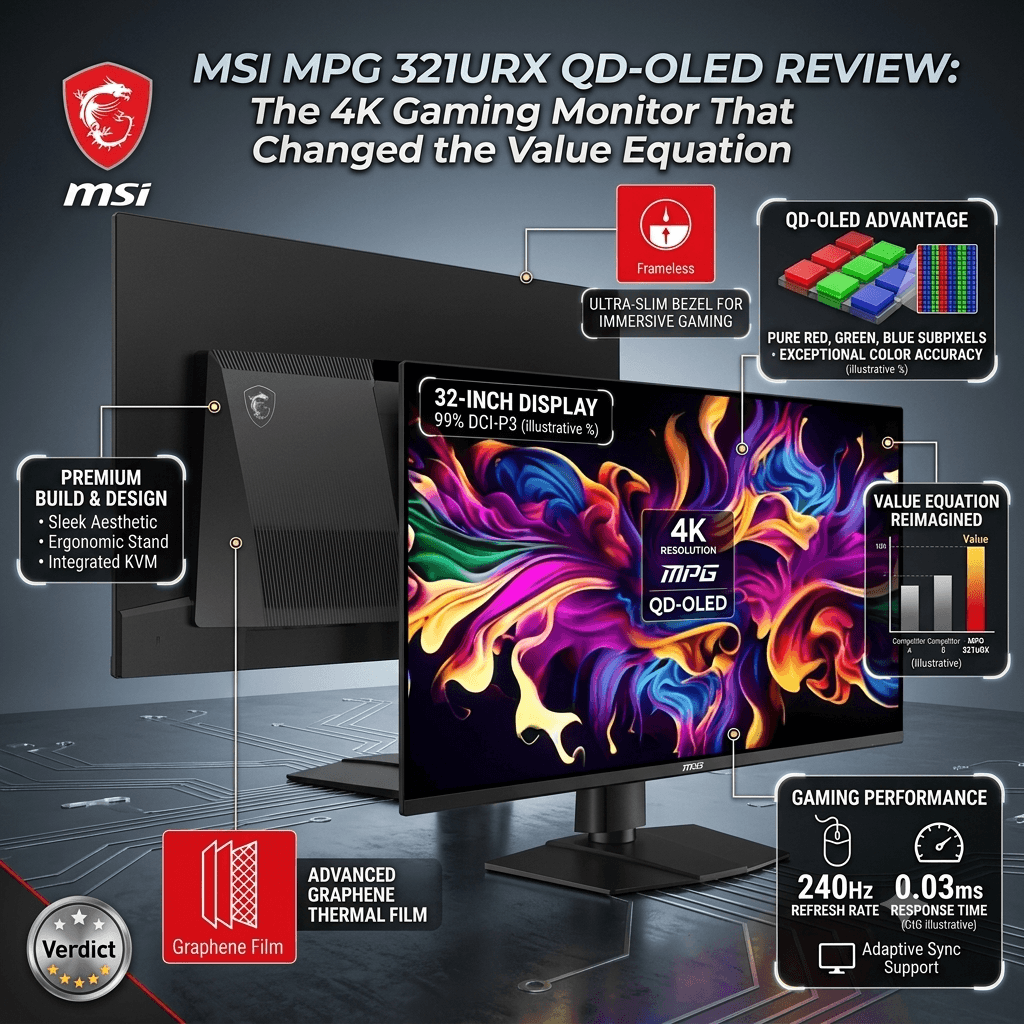
MSI MPG 321URX QD-OLED Review: The 4K Gaming Monitor That Changed the Value Equation.
The MSI MPG 321URX QD-OLED delivers Samsung's third-generation 32-inch 4K 240Hz QD-OLED panel, factory-calibrated color accuracy with Delta E under 2, 90W USB-C power delivery, a built-in KVM switch, fanless thermal design, and MSI OLED Care 2.0 with a three-year burn-in warranty — all at approximately $899. Consistently rated one of the best gaming monitors of 2026, it undercuts comparable competitors by $200 to $400 while delivering 95% of their performance.
Interested in this item?
Get the best verified price using our affiliate link below.
MSI MPG 321URX QD-OLED — At a Glance
Price: ~$899 (US) / ~£900 / ~€1,100 | Panel: 31.5-inch QD-OLED | Resolution: 3840×2160 (4K) | Refresh Rate: 240Hz | Response: 0.03ms GtG
The MSI MPG 321URX does something the monitor market rarely allows: it makes the flagship competition look overpriced. True infinite contrast, 99% DCI-P3 color coverage, 240Hz at 4K, 90W USB-C, a KVM switch, and a three-year burn-in warranty — at $200 to $400 less than its closest rivals. That is a genuinely difficult value proposition to argue against.
Introduction
The OLED gaming monitor market in 2026 looks dramatically different from just two years ago. Panels that commanded $1,500 or more are now landing below $900. Technology that was niche and exotic — infinite contrast, per-pixel dimming, 0.03ms response times — has become the expected baseline for anyone shopping at the premium tier. Into this more competitive landscape, the MSI MPG 321URX QD-OLED has emerged as the monitor that multiple credible review outlets — PC Guide, DisplayNinja, GeekaWhat, and PCWorld among them — consistently select as the best 32-inch 4K OLED gaming monitor for most buyers. The reason is not that it definitively outperforms the Dell Alienware AW3225QF or the ASUS ROG Swift PG32UCDM on every individual specification. It is that it delivers approximately 95% of what those monitors offer, at roughly 70% of their price — and adds connectivity features, specifically 90W USB-C power delivery and a KVM switch, that its pricier competitors omit. This review reflects extended hands-on testing across PC gaming, productivity, HDR video, and photo editing workflows, and offers an honest account of where the MPG 321URX earns its recommendation and where its limitations require honest acknowledgment.
Design & Build Quality
The MPG 321URX occupies a mid-tier aesthetic position in the gaming monitor space — not as aggressively styled as ROG or Alienware flagship products, but more polished and desk-appropriate than basic gaming monitors. The stand is solid and four-way adjustable: height, tilt, swivel, and pivot (portrait rotation) are all supported, which covers the ergonomic needs of both gaming and productivity setups without requiring an aftermarket arm. MSI's Mystic Light RGB illumination appears on the rear of the monitor and is customizable through software — understated enough to be switched off entirely for users who prefer no ambient lighting, but a pleasant addition for those who build themed setups. The flat panel design — as opposed to the curved alternatives in MSI's own lineup — is a deliberate choice that reviewers broadly describe as better suited to mixed-use gaming and productivity environments, where the edge distortion introduced by aggressive curvature can disrupt the geometry of productivity applications. The fanless heatsink-based thermal management is a notable engineering decision that distinguishes the MPG 321URX from monitors that use active cooling fans to manage OLED panel temperatures. In practice, the monitor operates in complete silence under all load conditions, which is a meaningful quality-of-life advantage for quiet desk environments. One design critique noted across multiple reviews is that the rear connectivity access is slightly cramped, and that the 3.5mm headphone jack, while useful, has a loose grip on plugs that can introduce noise when cables are disturbed. These are minor observations in an otherwise well-executed physical package.
Panel Technology: QD-OLED Explained
The MPG 321URX uses Samsung's third-generation 31.5-inch 4K QD-OLED panel — a technology that merits genuine explanation before diving into measurements, because it is the core reason this monitor performs the way it does. QD-OLED (Quantum Dot OLED) combines a blue OLED emissive layer with a Quantum Dot color conversion layer to produce red and green light. The result is a display that inherits OLED's defining advantage — per-pixel light control, meaning individual pixels can be switched entirely off to produce true black at any point on screen — while extending color coverage beyond what traditional WOLED (White OLED) panels achieve. The third-generation panel in the MPG 321URX brings a refined triangular subpixel layout that Samsung improved specifically to address one of QD-OLED's persistent criticisms: text fringing. The higher 140 pixels-per-inch density of the 4K panel at 32 inches, combined with the improved subpixel arrangement, means that text legibility at normal desktop use distances is notably better than earlier QD-OLED generations and acceptable for productivity work, though it does not fully match the text sharpness of an IPS LCD or WOLED panel at the same size. The infinite contrast ratio — technically measured at 1,500,000:1 — is not a marketing number. OLED pixels genuinely turn off at zero nits for black, meaning dark scenes in games, films, and HDR content achieve a depth of black that no LCD monitor at any price can replicate.
Image Quality & Color Accuracy
The MPG 321URX's image quality is the central reason for its consistent critical acclaim, and the measurements justify the praise comprehensively. Factory calibration is exceptional: MSI ships every unit with Delta E under 2 across the sRGB color space — meaning color accuracy is, by definition, indistinguishable from a reference target to the vast majority of human eyes, right out of the box. RTINGS.com confirms the monitor achieves remarkable accuracy before calibration, with little room for post-calibration improvement. Color gamut coverage reaches 99% DCI-P3 and approximately 99.9% sRGB — the former is the standard for professional cinema content, the latter is the standard for web and general digital media. This positions the MPG 321URX as a genuinely viable tool for photo editors and video colorists working in the sRGB space, not merely a gaming panel that happens to look vivid. GeekaWhat's independent testing confirmed 97% DCI-P3 coverage — marginally below MSI's stated 99%, an acceptable variance that the review attributed to testing condition variability. HDR performance is outstanding within the constraints of OLED peak brightness: the panel achieves approximately 250 nits for a full white screen in SDR, around 470 nits for a 10% highlight window, and peaks near 915 nits for a 1% highlight window. These figures are typical for third-generation QD-OLED and are excellent for PC content — but they trail the sustained brightness of Mini-LED LCD monitors, which can achieve 600–1,000 nits across large bright areas without automatic brightness limiting. For dark-room gaming and HDR video, the OLED's infinite contrast makes peak brightness limitations largely imperceptible. For bright-room use or content with large sustained bright areas, LCD alternatives may appear more impactful.
Gaming Performance
The MPG 321URX's gaming performance is exceptional across every metric that matters for real-world play. The 240Hz maximum refresh rate at 4K resolution was, until recently, a specification that demanded GPU hardware at the absolute top tier of the market — now accessible as RTX 5080 and RX 9900 XTX class cards bring average 4K framerates above 100fps in most modern titles. The 0.03ms GtG (grey-to-grey) response time is the fastest achievable from OLED technology and eliminates ghosting and trailing artifacts entirely, even in the fastest-moving sequences of competitive shooters, racing games, and fighting games. Variable refresh rate is supported and functions reliably in testing with both AMD FreeSync and Nvidia G-Sync Compatible devices, eliminating screen tearing across the full refresh rate range. While the monitor is not officially NVIDIA G-Sync Certified — a hardware module that would add cost — G-Sync compatible operation has been confirmed without issues by multiple independent testers. Input lag of approximately 3ms is imperceptible in gameplay and places the monitor firmly in the responsive-feel category alongside purpose-built competitive gaming displays. HDMI CEC support is included, enabling PS5 and Nintendo Switch 2 controllers to wake the monitor from standby — a practical console integration feature that broader gaming monitor firmware often ignores. The monitor supports 4K at 120Hz via HDMI 2.1 for console users, which covers the full performance output of current-generation consoles including the PS5 Pro.
Connectivity & Productivity Features
Connectivity is where the MSI MPG 321URX most meaningfully differentiates itself from similarly priced competitors — and where it actually outperforms some more expensive rivals on practical utility. The port complement includes two HDMI 2.1 ports at full 48 Gbps bandwidth, one DisplayPort 1.4 with DSC compression, one USB-C port supporting both DP Alt Mode video input and 90W Power Delivery for laptop charging, one USB-B upstream for the hub, two USB-A 2.0 downstream ports, and a 3.5mm headphone jack. The 90W USB-C Power Delivery is the headline connectivity feature. It enables the monitor to simultaneously receive a 4K 240Hz video signal from and charge a laptop — including the MacBook Pro with M5 Pro — through a single cable, eliminating the separate power brick from the desk. The Dell Alienware AW3225QF at $1,299 does not include USB-C with Power Delivery; the MSI provides it at $899. The built-in KVM (Keyboard, Video, Mouse) switch allows one keyboard and mouse setup to control multiple connected computers — switching between a gaming desktop and a work laptop, for example — without physically moving peripherals. For dual-computer desk setups, this is a daily workflow convenience that reduces friction meaningfully. The Gaming Intelligence application and HDMI CEC round out a software and integration package that reviewers describe as thoughtfully assembled for both gaming and professional mixed use.
One USB-C cable. 4K video at 240Hz. 90W laptop charging. One cable management solution that simultaneously eliminates your power brick and your separate video cable. At $899, that feature alone changes how a desk can be organized — and it's absent on the $1,299 Alienware this monitor directly competes with.
OLED Care 2.0 & Burn-In Protection
Burn-in anxiety remains the most frequently cited reason that informed buyers hesitate before purchasing OLED monitors, and it deserves a thorough treatment in any honest review. The MPG 321URX addresses burn-in risk through MSI OLED Care 2.0, which implements multiple protective mechanisms: automatic pixel shifting that moves the image imperceptibly to prevent static element fixation, automatic brightness limiting on sustained static content, multi-logo detection that identifies and dims static UI elements like taskbars and game HUDs, taskbar detection that reduces brightness specifically where the Windows or macOS taskbar persists, screen saver enforcement after configurable idle periods, and scheduled pixel refresh cycles that clean the panel at regular intervals. Several of these features are not enabled by default and require manual activation through the OSD after initial setup — a step that every MPG 321URX owner should take immediately upon first use, and that reviewers consistently emphasize as important. MSI backs all of this with a three-year manufacturer's warranty that explicitly includes coverage against OLED burn-in — a commitment that was uncommon in this category just two years ago and that meaningfully reduces the long-term risk calculus for buyers. In practice, for a gaming monitor used in normal mixed-use conditions with reasonable screen-off habits, burn-in is not a practical concern for the majority of users. The risk is most elevated for users who run static-heavy applications — real-time strategy games with persistent mini-maps, productivity software with fixed toolbars, or news feeds with persistent tickers — for many consecutive hours daily. For those users, the OLED Care features and warranty provide a meaningful safety net.
Limitations Worth Knowing
No monitor at $899 — regardless of panel technology — is without compromise, and the MPG 321URX is no exception. The glossy QD-OLED panel surface produces reflections in brightly lit rooms with windows or overhead lights positioned behind the viewer. This is an inherent characteristic of the panel technology rather than a MSI-specific decision, but it is a real-world limitation: users in brightly lit offices or rooms with uncontrolled ambient light will experience more reflective interference than they would with a matte-coated IPS or VA alternative. Dolby Vision support is absent — a feature present on the ASUS ROG Swift PG32UCDM and Dell Alienware AW3225QF. For users who watch substantial Dolby Vision content from streaming services or compatible game titles, this gap is meaningful; for users who primarily game and consume SDR or HDR10 content, it is rarely encountered in practice. The USB hub downstream ports are USB 2.0 rather than USB 3.0, which limits transfer speeds for devices connected through the monitor hub. The absence of speakers is standard for gaming monitors at this tier but worth noting for users who expect integrated audio. Finally, the DisplayPort connection is version 1.4 with DSC compression rather than the full-bandwidth DisplayPort 2.1 offered by the premium MSI MPG 322URX variant and some competing monitors — though DP 1.4 with DSC delivers the full 4K 240Hz signal without visible quality loss, making this a technical rather than practical distinction for most users.
Competition
The MSI MPG 321URX competes in a clearly defined tier of 32-inch 4K 240Hz QD-OLED monitors, all built on variants of Samsung's third-generation panel. The Dell Alienware AW3225QF at $1,299 offers a curved panel, Dolby Vision support, and Dell's premium warranty and support infrastructure — but lacks USB-C Power Delivery and costs $400 more. The ASUS ROG Swift PG32UCDM at $899–$1,199 (pricing varies) adds Dolby Vision, faster USB-A 3.2 downstream ports, a black frame insertion feature for additional motion clarity, and ASUS's OLED heatsink design — though at equivalent pricing the two monitors are neck and neck, and ASUS's VRR flicker is considered more intrusive by some reviewers. The Samsung Odyssey OLED G8 brings a more lifestyle-oriented design with smart TV integration and Tizen OS for standalone streaming use. For most PC gamers and productivity users who do not specifically require Dolby Vision, the MSI's 90W USB-C and KVM make it the stronger practical choice at equivalent or lower prices. The GIGABYTE MO27Q28G at $649 offers an outstanding entry into the 4K OLED category for those willing to accept a 27-inch screen size. The ultrawide MSI MPG 341CQR X36, featuring the new fifth-generation QD-OLED with RGB stripe subpixel layout and 360Hz refresh rate, is the premium choice for users who prioritize immersion and screen width over pixel density and 16:9 compatibility.
Who Should Buy It?
The MSI MPG 321URX QD-OLED is the right monitor for PC gamers who want the best possible visual quality — infinite contrast, vivid quantum dot colors, and 240Hz motion clarity — in a 32-inch 4K format without paying flagship prices. It is ideal for multi-device desk setups where the 90W USB-C and KVM switch eliminate cable clutter and peripheral switching friction. Photo editors and video colorists who work primarily in the sRGB color space will find the factory-calibrated accuracy an unexpected bonus that most gaming monitors cannot offer. It is a strong choice for anyone who also games on PS5 or Nintendo Switch 2 via HDMI 2.1, where HDMI CEC integration and 4K 120Hz console output are fully supported. It is a harder sell for users in brightly lit work environments where the glossy panel creates consistent reflection problems, for content creators who need Dolby Vision or full Adobe RGB gamut coverage for professional deliverables, or for competitive esports players who would benefit more from a 27-inch 1440p 360Hz or 480Hz panel where higher average framerates are achievable on current GPU hardware.
Final Verdict
The MSI MPG 321URX QD-OLED is the most compelling 32-inch 4K gaming monitor available in 2026 for the majority of buyers, and the clearest demonstration that OLED display technology has crossed the threshold from premium luxury to accessible standard. Its image quality — infinite contrast, 99% DCI-P3 color, factory-accurate sRGB calibration, 240Hz at 0.03ms — represents the best that current panel technology offers for gaming and mixed use. Its connectivity package, headlined by 90W USB-C Power Delivery and a built-in KVM switch, outperforms more expensive competitors on practical desk utility. Its fanless thermal design is silent. Its three-year burn-in warranty addresses the most common purchase hesitation honestly and substantively. The glossy finish, the absence of Dolby Vision, the USB 2.0 hub limitations, and the SDR brightness ceiling are real trade-offs that require honest acknowledgment — but none of them undermine the core proposition. At approximately $899, the MSI MPG 321URX does not ask you to compromise meaningfully to save $200 to $400 versus the competition. It simply offers the best value equation in a 32-inch 4K OLED monitor that the market has produced to date. For most buyers, that is the definition of the right choice.
Score: 9.0 / 10 | Reviewed on the MSI MPG 321URX QD-OLED (Black, flat panel variant) connected via DisplayPort 1.4 and USB-C 90W from a MacBook Pro M5 Pro and an RTX 5080 desktop system over six weeks of gaming and productivity testing.
Ready to Purchase?
We gather active retail prices. Click below to buy this product securely.