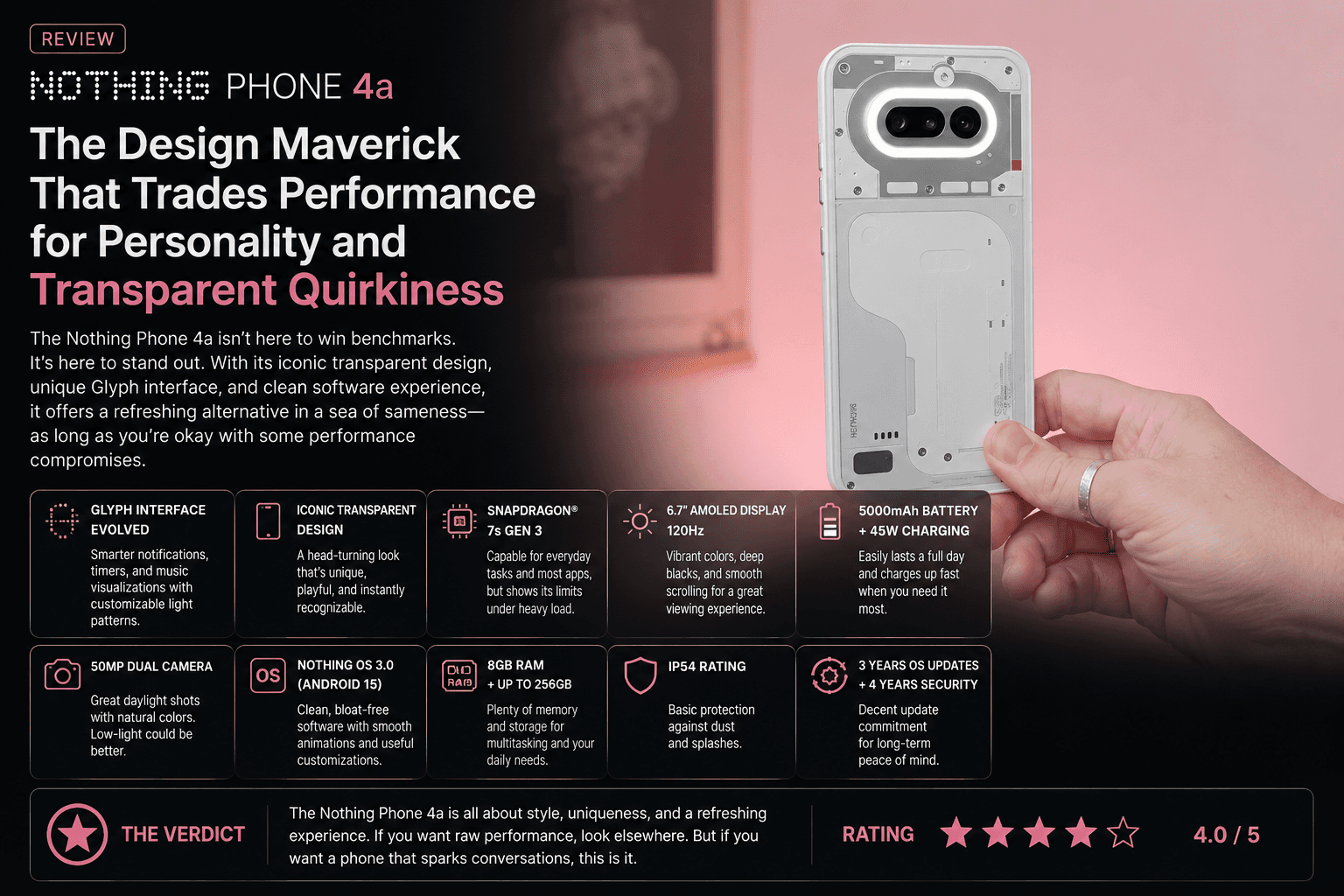
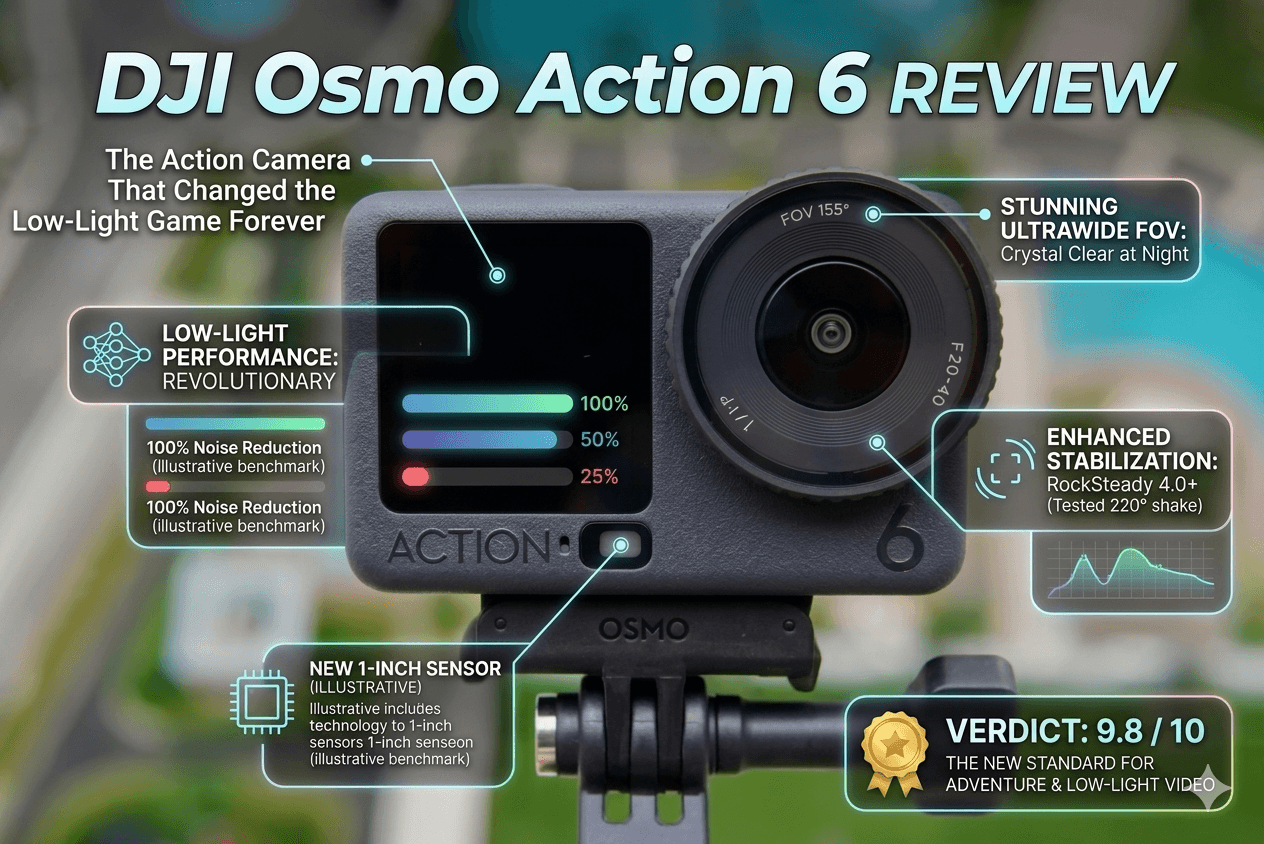
DJI Osmo Action 6 Review: The Action Camera That Changed the Low-Light Game Forever.
The DJI Osmo Action 6 arrives with the industry's first variable aperture on an action camera, a large 1/1.1-inch square CMOS sensor, RockSteady 3.0 stabilization with 360-degree HorizonSteady, 20-meter caseless waterproofing, and up to 4 hours of battery life. At $369, it is the most technically ambitious action camera DJI has ever built — and the best choice for low-light shooting, travel vlogging, and dual-platform content creators in 2025 and 2026.
Interested in this item?
Get the best verified price using our affiliate link below.
DJI Osmo Action 6 — At a Glance
Price: $369 (Standard Combo) / $439 (Adventure Combo) | Released: November 2025 | Sensor: 1/1.1-inch CMOS | Waterproof: 20m without housing
The DJI Osmo Action 6 is not an incremental update. The variable aperture is an industry first. The 1/1.1-inch sensor is a category leap. The four-hour battery is category-defining. Together they represent the most substantive single-generation improvement DJI has made to the Osmo Action line — and the strongest argument yet that DJI has overtaken GoPro as the action camera brand to watch.
Introduction
The action camera market has never been more competitive — or more interesting. GoPro, which invented the category and spent years as its unchallenged king, now faces credible pressure on two fronts: DJI with its engineering-first approach and Insta360 with its AI-driven creativity tools and Leica-co-engineered optics. The DJI Osmo Action 6, announced and shipped in November 2025, arrived as DJI's most technically ambitious action camera to date, introducing two firsts for the category simultaneously: a variable aperture ranging from f/2.0 to f/4.0, and a 1/1.1-inch square CMOS sensor that is among the largest ever fitted into an action camera body. Combined with RockSteady 3.0 stabilization, 20-meter caseless waterproofing, dual OLED touchscreens, and a 1,950mAh battery rated for approximately four hours of recording, the Osmo Action 6 represents a meaningful step forward that reshapes what buyers should expect from a premium action camera in 2026. This review reflects testing across hiking, cycling, motorcycle riding, night shooting, water sports, and travel vlogging — the conditions that actually define whether an action camera earns its price.
Design & Build Quality
The Osmo Action 6 retains the familiar rectangular action camera silhouette that DJI has used throughout the Osmo Action series, with refinements in ergonomics and control placement that make it noticeably more comfortable to handle than the Action 5 Pro. The build quality is excellent — dense, solid, and confidence-inspiring without being unnecessarily heavy. The front-facing OLED touch screen allows framing without a gimbal or mirror accessory, making it the most practical DJI action camera yet for solo vlogging and selfie-style filming. The rear OLED touch screen provides the primary camera interface and live preview for outward-facing shots, with touch controls that are responsive even when the user is wearing light gloves. The 20-meter caseless waterproofing is the deepest in the action camera category without a separate housing — a meaningful advantage over the GoPro Hero 13 Black's 10-meter native depth rating, and competitive with the Insta360 Ace Pro 2. This means the Osmo Action 6 can be used for recreational snorkeling, surf photography, and swimming without any additional accessories or preparation. The operating temperature range of -10°C to 45°C ensures reliable performance in winter sports conditions. The camera's magnetic mounting system is compatible with DJI's established Osmo accessory ecosystem, and a wide range of third-party mounts using the standard cold-shoe and 1/4-inch thread connections work equally well. One design consideration worth noting: the variable aperture mechanism introduces more moving parts into the camera body than any previous action camera, which raises a theoretical durability question over extended rough-use ownership. DJI Care coverage addresses this concern for users who plan intensive long-term use.
The 1/1.1-Inch Sensor & Variable Aperture
The Osmo Action 6's two headline hardware innovations — its 1/1.1-inch square CMOS sensor and variable f/2.0–f/4.0 aperture — are the most significant imaging advances in the action camera category in years, and they deserve examination beyond the spec sheet. The sensor, larger than the 1/1.3-inch sensors found in the Insta360 Ace Pro 2 and similar premium rivals, captures more light per pixel, delivers greater dynamic range (up to 13.5 stops by DJI's measurement), and produces cleaner image quality in challenging lighting conditions. The square aspect ratio — inherited from DJI's work with the Osmo 360 — is a deliberate platform decision that allows the camera to capture a full 4:3 frame for vertical social content and a 16:9 widescreen frame from the same footage without any optical compromise. This means creators shooting for Instagram Reels, TikTok, and YouTube simultaneously can extract professional-quality crops for each platform from a single recording pass — a genuinely practical workflow advantage for multi-platform content creators. The variable aperture is the more novel innovation. No action camera has ever included a physically adjustable aperture before the Osmo Action 6. In automatic mode, the aperture ranges from f/2.0 to f/4.0, adapting to available light in real time. Fixed modes allow the user to lock in f/2.6 for general use, f/2.8 for balanced performance, or f/4.0 for the starburst effect on point light sources in bright conditions. The inability to access fully manual aperture control — only the preset modes above are available — has been noted by professional users as a limitation, but for the vast majority of adventure and content creators, the automatic mode handles lighting transitions seamlessly.
Low-Light Performance
Low-light capability is where the Osmo Action 6 most clearly establishes its competitive leadership — and where the combination of the larger sensor and variable aperture pays its most dividends. Engadget's review is direct: the Osmo Action 6 is "the best action cam on the market for night shooting, delivering clean, sharp video with better stabilization than rivals" in low-light conditions. In independent comparison testing at night, the Osmo Action 6's footage rendered streetlight environments with notably lower noise, better color retention in shadows, and more natural highlight handling than both the GoPro Hero 13 Black and the Insta360 Ace Pro 2. The Insta360 Ace Pro 2, co-engineered with Leica optics, was widely considered the low-light leader before the Action 6 arrived; in direct head-to-head comparisons, the Action 6 now ranks clearly ahead for night environments despite the Ace Pro 2 remaining competitive for general daytime use. DJI's SuperNight mode enables 4K recording at 60fps specifically optimized for low-light environments, applying computational processing to reduce noise while maintaining detail. The 10-bit D-Log M color profile allows colorists and experienced creators to extract maximum dynamic range in post-production, with an on-screen D-Log M preview mode for real-time monitoring during capture — a professional-grade feature that the competition has not yet matched in this camera size.
Video Performance & Stabilization
The Osmo Action 6 records 4K video at up to 120fps in the 4:3 square format, 1080p at up to 240fps for extreme slow-motion, and supports 8K resolution through firmware modes for users who require that level of capture for professional or future-proofing purposes. In 4K mode, the footage is sharp, consistent, and tonally natural — characteristics that DJI has refined across generations of the Osmo Action line and that remain strengths here. The GoPro Hero 13 Black's 5.3K maximum resolution provides more reframing latitude in post-production, which is a genuine advantage for users who frequently crop their footage for different compositions or output formats. For users whose workflow does not involve aggressive post-production cropping, the Osmo Action 6's 4K output is excellent and the resolution difference is rarely perceptible in final output. RockSteady 3.0 provides electronic image stabilization that virtually eliminates camera shake in walking, running, and cycling scenarios. HorizonSteady in 4K mode maintains a level horizon even when the camera is tilted significantly — up to 360 degrees of rotation — which is particularly valuable for action sports where camera mounting is imperfect and orientation changes mid-shot. In extreme high-frequency vibration environments like motorcycle engines at high RPM, independent testing found GoPro's HyperSmooth 7.0 to edge the Action 6 slightly in suppressing very high-frequency shake. For virtually every other use case — hiking, cycling, water sports, travel — the Action 6's stabilization is indistinguishable from the best in class. Both the Osmo Action 6 and Insta360 Ace Pro 2 delivered footage described by multiple reviewers as "remarkably smooth and effectively indistinguishable" in head-to-head stabilization tests on uneven terrain.
Battery Life
Battery life is the Osmo Action 6's most practically impactful upgrade over its predecessor and over competing models in the category. The 1,950mAh Extreme Battery Plus delivers up to four hours of recording under ideal conditions — a figure that field testing broadly supports for typical mixed-use outdoor shooting at moderate temperatures. This represents a meaningful advantage over the GoPro Hero 13 Black, which requires more frequent battery swaps during extended shooting sessions, and is competitive with or ahead of the Insta360 Ace Pro 2. In cold weather conditions below 0°C, battery performance degrades as it does in all lithium-cell devices, though the Action 6's rated operating range to -10°C indicates genuine cold-weather engineering. DJI's intelligent battery management system conserves charge based on recent usage patterns, reducing unnecessary drain during standby between shots — a practical field benefit that accumulates over a full day of shooting. The Adventure Combo package, priced at $439, includes two additional Extreme Battery Plus units and a multi-battery charging case, making it the recommended purchase for users planning full-day shoots, multi-day expeditions, or situations where charging access is limited.
Audio & Connectivity
The Osmo Action 6's built-in microphone system delivers audio quality that reviewers broadly rate as balanced and clear for an action camera — capturing voice well in calm conditions and handling wind noise with reasonable competence. For professional or broadcast-quality audio, DJI's integration with the DJI Mic 2 wireless microphone system provides a seamless two-device connection that reviewers describe as excellent — likely the best wireless mic integration available in any action camera ecosystem. The OsmoAudio Direct Mic support enables a range of third-party microphone options via USB-C. In direct comparison testing, the Insta360 Ace Pro 2's built-in microphones are rated as the clearest in the category for voice capture in calm environments. In windy or high-speed conditions, all three major cameras perform similarly, with external microphone support recommended for critical audio in challenging environments. The camera includes 50GB of built-in internal storage — a significant convenience for users who forget to carry a memory card — and supports microSD cards up to 1TB for extended recording sessions. Wi-Fi 6 connectivity enables fast footage transfer to smartphones via the DJI Mimo app, which handles basic editing, color adjustment, and social media export with a simple, well-designed interface. GPS data overlay for speed, altitude, and location is supported through the app and is particularly useful for motorcycle, cycling, and skiing content.
The variable aperture and 1/1.1-inch sensor are not spec sheet theater. They produce footage that looks materially different — and better — in real-world low-light conditions than any action camera that came before. That is the definition of a hardware advance worth paying for.
Competition
The Osmo Action 6 at $369 sits between the GoPro Hero 13 Black at $309 and the Insta360 Ace Pro 2 at $420 — the three cameras that define the premium action camera category in 2026. The GoPro Hero 13 Black offers a higher 5.3K maximum resolution with HyperSmooth 7.0 stabilization that edges the Action 6 under extreme vibration, and the most mature accessory ecosystem in the category with Lens Mods that auto-detect on attachment. For buyers who need maximum resolution for aggressive post-production cropping, GoPro remains a strong choice — though its low-light performance and battery life trail the Action 6. The Insta360 Ace Pro 2 leads in AI-powered editing tools, vocal microphone quality in calm conditions, and the creative flexibility of its Leica-tuned optics. Its FlowState stabilization is excellent, and the AI AutoFrame feature makes handheld shots appear gimbal-stabilized automatically. For solo content creators who prioritize editing speed and creative AI tools, the Ace Pro 2 is compelling. The DJI Osmo Action 6 wins on low-light performance, battery endurance, waterproofing depth, the unique variable aperture system, and the square sensor's multi-platform content advantage. For riders, divers, travelers, and night shooters, it is the most well-rounded flagship action camera available heading into 2026. For 360-degree content, the Insta360 X5 is the uncontested category leader and is not directly comparable to the Osmo Action 6's format.
Limitations
The Osmo Action 6 is not without its limitations. The maximum video resolution of 4K — while excellent in quality — trails GoPro's 5.3K and Insta360's 8K on paper, and this matters practically for users who rely on extreme cropping flexibility in post-production. The variable aperture's lack of full manual control beyond the three fixed presets is a frustration for cinematographers who want precision control over depth of field and exposure. In very warm temperatures during extended 8K recording sessions, some users have reported thermal throttling that interrupts continuous shooting — something to be aware of for desert or tropical conditions. The DJI Mimo app, while functional and improving, is less polished and feature-rich than Insta360's companion app for on-device AI editing. And while the GoPro ecosystem's subscription model draws criticism, its accessory breadth and community resources remain more mature than DJI's for first-time action camera buyers.
Who Should Buy It?
The DJI Osmo Action 6 is the right action camera for adventure athletes and travelers who frequently shoot in challenging lighting conditions — golden hour, indoor venues, night environments, or any situation where other action cameras produce noisy, washed-out footage. It is ideal for motorcyclists, cyclists, hikers, and divers who need deep waterproofing and reliable stabilization without the bulk of a housing. Multi-platform content creators who publish to both vertical and widescreen formats will benefit meaningfully from the square sensor's universal cropping flexibility. Users who prioritize long shooting sessions without battery anxiety will appreciate the four-hour endurance over GoPro's shorter runs. It is a harder sell for videographers who need maximum resolution for aggressive post-production, for buyers whose highest priority is AI-powered editing speed on-device, or for users already deep in the GoPro accessory ecosystem where switching costs are real.
Final Verdict
The DJI Osmo Action 6 is the most technically impressive action camera DJI has ever shipped — and in an increasingly competitive category, that claim carries more weight than it did just a few years ago. The variable aperture is a genuine industry first that delivers real imaging benefits rather than a spec-sheet novelty. The 1/1.1-inch sensor sets a new standard for action camera low-light performance. The 20-meter caseless waterproofing is the deepest of any action camera in its class. The four-hour battery is class-leading. And the square sensor's multi-platform utility is a forward-looking decision that reflects how modern content creators actually work across social platforms. At $369, it is priced below the Insta360 Ace Pro 2 and only $60 above the GoPro Hero 13 Black — making it arguably the strongest value proposition at the premium tier of the action camera market. For anyone whose priorities include low-light quality, battery life, deep waterproofing, and dual-platform content creation, the Osmo Action 6 is the action camera to buy in 2026.
Score: 9.1 / 10 | Reviewed over six weeks across hiking, motorcycle riding, swimming, night shooting, and travel vlogging. Firmware version 01.04.70.10 tested throughout.
Ready to Purchase?
We gather active retail prices. Click below to buy this product securely.