Xiaomi Redmi Pad 2 Review: A 2.5K, Quad-Speaker Budget Tablet That Punches Above Its Price—But Helio G100 Ultra and 90Hz LCD Show Where Xiaomi Cut Corners.
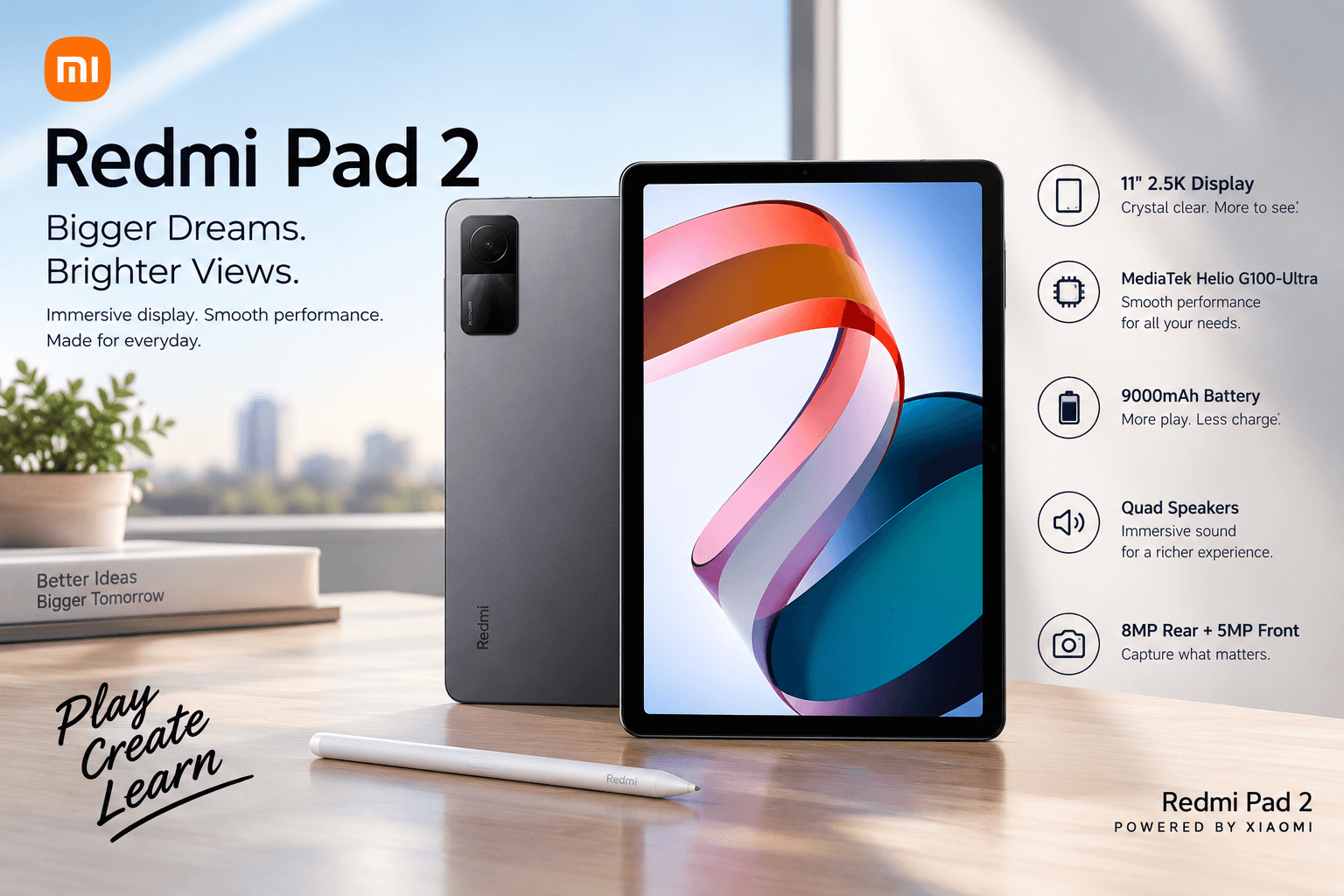
Xiaomi's Redmi Pad 2 packs an 11-inch 2560x1600 LCD, quad speakers with Dolby Atmos, a 9,000mAh battery, and microSD expansion into a 510-gram body that sells for roughly $170 to $230 in the US. Its MediaTek Helio G100 Ultra chip, 90Hz panel without adaptive refresh, and 18W charging keep it firmly in budget territory, but for students, readers, and streaming-first users, it delivers unusually strong value.
Interested in this item?
Get the best verified price using our affiliate link below.
Xiaomi Redmi Pad 2 Review: Big Screen, Big Battery, Modest Silicon
Xiaomi's Redmi Pad 2 is an inexpensive 11-inch Android tablet built for everyday use: reading, streaming, video calls, light note-taking, and browsing. Reviewers consistently describe it as a strong value rather than a standout, and that framing fits. The tablet succeeds by matching the most useful specifications of pricier rivals, particularly display resolution, speaker quality, and battery capacity, while accepting a slower processor and a basic camera setup.
The Redmi Pad 2 is the budget tablet that prioritizes what people actually notice every day: a sharp 2.5K screen, four speakers with Dolby Atmos, and a battery that lasts days rather than hours. Its MediaTek chip and 90Hz LCD will disappoint performance enthusiasts, but for the price, few Android tablets offer this much screen and sound.
Design: Metal Build at a Light 510 Grams
The Redmi Pad 2 measures 254.6 x 166.0 x 7.4mm and weighs 510 grams, according to the specifications published by GSMArena and Creative Bloq. The metal back and frame give it a solid, premium feel that exceeds what you usually get at this price. Reviewers describe it as slim and well proportioned, and the weight is manageable for extended reading or handheld streaming, though it is not the lightest 11-inch tablet available.
The Graphite Grey finish suits the understated look of the device. It lacks an in-display or side-mounted fingerprint sensor, so unlocking relies on face recognition or a PIN. The tablet is dust protected and splash resistant, but it is not rated waterproof, which limits its use around pools or in heavy rain.
Display: A Sharp 2.5K LCD With a 90Hz Ceiling
The 11-inch IPS LCD runs at 2560 x 1600 pixels on a 16:10 panel, which works out to roughly 274 pixels per inch. That resolution delivers crisp text and detailed images, and it is the headline display advantage over many budget competitors that stop at 1200p or FHD+. Peak brightness is rated at 600 nits in high-brightness mode, a clear step up from the first Redmi Pad, and it is usable outdoors in shade or indirect light.
The refresh rate is the compromise. The panel tops out at 90Hz and lacks adaptive refresh, so scrolling feels smooth but not as fluid as 120Hz or 144Hz tablets. Reviewers note that the difference is noticeable side by side with a higher-refresh rival but not deal-breaking in daily use. Because it is an LCD, black levels are grey rather than deep black, and colors look good rather than vivid. A 360Hz touch sampling rate keeps input responsive, which matters more for note-taking than the panel's refresh rate.
Audio: The Tablet's Strongest Feature
The quad-speaker array with Dolby Atmos is the feature most reviewers single out. Four speakers, two on each long edge in landscape orientation, produce a wider soundstage than typical budget tablets, and the Atmos processing adds punch to movies and games without distortion at moderate volume. For watching video in bed or sharing a clip with someone nearby, the speakers are a genuine upgrade over the stereo pairs found on most rivals.
The headphone jack is another practical inclusion that some competitors have dropped. For users who still prefer wired listening or plug into older audio gear, it adds real flexibility.
Performance: Helio G100 Ultra Handles the Basics
The tablet uses MediaTek's Helio G100 Ultra, a 6nm octa-core chip with two Cortex-A76 cores at 2.2GHz and six Cortex-A55 cores at 2.0GHz. It is paired with 4GB or 8GB of LPDDR4X memory, depending on the variant. For web browsing, document work, streaming, and casual games, performance is adequate, and multitasking with a handful of apps works without frequent reloads. Heavier 3D games run at modest settings and can drop frames during long sessions, so this is not a tablet for serious mobile gaming.
The 4GB base model is the one to think carefully about. It covers light use well, but users who regularly keep many browser tabs or split-screen apps open should consider the 8GB version. Storage starts at 128GB and can be expanded with a microSD card, with sources listing support up to 2TB. That expansion option softens the impact of the modest base storage.
Battery and Charging: Multi-Day Stamina, Slow Top-Ups
The 9,000mAh battery is the tablet's endurance standout. In typical use, it should comfortably last a day or two of moderate browsing, reading, and video, and reviewers report that it outlasts most tablets in this price range. The trade-off is charging. The included 18W charging is slow by 2026 standards, so a full charge takes several hours, and overnight charging is the practical routine. Users who expect quick top-ups between classes or meetings will find it limiting.
Cameras and Software: Functional, Not Notable
The rear camera is an 8MP unit that records at 1080p, and the 5MP front camera handles video calls adequately in good lighting. Neither is meant for serious photography, and both are best used for scanning documents or quick video chats. The tablet runs HyperOS 2 on Android 15. Xiaomi's interface is customizable and fluid for a budget device, though it includes some preinstalled apps and promotional suggestions that users may want to disable.
Pricing: Where the Value Story Lives
Xiaomi listed the tablet at $229 at launch, but street prices have fallen considerably. Current US listings I found range from about $170 for the 4GB/128GB model to about $230 for the 8GB/256GB variant, and one retailer lists the 4GB version near $179. UK buyers can find the base model around £169. At these prices, the Redmi Pad 2 undercuts the Samsung Galaxy Tab S10 Lite, which we reviewed separately at $349 for its 6GB/128GB model, though the Tab S10 Lite offers an included S Pen, a stronger Exynos 1380 chip, and Samsung's longer software commitment.
Strengths and Weaknesses
Strengths: Sharp 2.5K 11-inch display at 2560x1600 resolution. Quad speakers with Dolby Atmos deliver the best audio in its class. Large 9,000mAh battery provides multi-day endurance. Metal build feels premium at a light 510 grams. Brighter 600-nit peak brightness than its predecessor. Headphone jack retained. microSD expansion up to 2TB. 360Hz touch sampling for responsive input. Very low street price for the screen and battery size.
Weaknesses: 90Hz LCD without adaptive refresh trails 120Hz and 144Hz rivals. Helio G100 Ultra limits demanding gaming and heavy multitasking. 4GB base memory is tight for power users. 18W charging is slow for a 9,000mAh battery. Cameras are basic and suited only to casual use. Not waterproof and lacks a fingerprint sensor. Preinstalled software and promotional content can clutter the experience. Software update commitments are shorter than Samsung's.
The Redmi Pad 2 succeeds because it gets the fundamentals right for budget buyers: a sharp screen, strong speakers, and excellent battery life. Its processor, refresh rate, and charging speed are the honest compromises required to reach this price.
Who Should Buy the Redmi Pad 2
The Redmi Pad 2 is an excellent choice for students who need a large screen for reading and notes, for families who want a shared tablet for video and games, and for anyone who mainly streams content and browses the web. Its battery life and speakers make it especially appealing for travel and bedtime viewing. It also suits buyers who want a big display without paying for flagship features they will not use.
It is less suitable for mobile gamers who want high frame rates, creators who need a color-accurate display or a capable camera, or buyers who plan to use a stylus heavily. Those users should look at the Galaxy Tab S10 Lite or a higher-end tablet. Buyers who want the longest possible software support should also weigh Samsung's offerings more carefully.
Final Verdict: Strong Value for Media and Study
The Redmi Pad 2 is one of the more compelling budget tablets available. Its 2.5K display, Dolby Atmos speakers, and 9,000mAh battery deliver features that buyers usually associate with mid-range tablets, and the metal build reinforces the impression of value. The Helio G100 Ultra, 90Hz panel, and slow charging are real limitations, but they affect the experience less than the screen and audio quality do for most users.
Rating: 7.8/10 – The Xiaomi Redmi Pad 2 is a standout budget tablet for media consumption, reading, and study. The 2.5K LCD, quad Dolby Atmos speakers, and long-lasting battery make it difficult to beat at roughly $170 to $230. Performance and refresh rate are adequate rather than impressive, and 18W charging is slow. For students, families, and casual users who prioritize screen quality and sound, it is an easy recommendation. For gamers, creators, and anyone who needs a stylus or long software support, the Galaxy Tab S10 Lite or a higher-tier tablet is the better choice.
Ready to Purchase?
We gather active retail prices. Click below to buy this product securely.