Meta Quest 3S Review: The $349 Gateway to Mixed Reality That Proves Affordable VR Has Reached Prime Time—But Fresnel Lenses and Lower Resolution Reveal the Compromises.
Meta's Quest 3S delivers mixed-reality capability at $349.99 through Snapdragon XR2 Gen 2 performance, full-color passthrough, and access to Quest 3's game library. But the Fresnel lens downgrade, lower 1832x1920 display resolution, and April 2026 price increase challenge its value proposition against the still-excellent Quest 3.
Interested in this item?
Get the best verified price using our affiliate link below.
Meta Quest 3S Review: The VR Gateway at $349—Affordable Mixed Reality Without the Premium Price
Meta Quest 3S was released on October 15, 2024, with introductory pricing at US$299 (128 GB) and US$399 (256 GB). The Meta Quest 3S 128GB price increased to $349.99 in April 2026, marking a 16.7% rise from its $299.99 launch price in October 2024. The Quest 3S represents Meta's commitment to democratizing mixed reality—bringing color passthrough, powerful performance, and a legitimate gaming library to the mass market at accessible pricing, though not without strategic compromises.
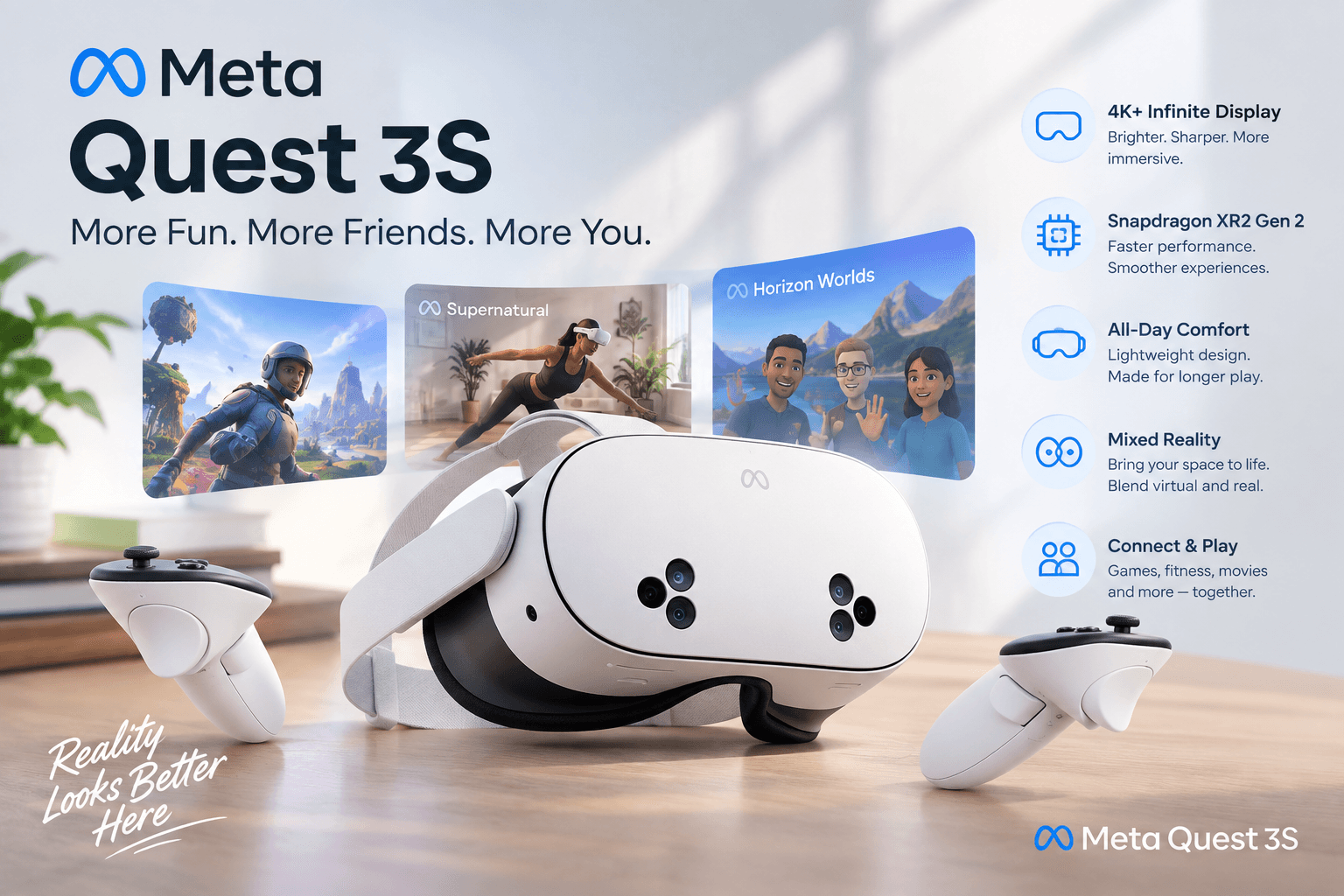
Meta Quest 3S: The VR mainstream made accessible. Snapdragon XR2 Gen 2 performance, full-color passthrough, and thousands of games at $349.99. The Fresnel lenses and lower resolution reveal intentional compromises that keep pricing aggressive—a deliberate trade-off prioritizing accessibility over optical perfection.
Design and Comfort: Lightweight Practicality
Weight: ~514g. Display: One LCD display. Lens type: Fresnel. Display resolution: 1832 x 1920 per eye. The 514-gram weight—lighter than the standard Quest 3's 515g—represents negligible difference but achieves comfortable all-day wear for most users. The compact form factor enables extended play sessions without excessive fatigue.
You can wear glasses with the Meta Quest 3S using the glasses spacer included in the box. Custom prescription Meta Quest 3S lenses are available for added comfort (sold separately). The included glasses spacer enables comfortable wear for spectacle wearers. The design supports optional prescription lenses for enhanced visual clarity.
Display and Optics: The Compromise That Enables $349 Pricing
Although the headset's resolution is a little lower (1832 x 1920 pixels per eye, compared to 2064 x 2208), this could actually mean the headset performs better. Lower display resolution on the 3S (1,832 × 1,920 per eye) versus the Quest 3 (2,064 × 2,208) — though in real use, the difference isn't huge. The resolution reduction represents a pragmatic compromise—the visual difference remains subtle for most experiences.
More limited field of view: around 96° on the 3S, compared to about 110° on the Quest 3. No eye-relief adjustment or headphone jack on the Quest 3S — both of which are standard on the Quest 3. The Fresnel lens optics represent the most obvious cost reduction—the pancake lenses used on the Quest 3 cost substantially more to manufacture. The trade-off in peripheral clarity and optical distortion at image edges is visible but acceptable at the price point.
Performance: Snapdragon XR2 Gen 2 Delivers
System on a chip: Qualcomm Snapdragon XR2 Gen 2 (TSMC 4nm / N4X). Memory: 8 GB LPDDR4X @ 2600MT/s. Storage: 128 GB, 256 GB. The identical Snapdragon XR2 Gen 2 processor ensures performance parity with the more expensive Quest 3. The 8GB LPDDR4X RAM proves adequate for game execution and mixed-reality experiences.
Under the hood, the Quest 3S runs the same Snapdragon XR2 Gen 2 chip as its more expensive sibling, features 8 GB of RAM, and supports the same tracking and Touch Plus controllers. Real-world performance remains smooth—demanding games execute at consistent frame rates, and mixed-reality interactions remain responsive.
Mixed Reality: The Headline Feature
Color passthrough enables genuine mixed reality experiences: your room visible with virtual objects placed in it, Horizon OS home environments that blend with physical space. At this price tier, mixed reality capability is a significant differentiator from older budget headsets. Quest 3S is fully compatible with the Quest 3's mixed reality app library. The full-color passthrough transforms the experience from pure VR into practical mixed-reality applications.
The passthrough cameras enable fitness applications, productivity tools, and social VR experiences where physical awareness matters. This capability previously required flagship headsets at premium pricing—the Quest 3S democratizes access to mixed reality for mainstream consumers.
Battery Life and Game Library Access
Battery: ~2.5 hours gaming / ~3 hours light use. Platform: Meta Horizon OS. The 2.5-hour battery life limits extended sessions but proves adequate for typical gaming and social-VR experiences. The lightweight charging requirement reflects modern fast-charging standards—brief sessions enable multiple play sessions daily.
The Quest 3S has full access to the Meta Horizon app store, including new releases like Metro Awakening, Behemoth, and Batman: Arkham Shadow. The game library access proves critical—the Quest 3S doesn't sacrifice software—it accesses thousands of experiences at no additional cost beyond the headset purchase.
The April 2026 Price Increase: Value Erosion
The Meta Quest 3S 128GB moved from $299.99 to $349.99 and the 256GB model from $399.99 to $449.99 on April 19, 2026, citing the rising cost of memory chips. The $50 increase (16.7% rise) within eighteen months creates uncomfortable pricing pressure. At $349.99 for 128GB or $449.99 for 256GB, the Quest 3S no longer positions as dramatically different from the Quest 3 at $599.99.
Price is the recurring argument in Reddit buying threads: the Quest 3S 128GB costs $349.99 versus $599.99 for the Quest 3 512GB, a $250 gap after the April 2026 increases. The gap remains meaningful but less dramatic than the original $200 differential at launch.
Strengths and Weaknesses
Strengths: Exceptional $349.99 pricing for mixed-reality capability. Identical Snapdragon XR2 Gen 2 processor to Quest 3. Full-color passthrough enables mixed-reality experiences. Access to thousands of games and Meta Horizon ecosystem. Touch Plus controllers with advanced haptic feedback. Inside-out 6DoF tracking. Lightweight 514g design enables comfortable extended wear. Glasses spacer supports spectacle wearers. Optional prescription lenses available. 2.5-hour battery adequate for typical sessions. Excellent entry point for first-time VR users. Affordable way to sample mixed-reality experiences. Quality comparable to Quest 3 except optics.
Weaknesses: Fresnel lens optics versus Quest 3's superior pancake lenses. Lower 1832x1920 resolution versus Quest 3's 2064x2208. Narrower ~96° field of view versus Quest 3's ~110°. No eye-relief adjustment (Quest 3 standard). No headphone jack (Quest 3 has 3.5mm). April 2026 price increase erodes value proposition. 128GB storage feels restrictive for game installations. Battery limited to 2.5 hours gaming. Lower optical quality noticeable in side-view clarity. No cooling solution for extended gaming sessions. Fresnel lens flare visible in bright scenes.
Quest 3S succeeds as the affordable mixed-reality gateway—democratizing access that previously required premium pricing. But the April 2026 price increase ($50) and Fresnel lens compromises reveal this as a deliberate value positioning rather than a simple budget cut-down.
Final Verdict: The Mainstream Mixed Reality Entry Point
Meta has once again surpassed all expectations of what a standalone VR headset can be for just $299. The Meta Quest 3S is quite literally a Quest 3 with the Quest 2's lenses and display, better hand tracking and low light tracking, a new mixed reality button on the headset, and all the exclusive games the more expensive Quest 3 gets. The Meta Quest 3S brings mixed reality to the masses at $299, making it the best entry-level VR headset for 2026 despite some display trade-offs.
Meta has delivered a headset that's $200 cheaper than the Meta Quest 3 without sacrificing its powerful graphics, full-color mixed reality vision, new controllers with advanced haptic feedback, and seamless software. The strategic trade-offs in optics and resolution prove acceptable compromises for mainstream accessibility.
Rating: 8.3/10 – The Meta Quest 3S is the mainstream mixed-reality gateway at $349.99, delivering Snapdragon XR2 Gen 2 performance, full-color passthrough, and access to thousands of games. The Fresnel lenses and lower resolution represent intentional compromises that prove acceptable at this price point. The April 2026 price increase ($50) erodes the original value proposition slightly. For first-time VR users, budget-conscious buyers, and those seeking mixed-reality without premium pricing, the Quest 3S remains the best entry point. For those seeking optical excellence and premium experiences, the Quest 3 justifies the additional investment.
Ready to Purchase?
We gather active retail prices. Click below to buy this product securely.