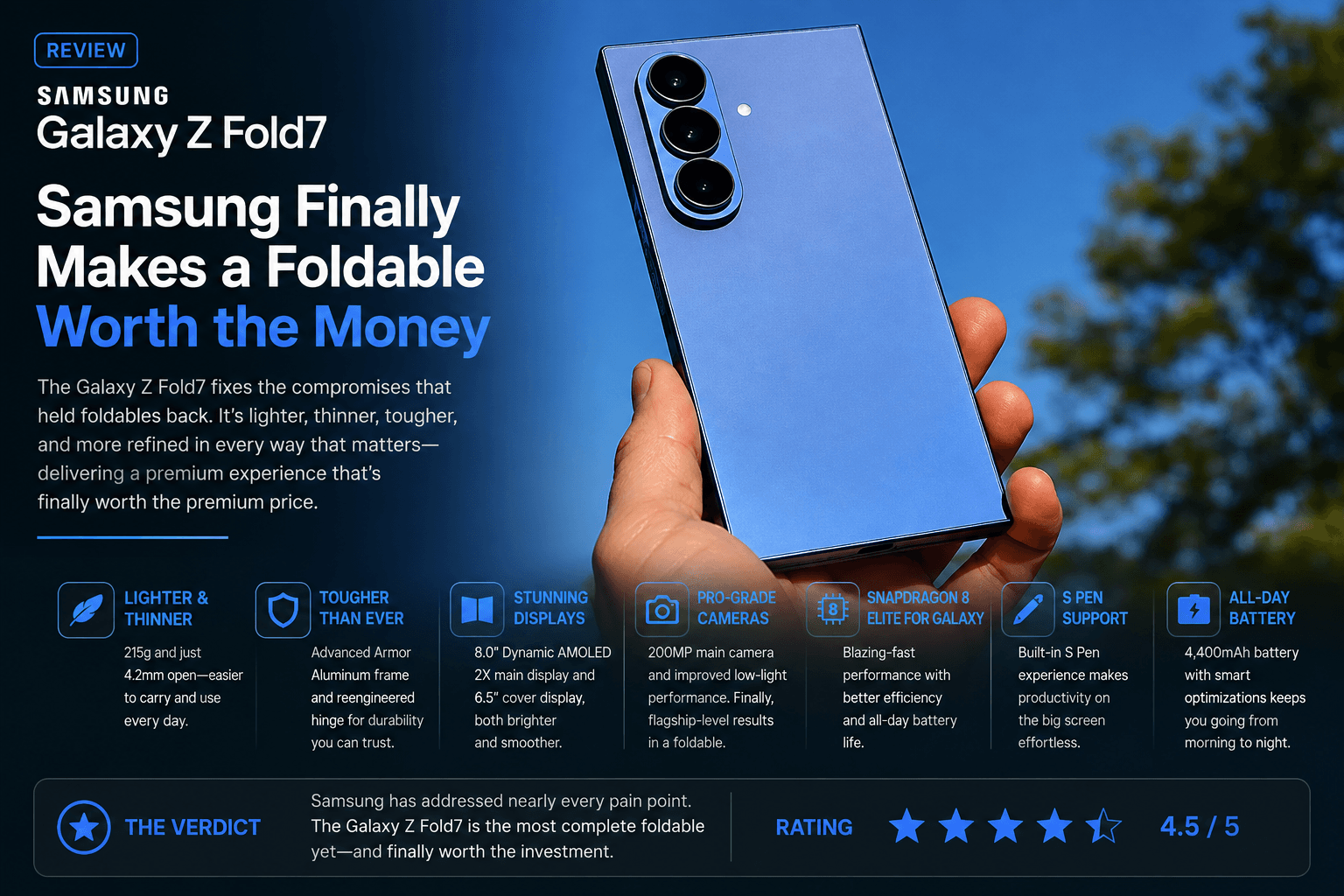
Samsung Galaxy Z Fold7 Review: Samsung Finally Makes a Foldable Worth the Money.
The Galaxy Z Fold7 is dramatically thinner and lighter than its predecessor, borrows the Galaxy S25 Ultra's 200MP camera, and finally has a cover screen that feels like a normal phone. The S Pen is gone, the battery and charging speed haven't budged, and the price has climbed — but this is the most convincing Fold Samsung has built yet.
Interested in this item?
Get the best verified price using our affiliate link below.
Foldable phones have spent the better part of six years being described as promising but compromised, and Samsung's own Z Fold series has often been Exhibit A — chunky when closed, cramped on the cover screen, and never quite matching a flagship candy-bar phone on camera or battery. The Galaxy Z Fold7, announced in July 2025, is Samsung's most serious attempt yet at closing that gap. It's dramatically thinner, meaningfully lighter, and finally carries a camera system worthy of the price. It also drops a feature longtime Fold fans have used for years. Whether that trade-off is worth it depends heavily on what you actually do with a foldable phone.
After several generations of incremental tweaks, the Z Fold7 is the first Fold that feels less like a tablet-phone compromise and more like a genuinely well-rounded flagship that happens to fold.
Design & Build Quality
This is where the Z Fold7 makes its biggest leap. Folded thickness drops from 12.1mm on the Z Fold6 to just 8.9mm, while unfolded thickness falls from 5.6mm to 4.2mm — thin enough that, folded, it's actually slimmer than Samsung's own Galaxy S25 Ultra. At 215 grams, it's also lighter than that phone despite housing two screens and a hinge mechanism. The frame uses a new Armor Aluminum construction with Corning Gorilla Glass Ceramic 2 on the cover display and Gorilla Glass Victus 2 on the back, and the phone carries an IP48 rating for dust and water resistance. The most significant omission is the S Pen: Samsung has removed both stylus support and its housing entirely in pursuit of this slimmer profile, a decision that will disappoint longtime Fold loyalists who relied on it, even if, as several reviewers note, plenty of Fold owners never used it in the first place.
Display
Both screens have grown. The cover display now measures 6.5 inches, up from 6.3 inches, and finally adopts a 21:9 aspect ratio that makes it usable like a normal phone rather than a cramped afterthought — a long-requested fix that reviewers consistently single out as one of the most meaningful upgrades this generation. The internal foldable display has grown from 7.6 to 8.0 inches, giving considerably more room for multitasking. Both panels are Dynamic AMOLED 2X with adaptive 1-120Hz refresh rates and peak brightness reaching 2,600 nits — the brightest displays Samsung has ever put on a Fold. The crease, long a point of criticism for foldables generally, is reportedly much less noticeable than on previous generations, though it hasn't been eliminated entirely.
Performance
The Z Fold7 runs on the Snapdragon 8 Elite for Galaxy, paired with 12 or 16GB of RAM and storage options up to 1TB. Independent benchmark testing has found the Fold7 performs comparably to other Snapdragon 8 Elite devices, though it trails the Galaxy S25 Ultra specifically — a gap reviewers attribute to less aggressive cooling and thinner internals rather than a slower chip. In everyday use, that's rarely noticeable; multitasking across the large internal display, running three app windows simultaneously, and general responsiveness all feel smooth. Gaming performance benefits from the bigger internal screen and improved graphics optimization, though sustained heavy workloads will still show the limits of a phone this thin more than they would on a standard flagship.
Cameras
Samsung's decision to bring over the Galaxy S25 Ultra's 200MP ISOCELL HP2 main sensor is the single biggest upgrade to the Fold7's camera system, and it shows — dynamic range, color accuracy, and detail retention all mark a substantial step up from the Z Fold6. The ultrawide camera now supports autofocus, unlocking closer macro-style shooting that wasn't previously possible, while the internal selfie camera jumps from 4MP to 10MP with a wider field of view, making group selfies on the big screen considerably more usable. Telephoto performance still trails a dedicated Ultra-class phone beyond roughly 3x zoom, and the Fold7 doesn't quite match the S25 Ultra's full zoom range, but for a foldable, this is comfortably the best camera experience Samsung has shipped in the category.
Battery Life & Charging
This is the clearest area where the Z Fold7 hasn't kept pace with its redesign. The battery remains unchanged at 4,400mAh, and charging speed is still capped at a comparatively slow 25W wired, with 15W wireless charging. Samsung's own testing claims up to 24 hours of video playback thanks to display and chip efficiency improvements, and several reviewers note the phone comfortably lasts a full day of typical use. But by 2026 flagship standards — where phones like the OnePlus 15 ship with batteries well over 7,000mAh and charge in under 40 minutes — the Fold7's battery and charging specs look dated, and multiple reviewers have flagged this as the most obvious area for Samsung to address in the next generation.
Software Experience
The Z Fold7 launched as the first non-Pixel device running Android 16, layered with One UI 8 and Samsung's Galaxy AI suite, including Gemini Live integration. The larger internal display makes Samsung's multi-window multitasking genuinely practical rather than merely a novelty, and features like Samsung DeX let the phone function as a makeshift desktop when connected to an external display. Software support follows Samsung's now-standard long-term commitment, matching the S26 Ultra's update policy — a genuine advantage for anyone planning to keep a premium foldable for several years given its high upfront cost.
Competition
Starting at $1,999 for the base 256GB/12GB configuration, the Z Fold7 sits considerably above standard flagships, competing most directly with foldables like the Vivo X Fold5 and Honor's Magic V series, along with Google's Pixel Fold lineup. Against Samsung's own Galaxy S25 Ultra, the Fold7 still trails in battery life and charging speed, and its camera — while much improved — doesn't fully match the Ultra's telephoto versatility. What it offers instead is a genuinely larger, more usable multitasking canvas and a cover screen that no longer feels like a compromise, which for buyers specifically drawn to the foldable form factor is likely to matter more than a slight camera or battery gap.
Who Should Buy It
The Galaxy Z Fold7 is best suited to buyers who want a genuine tablet-and-phone hybrid, value multitasking and productivity features over raw battery endurance, and are willing to pay a significant premium for a thinner, lighter foldable with a flagship-grade camera. It's a harder sell for existing S Pen users who relied on stylus input, and for anyone who considers battery life and charging speed non-negotiable, where standard flagships still hold a clear advantage.
Final Verdict
The Samsung Galaxy Z Fold7 is the clearest sign yet that foldables are maturing out of their awkward early years. A genuinely usable cover screen, a camera borrowed from Samsung's best conventional flagship, and a build that's thinner than a standard Ultra phone add up to the most convincing Fold Samsung has ever released. The unchanged battery and charging speed, along with the loss of S Pen support, keep it from being a flawless upgrade, and the price remains steep. But for buyers who've been waiting for a foldable that doesn't feel like a compromise, the Z Fold7 is finally that phone.
Ready to Purchase?
We gather active retail prices. Click below to buy this product securely.