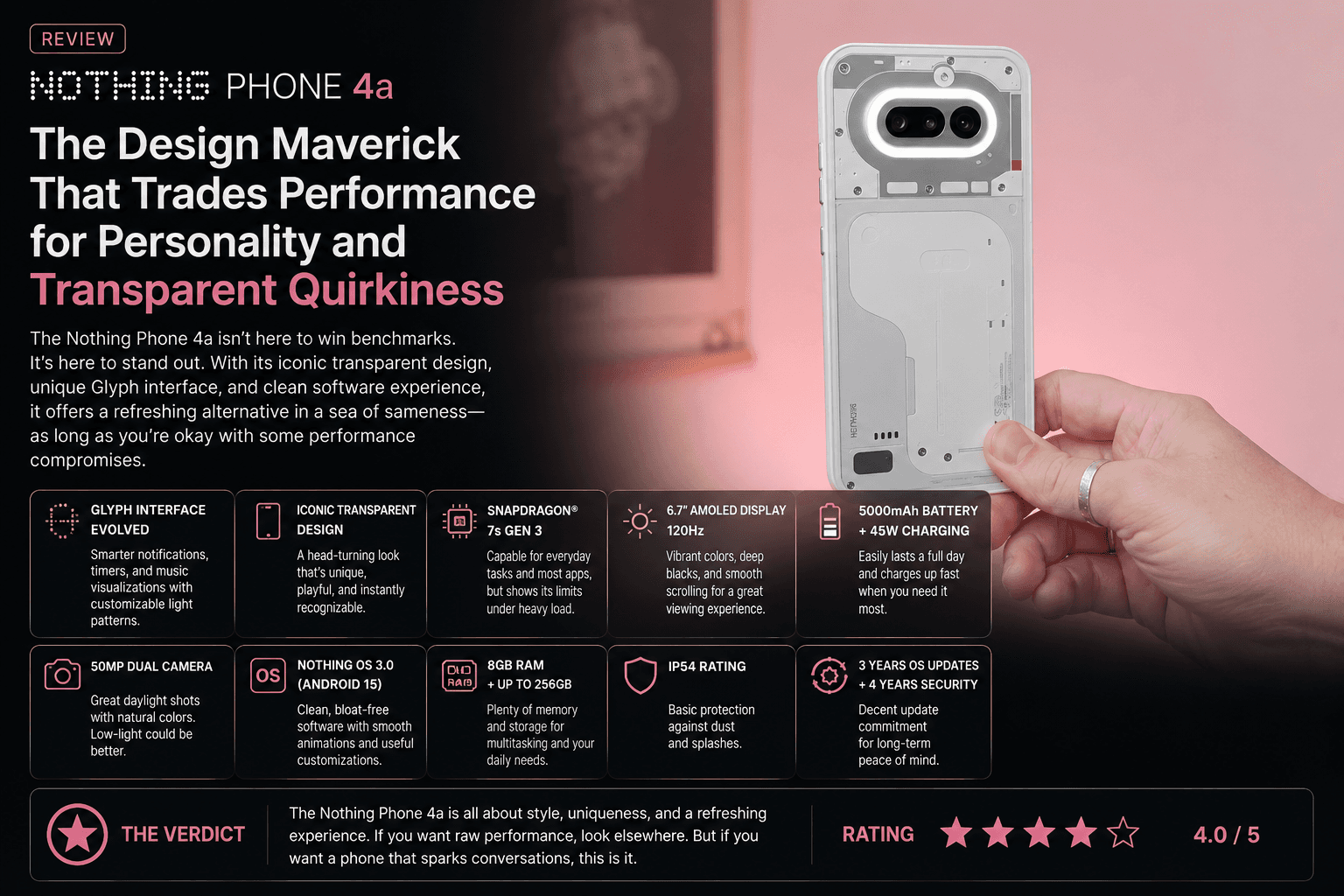
Nothing Phone 4a Review: The Design Maverick That Trades Performance for Personality and Transparent Quirkiness.
Nothing's Phone 4a embraces minimalism and design personality over flagship specs, featuring the new Glyph Bar lighting system, a capable 3.5x telephoto lens, and clean Nothing OS. But mediocre low-light photography and heating during gaming reveal where design ambition outruns engineering capability.
Interested in this item?
Get the best verified price using our affiliate link below.
Nothing Phone 4a Review: The Design Maverick That Trades Performance for Personality and Transparent Quirkiness
Nothing officially launched its 2026 mid-range Phone (4a) series, with the Phone (4a) starting at £349 and launching March 13th, representing a price increase over predecessors. The Nothing Phone (4a) aligns with the brand's identity to be different, rather than rewriting the mid-range rulebook. Nothing's philosophy has always been distinctive—reject the conformity of smartphones that all look identical. The Phone 4a pushes this philosophy further, embracing transparent design elements, functional LED lighting, and a focus on lifestyle over raw specifications.
The Nothing Phone 4a is for users who believe smartphones have become boring and identical. It prioritizes design personality, functional innovation in the Glyph Bar, and clean software over gaming performance and processing power. If you hate cookie-cutter phones, this is your rebellion.
Design: Transparent Thinking Meets Minimalist Brutalism
The Nothing Phone (4a) boasts a stunning AMOLED screen measuring 6.78 inches with a resolution of 1224x2720 (QHD). The screen sports a refresh rate of 120 Hz, and a maximum brightness of 1600 cd/m² (HBM). With a refresh rate of 120 Hz and a maximum brightness of 1600 cd/m² (HBM), this display offers a visually immersive experience with vibrant colors and crisp details.
The phone features a sleek and modern design, with a plastic body that exudes elegance and sophistication. With an impressive usable surface of 88.4%, the Nothing Phone (4a) maximizes screen real estate for an immersive and seamless user experience. The choice of plastic over glass is deliberate—durability without weight. The design philosophy emphasizes transparency and visibility, allowing users to glimpse internal components.
The Nothing Phone (4a) introduces a new Glyph Bar featuring 63 tiny LEDs, divided into seven small boxes stacked vertically. While Nothing retains its signature white lights for six out of seven boxes, it adds a functional red light for the first time on a Phone (a) series smartphone. The red light is not synced with the rest of the boxes and is limited to video and Essential Space voice recordings. This design evolution shows Nothing's commitment to functional design—every element serves a purpose.
Display: Clean AMOLED Panel Without Unnecessary Frills
With a 6.78-inch AMOLED screen with 1224x2720 resolution, HDR10+ support, and 1,600 nits brightness in High Brightness Mode, the display delivers excellent viewing experiences. The 120Hz refresh rate ensures smooth scrolling, though some competitors offer 144Hz panels at similar price points. The AMOLED technology delivers the perfect blacks and vibrant colors expected from the technology.
Nothing's new Glyph Bar is an absolute scorcher. The new look lighting system packs 63 mini LEDs across six zones, stacked vertically to the right side of the rear camera island. It's a whopping 40% brighter than the glyph strips on Phone 3a and is even more customisable. The display remains adequately bright for outdoor visibility, and the refresh rate transformation is noticeable in daily use compared to 60Hz alternatives.
The resolution is crisp with approximately 393 PPI density. The AMOLED implementation ensures excellent color accuracy, though color tuning leans toward vibrant saturation over accuracy. For everyday use, the display excels at everything except gaming performance, which is limited by the Snapdragon 7s Gen 4 processor rather than display capabilities.
Performance: Adequate Everyday Speed Hampered by Gaming Limitations
Under the hood, the Nothing Phone (4a) is powered by the Qualcomm Snapdragon 7s Gen3 processor, built on a 4nm process for blazing-fast performance and efficiency. Paired with 8GB or 12GB of LPDDR4X RAM, depending on the configuration. It denotes a slower version of the chip—about 25% less score in benchmarks compared to the Snapdragon 7 Gen 4. It also has less memory bandwidth and a slower modem.
In side-by-side performance testing, both devices deliver nearly identical real-world frame rates in gaming. If you are upgrading strictly for raw gaming power, the Phone 4A does not offer a noticeable day-to-day leap over its predecessor. The processor is entirely adequate for everyday tasks—messaging, social media, video streaming, and web browsing all perform flawlessly. The 8GB or 12GB LPDDR4X RAM ensures multitasking remains fluid.
Unstable gaming frame rates, dropping down to 40–45 FPS during intense combat. Heavy battery drain during gaming (losing 27% per hour). Gaming is the Phone 4a's weak point. While casual titles run acceptably, demanding games show noticeable frame rate inconsistency and thermal concerns. The processor simply wasn't designed for sustained high-performance gaming.
Camera System: Impressive Telephoto Undermined by Aggressive Processing
Nothing Phone 4a camera setup includes 50MP Triple rear camera and 32 MP selfie camera. The primary 50MP sensor captures daylight photographs with natural color reproduction. The 3.5x telephoto lens represents a genuine upgrade from predecessors, enabling portrait-grade zoomed shots.
Phenomenal 50MP 3.5x telephoto lens delivering portrait-grade daylight photos. Smooth, professional exposure shifting and stabilization in 4K video recording. Aggressive, contrast-heavy photo tuning that routinely crushes shadow details. Disappointing low-light photography performance on the main and ultra-wide sensors. The camera processing leans heavily toward contrast and saturation, which looks stunning in marketing materials but often crushes shadow detail and produces unnatural-looking results.
A lot of test shots ended up blurry, despite standing still to shoot. Bright light sources regularly get blown out, seemingly in pursuit of shadow detail, and scenes were often artificially brightened from reality. The 3.5x telephoto lens deserves special praise—it delivers exceptional portrait shots with natural bokeh. However, low-light performance remains underwhelming compared to competitors at this price point.
Battery Life: Solid Single-Day Endurance Without Exceptional Performance
While the Phone 4A introduces a faster UFS 3.1 storage drive, a rearranged button layout, and a larger 5400mAh battery. Battery life depends largely on how you use a phone. My sense from using this particular phone is that the battery should last even the most demanding users a full day on a fully topped-up battery. Even on days when testing the camera, video recording and benchmark stress tests, I wasn't able to completely drain it.
The improved camera versatility, coupled with its class-leading 24-hour battery life and a more capable processor, makes this a serious threat to the Pixel 10a. The battery delivers solid everyday endurance—easily lasting a full 24 hours with moderate usage. However, gaming sessions will noticeably accelerate battery drain. The inclusion of stereo speakers enhances multimedia consumption without battery penalty.
There is no wireless charging on the Phone 4a Pro. Overall, battery life and charging speeds are just fine, but yes, I do wish wireless charging could magically work through this metal backside. The absence of wireless charging at this price point is disappointing, though not uncommon. Wired charging speeds are respectable if not exceptional.
Software Experience: Clean Nothing OS With Ad-Free Philosophy
Nothing OS represents the company's commitment to clean Android without bloatware. Clean, ad-free Nothing UI with no annoying bloatware. Loud and well-balanced dual stereo speakers. The software philosophy emphasizes simplicity and functionality over unnecessary features. This clean approach is genuinely refreshing compared to competitors burdened with pre-installed applications.
Hit or miss AI functionality. Nothing's AI features, while present, feel somewhat underdeveloped compared to competitors. The software remains the least intrusive among major Android manufacturers, preserving the near-stock experience that power users appreciate. The Glyph lighting system integrates seamlessly into the OS with customizable notification patterns and status indicators.
The update commitment remains respectable for mid-range devices. Nothing's focus on software simplicity means even older hardware continues performing well, making the phone feel faster than specifications suggest. The absence of aggressive background app management and artificial performance degradation sets Nothing apart from competitors.
The Glyph Bar: A Gimmick That Actually Works
The red video recording light has been carried over from its predecessor. Yes, it's a bit of a gimmick—but it's loved all the same. The LEDs flash to indicate NFC contactless payments, your camera's countdown timer and the handset volume. They blink bespoke patterns to mark out notifications or calls from specific contacts. The Glyph Bar represents Nothing's commitment to functional design—every LED serves a genuine purpose.
The system is surprisingly useful in practice. Incoming calls create specific LED patterns, silent mode indicators pulse distinctly, and volume adjustment displays graphically. For content creators, the red recording light provides genuine functional value. A standout software feature for video creators is the Glyph Recording Light. The brightness can be customized to avoid excessive light pollution in quiet environments.
Competition and Market Positioning
You may still find alternatives, such as the Motorola Edge 70, a better value proposition for its ergonomics, performance, and more capable primary, selfie, and ultrawide cameras. The OnePlus Nord 5, on the other hand, holds superiority in performance, battery, and an additional year of major OS upgrades. The Nothing Phone 4a competes against well-established alternatives offering similar specifications.
The $499/£499 Phone 4a Pro lands firmly in affordable territory alongside Google's Pixel 10a and a whole host of year-old flagships that've been discounted from their original retail price—including Nothing's own Phone 3. The pricing is competitive, though not exceptional. The Phone 4a's value proposition depends entirely on whether you value design personality and software cleanliness over raw performance and feature completeness.
Strengths and Weaknesses
Strengths: The design is genuinely distinctive in a sea of identical smartphones. The Glyph Bar is functional and adds genuine personality. The 3.5x telephoto lens delivers impressive portrait shots. Nothing OS is refreshingly clean and ad-free. The AMOLED display is bright and responsive. The plastic construction is durable and lightweight. Stereo speakers provide excellent audio. The software experience remains snappy despite mid-range processor. The build quality feels premium despite plastic materials. The approach to design is refreshingly unconventional in an industry dominated by conformity.
Weaknesses: The Snapdragon 7s Gen 4 struggles with demanding gaming. Low-light camera performance is underwhelming compared to competitors. Aggressive photo processing crushes shadow detail and produces unnatural results. Unstable gaming frame rates during intensive sessions. Heavy battery drain during gaming. Thermal throttling during extended use. No wireless charging at this price point. Only 3 years of OS updates. The ultra-wide and macro cameras lack the versatility of alternatives. Camera video quality is limited to 1080p on front and ultra-wide. The design, while distinctive, appeals to niche audiences rather than mass markets.
The Nothing Phone 4a succeeds at being exactly what Nothing intended: a design statement that refuses to conform. It sacrifices gaming performance and low-light photography prowess for personality. If that trade-off aligns with your values, the 4a is perfect. If you need raw power or universally excellent cameras, look elsewhere.
Who Should Buy the Nothing Phone 4a?
The Nothing Phone 4a is ideal for users who tire of cookie-cutter smartphone designs and value personality over specifications. Design enthusiasts appreciate the transparent elements and Glyph lighting system. Content creators benefit from the telephoto lens for portrait work and the Glyph recording light. Students seeking an affordable device that feels premium will enjoy the design. Users prioritizing software cleanliness and minimal bloatware will appreciate Nothing OS.
The Phone 4a is less suitable for hardcore gamers demanding consistent high frame rates. Photography enthusiasts requiring versatile ultra-wide and macro capabilities should look at alternatives. Users demanding rapid charging should evaluate competitors. Those requiring robust low-light camera performance need more capable sensors. Power users needing extensive software customization may find Nothing OS too minimal.
Final Verdict: A Design Statement That Sacrifices Practicality for Personality
The Nothing Phone (4a) is a great budget-friendly phone, offering impressive performance, an upgraded display, and streamlined software. It's priced very competitively. Camera quality isn't exactly exceptional on this model, and I would've liked to have seen wireless charging on board, but this is still a very good phone all things considered.
Performance, battery life and camera image quality are all up to par for a mid-ranger, while the streamlined software makes it a joy to live with. The Phone 4a succeeds at being unconventionally beautiful in an industry that has converged on uniform glass-and-metal rectangles. The Glyph Bar is more than a gimmick—it's functional design that improves daily life. Nothing OS remains the cleanest Android implementation available.
Rating: 7.8/10 – The Nothing Phone 4a is a design maverick that unapologetically rejects conformity. It delivers a unique experience with its transparent design elements, functional Glyph Bar, and exceptionally clean software. The Snapdragon 7s Gen 4 and underwhelming low-light camera performance reveal engineering compromises made to achieve the design vision. However, for users who value personality, design distinctiveness, and software cleanliness over gaming performance and photography versatility, the Phone 4a represents one of the most interesting mid-range purchases available. At £349 in the UK and €349 in Europe, the Nothing Phone 4a offers genuine value for design-conscious buyers who refuse to settle for another beige smartphone rectangle.
Ready to Purchase?
We gather active retail prices. Click below to buy this product securely.