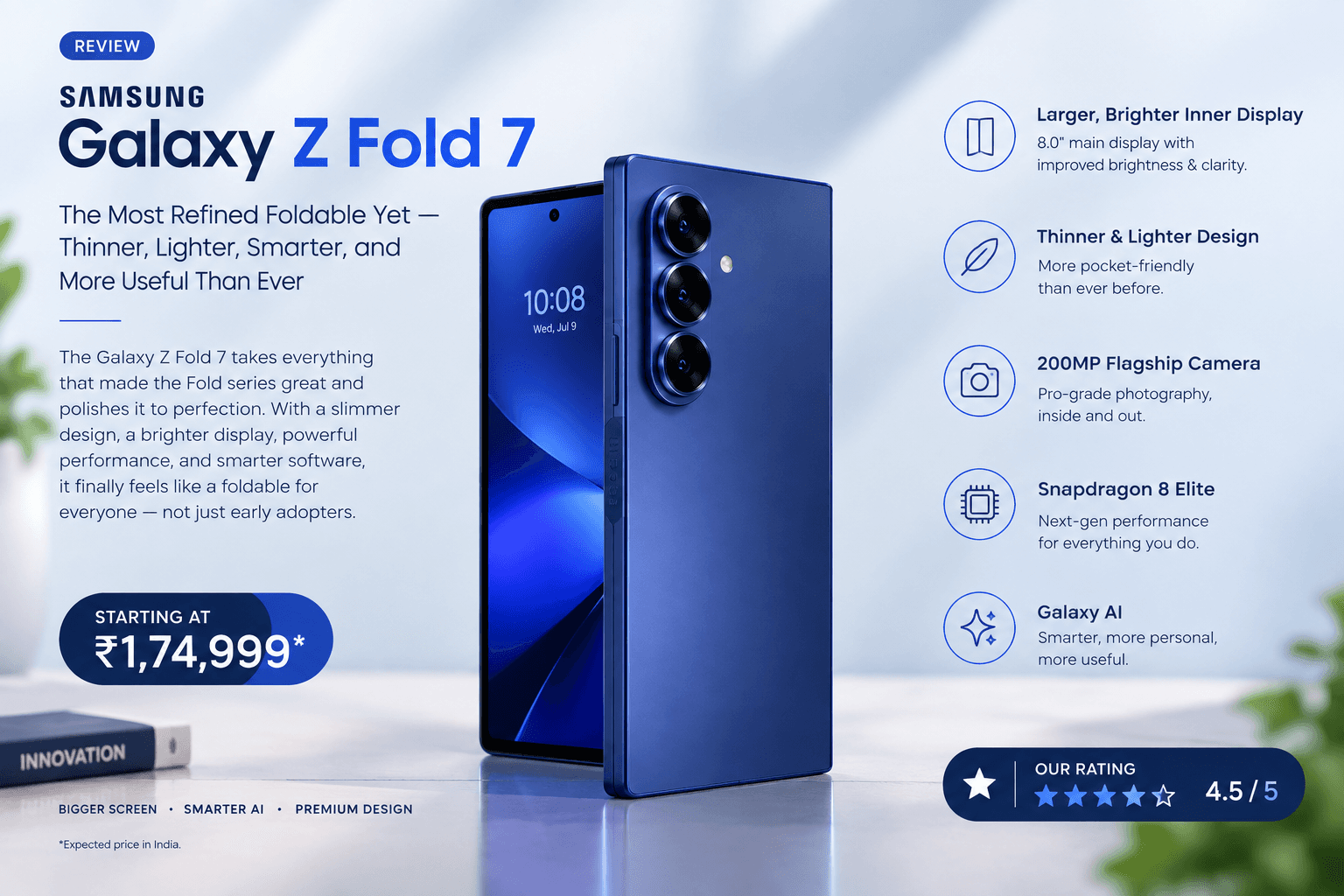
Samsung Galaxy Z Fold 7 Review: The Thinnest Foldable Ever With 200MP Camera and 7-Year Support, But $1,999 Price and Mediocre Battery Life Demand Serious Justification.
Samsung's Galaxy Z Fold 7 delivers the most refined foldable design yet with a 26% thinner profile, class-leading 200MP main camera, Snapdragon 8 Elite performance, and seven-year software commitment. But mediocre battery life, weak secondary cameras, and aggressive $1,999 pricing reveal where Samsung prioritized thinness over practicality.
Interested in this item?
Get the best verified price using our affiliate link below.
Samsung Galaxy Z Fold 7 Review: The Thinnest Foldable Ever With 200MP Camera and 7-Year Support, But Mediocre Battery and $1,999 Price Demand Justification
The Samsung Galaxy Z Fold 7 starts at $1,999 for 256GB of storage and 12GB of RAM. No, that's not a typo. That's $100 more than the Galaxy Z Fold 6 and the most expensive phone you can buy in the U.S. Though if you can handle the price, in a lot of ways, Samsung has finally achieved foldable phone nirvana with the Galaxy Z Fold 7. Samsung's latest foldable represents the zenith of engineering refinement—the thinnest, lightest book-style foldable ever created. Yet the $1,999 price tag with unchanged battery capacity and mediocre secondary cameras reveals where Samsung prioritized aesthetic achievement over practical functionality.
The Samsung Galaxy Z Fold 7 is Samsung's foldable masterpiece from a design perspective—26% thinner, lighter than the S25 Ultra, with a stunning 200MP camera and seven-year software support. But $1,999 for a phone with mediocre battery life and 4,400mAh capacity reveals the cost of thinness. This is engineering excellence constrained by practical compromises.
Design: Engineering Marvel That Prioritizes Thinness
Dimensions: 6.24 x 5.64 x 0.17 inches (~0.34 inches with camera bump) 158.4 x 143.2 x 4.2 mm (~8.6 mm with camera bump). Folded: 6.24 x28.66 x3.50 inches (158.4 x 72.8 x 8.9). Weight: 7.58 oz / 215.0 g. Back: Glass (Corning Gorilla Glass Victus 2). Frame: Aluminum. Resistance: Water, Dust; IP48. The 4.2mm thickness when unfolded represents a 26% reduction compared to the Z Fold 6—a genuinely remarkable engineering achievement.
With the Galaxy Z Fold 7, you really do get the best of both worlds. Its new design is just as sleek as comparable traditional flagships while hiding a larger display that makes the need for small tablets obsolete. The flat frame with aluminum construction provides premium feel despite the weight (215g) which actually makes the device feel substantial rather than fragile.
Samsung nails the display game yet again. The IP48 rating provides dust and splash resistance, though care remains necessary around prolonged water exposure. The color options including Jetblack, Silver Shadow, and Blue Shadow provide tasteful choices. The thinner profile makes the Fold 7 feel more like a premium phone when folded rather than a device requiring protective case bulging.
Display: Twin AMOLED Panels With Exceptional Brightness
Cover Display: 6.5″ Dynamic AMOLED 2X, 2520×1080, 21:9, 120Hz. Inner Display: 8.0″ Dynamic AMOLED 2X, 2184×1968, 120Hz LTPO, 2600 nits. The 8-inch main display with 2600-nit peak brightness represents the most expansive foldable screen, approaching tablet-like screen real estate while remaining pocket-sized when closed.
Even when folded, the outer screen is vibrant and practical for daily tasks, which makes switching between modes seamless. The 6.5-inch cover screen is genuinely usable for entire workflows—apps run natively without reloads when switching between displays. The 120Hz adaptive refresh rate intelligently adjusts based on content to balance visual smoothness with battery efficiency.
The AMOLED technology delivers exceptional color accuracy, perfect blacks, and vibrant colors on both panels. The HDR10+ support ensures streaming content appears appropriately dynamic. The 90.43% screen-to-body ratio on the inner display maximizes usable area while minimizing bezels. The visible crease has been minimized through improved hinge engineering, though it remains present—a practical concession to the folding mechanism.
Performance: Snapdragon 8 Elite for Galaxy With Thermal Concerns
Chipset: Snapdragon 8 Elite for Galaxy (3 nm). CPU: 2× Oryon V2 @ 4.47 GHz + 6× @ 3.53 GHz. RAM: 12 GB (256/512 GB models) / 16 GB (1 TB model). Storage: 256 GB / 512 GB / 1 TB (UFS 4.0). The custom Snapdragon variant optimized specifically for Samsung foldables delivers exceptional single-core performance while providing adequate multi-core capability.
On paper, the Z Fold 7's performance should be off the chart, but reality doesn't always match up. It runs on the Snapdragon 8 Elite for Galaxy, a tuned-up version of Qualcomm's flagship chipset, and with plenty of RAM, day-to-day performance is smooth, even when juggling multiple apps. However, Throttling limits performance during extended heavy workloads.
The Galaxy Z Fold 7 handles everyday tasks such as messaging, browsing, and media streaming with ease. Multitasking across split screen apps is smooth, and animations remain fluid when switching between folded and unfolded modes. Extended gaming or heavy workloads may cause some heat and increased battery drain. The thermal constraints of the thin profile remain a concern during sustained high-performance scenarios.
Camera System: 200MP Main Sensor With Uninspired Secondary Lenses
Main Camera: 200 MP (wide) + 12 MP (ultra-wide) + 10 MP 3× telephoto. Selfie Cameras: 10 MP cover + 10 MP inner (hole-punch). Samsung has finally given its foldable flagship a real camera boost. The Samsung Galaxy Z Fold 7 blends its signature hardware with impactful upgrades, most notably a leap to a 200MP main sensor, matching the Samsung Galaxy S26 Ultra.
The highlight of this phone is its #GalaxyAI Ultra Camera with a 200MP sensor. The detail and dynamic range are exceptional, capturing pro-grade shots in varied lighting conditions. The AI enhancements help with composition, optimization, and even real-time editing — making it effortless to produce stunning images and videos on the go. The primary camera delivers genuinely impressive daylight performance with excellent detail retention and dynamic range.
No periscope telephoto camera. Telephoto and ultrawide cameras feel weak next to the main sensor. The 12MP ultrawide and 10MP 3x telephoto feel underpowered alongside the flagship 200MP primary. The lack of a periscope telephoto is particularly disappointing at the $1,999 price point—competitors offer superior zoom flexibility through dedicated telephoto implementations.
Battery Life: The $1,999 Foldable's Achilles Heel
4400 mAh Battery with 25W Fast Charging. The 4,400mAh battery in the Galaxy Z Fold 7 can just barely last a full day with light to moderate use. If you don't use the large 8-inch foldable screen that often (and take a few less pictures), you can stretch it to get through a full day, but let's be honest: who's not using the big screen on this thing? It's the whole reason you buy a folding phone.
Battery Life – 6h 38m (video playback). Charge Time – 46% in ~30 minutes (wired), full in ~1h 23m. The 25W charging speed is disappointingly slow—even budget phones offer 45-90W charging. Real-world testing confirms that the Fold 7 struggles with demanding use scenarios, particularly when using the large inner display for extended periods.
Battery life is still playing catch-up. Real-world battery life shows modest improvements thanks to the more power-efficient Snapdragon 8 Elite for Galaxy chip. I could use it (albeit relatively lightly) throughout the day, only draining about 50% of the battery, slightly better than the Fold 6 provided when I tested it in 2024. The battery capacity remains identical to the Fold 6 despite aggressive thinning—a fundamental design compromise that undermines daily practicality.
Software: One UI 8 With Seven-Year Support
OS: Android 16 with One UI 8. Software Support: 7 years of OS & security updates. The seven-year update commitment represents industry-leading support, matching Google and exceeding most competitors. One UI 8 includes Galaxy AI features optimized for the foldable form factor, with Circle to Search and advanced camera processing.
With Samsung Dex and improved power efficiency, it's a powerhouse device that can easily replace your tablet or even your laptop for many tasks. The software's foldable optimization enables seamless transitions between the compact cover display and expansive inner screen. Multi-window functionality leverages the large screen for productive workflows—document editing, video creation, and research become genuinely practical on the 8-inch display.
Competition and Market Positioning
When we broaden the spectrum to beyond the confines of the U.S., it's a very different story. Vivo's X Fold 5 recently launched in select countries, bringing with it a design that's almost just as slim as the Fold 7. And despite using last year's chip, the X Fold 5 beats out the Fold 7 with battery life, and a camera system that's described as being "the best cameras of any foldable right now." The Motorola Razr Fold offers alternate form factor with superior battery capacity. The OnePlus Open provides strong competition with better thermal management.
Unfortunately, with a starting price of $2,000, Samsung hasn't addressed the last roadblock stopping people from trying out a device that might completely change the way they use their phone. The aggressive $1,999 (soon $2,000+) pricing combined with mediocre battery life creates a value proposition that demands careful evaluation against more practical alternatives.
Strengths and Weaknesses
Strengths: Exceptional 26% thinner design represents genuine engineering marvel. Class-leading 200MP main camera with impressive daylight performance. Seven-year software support provides industry-leading longevity. Snapdragon 8 Elite delivers smooth daily performance. Twin AMOLED displays with excellent brightness and color accuracy. Seamless multi-window multitasking leverages large screen. 8-inch inner display approaches tablet-like usability. Premium build quality with Gorilla Glass Victus 2. IP48 rating provides practical durability. Lightweight at 215g for a foldable. Samsung Dex enables productivity workflows.
Weaknesses: $1,999 price represents $100 annual increase with minimal meaningful battery improvements. 4,400mAh capacity unchanged from Z Fold 6 despite aggressive thinning. Mediocre battery life barely lasts full day with heavy use. Weak secondary cameras—12MP ultrawide and 10MP telephoto don't match 200MP main. No periscope telephoto limits zoom versatility. Slow 25W charging—glacial by 2026 standards. No S Pen support removed productivity feature. Thermal throttling during extended high-performance scenarios. Visible crease remains present despite improvements. Limited app optimization on large inner screen persists. High cost per year of use exceeds traditional flagship phones.
The Samsung Galaxy Z Fold 7 succeeds at delivering the thinnest, lightest foldable ever created with exceptional 200MP camera and seven-year support. But $1,999 for a phone with unchanged battery capacity, slow charging, and mediocre all-day endurance reveals that thinness came at the cost of practical functionality.
Who Should Buy the Samsung Galaxy Z Fold 7?
The Galaxy Z Fold 7 is ideal for Samsung ecosystem loyalists seeking the most advanced foldable available. Productivity professionals leveraging the 8-inch display for document work and creative tasks will find genuine value. Photography enthusiasts appreciating the 200MP camera upgrade will benefit from the imaging capability. Power users with predictable charging access appreciate the seven-year software support. Those seeking the thinnest foldable form factor will find engineering satisfaction.
The Galaxy Z Fold 7 is less suitable for battery-conscious users—the all-day endurance with the large screen is questionable. Photography professionals requiring versatile zoom will find secondary cameras limiting. Budget-conscious buyers should explore more affordable alternatives. Those demanding rapid charging should evaluate competitors offering 45-120W speeds. Casual users should strongly consider traditional phones offering better battery and charging at lower cost.
Final Verdict: Engineering Excellence Compromised By Battery and Pricing
Samsung has hit its stride again with the Galaxy Z Fold 7. While it's not without flaws—minimal improvements to battery life, slow charging, no S Pen support, and a telephoto camera that doesn't quite impress—the overall package feels far more refined and practical for the mass market than previous releases have. Though if you can handle the price, in a lot of ways, Samsung has finally achieved foldable phone nirvana with the Galaxy Z Fold 7.
The Galaxy Z Fold 7 is Samsung's best foldable yet, and in design terms, the best-looking foldable on the market right now. Its slim build, excellent cover screen, and standout main camera sensor make it a genuinely appealing device for those willing to embrace foldable form factor. The seven-year update commitment provides exceptional long-term value compared to traditional flagships.
Rating: 8/10 – The Samsung Galaxy Z Fold 7 is a design masterpiece that delivers the thinnest foldable ever created with a class-leading 200MP camera, Snapdragon 8 Elite performance, and seven-year software support. The thin profile is genuinely impressive, and the 8-inch inner display transforms productivity workflows. However, $1,999 for a phone with unchanged battery capacity, mediocre all-day battery life, slow 25W charging, and weak secondary cameras demands serious justification. For Samsung ecosystem loyalists and productivity professionals valuing the large display, the Z Fold 7 represents the pinnacle of foldable engineering. For battery-conscious or budget-aware buyers, traditional flagships or more practical foldables offer superior value.
Ready to Purchase?
We gather active retail prices. Click below to buy this product securely.