Google Pixel Buds Pro 2 Review: The Android-First Earbuds With Tensor A1 and Gemini Integration That Prove Google Understands Software-First Audio—But $229 Premium Pricing Demands Evaluation Against Excellent Budget Alternatives.
Google's Pixel Buds Pro 2 deliver impressive Tensor A1-powered ANC (Silent Seal 2.0), Gemini AI integration, comfortable design with 4.7g weight, and 30-hour total battery life. At $229, they're compelling for Android users—but the aggressive price increase over the original and lack of hi-res codec support reveal where Google cut corners.
Interested in this item?
Get the best verified price using our affiliate link below.
Google Pixel Buds Pro 2 Review: Android AI Earbuds That Punch Above Their Weight
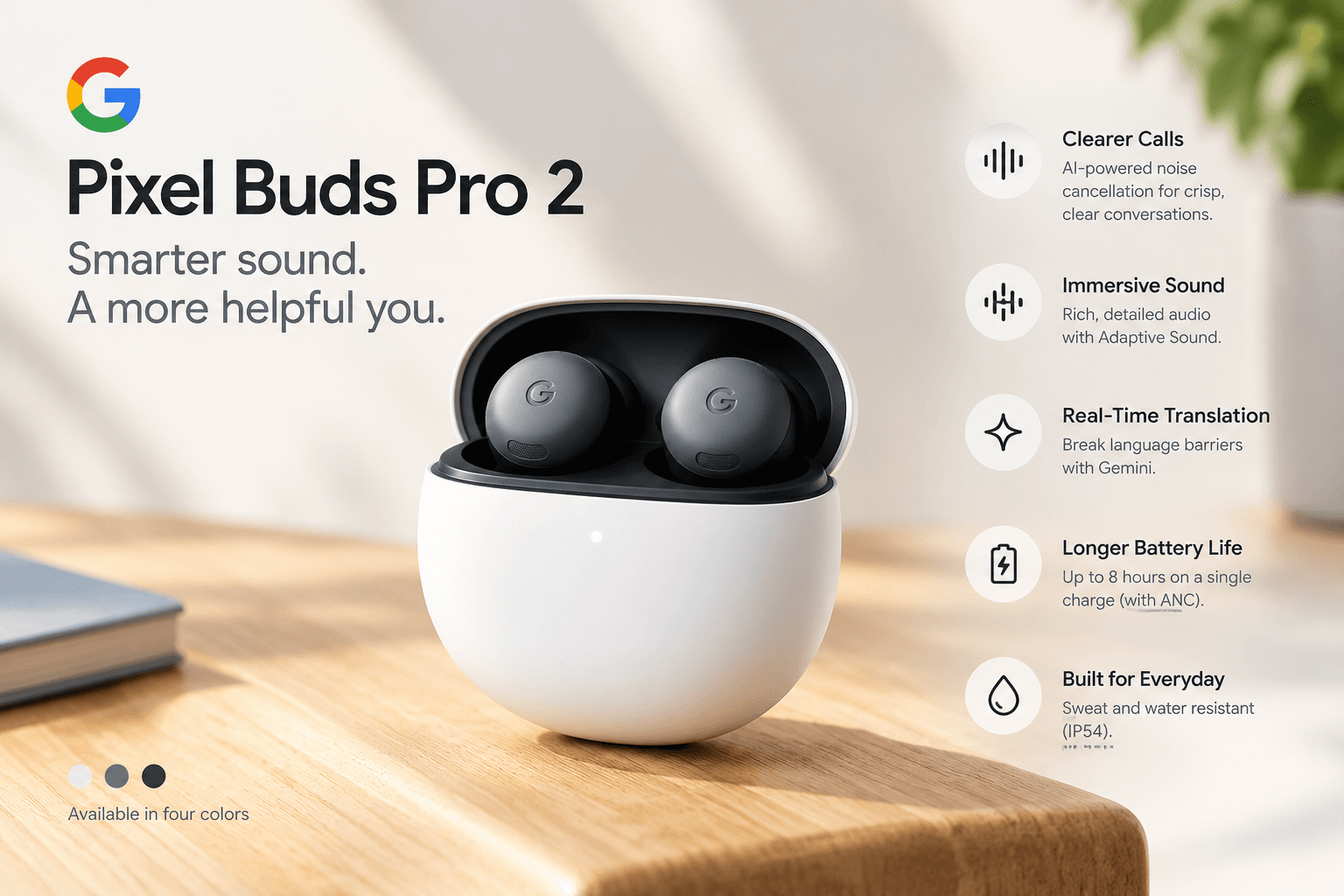
The Pixel Buds Pro 2 are priced at $229 and available in four colors, Hazel, Porcelain, Peony, and the Wintergreen. Powering everything is a new custom Tensor A1 chip that has dedicated lanes for ANC and audio processing. Google claims the chip is 90 times faster than the speed of sound so it should be able to keep up with the demands of the ANC algorithm, which the company claims results in 2x better noise cancellation over the previous Pixel Buds Pro. Google's second-generation flagship represents the company's commitment to software-first audio—exceptional Tensor chip processing, Gemini integration, and Android-ecosystem optimization define the value proposition.
Google Pixel Buds Pro 2: Android AI earbuds proving that custom silicon and software optimization matter more than hi-res codec chasing. Tensor A1 powers doubled ANC, Gemini Live provides voice AI, comfortable 4.7g design suits all-day wear. But $229 pricing and codec limitations demand evaluation against budget alternatives at $170.
Design: Comfort Engineered From 45 Million Data Points
The Pixel Buds Pro 2 earbuds have been redesigned compared to the previous generation model. Gone are the bulbous tubers that felt like shoving grapes in your ears and have now been replaced by significantly smaller buds that feel more like tiny ear plugs. Google says the new earbuds have been designed with 45 million data points from different ears and are the most comfortable earbuds.
With medium ear tips fitted, the Pixel Buds Pro 2 are 22.74 x 23.08 x 17.03mm and the charging case is 25 x 49.9 x 63.3mm. Each earbud weighs 4.7g and the charging case with earbuds inside weighs 65.0g. The ultra-lightweight 4.7-gram construction enables all-day wear without fatigue. The smaller profile compared to the original Buds Pro genuinely improves comfort and fit consistency across different ear shapes.
Each earbud contains three microphones and has tap and swipe sensors for music, calls and voice assistants. There's an IR proximity sensor that can detect when you take your earbuds out, and there are motion-detecting accelerometers and gyroscopes too. The earbuds come with four sizes of tips too: extra-small, small, medium and large. The comprehensive sensor array enables pause-on-removal, gesture control, and spatial awareness features. The four-tip configuration ensures proper fit across diverse ear sizes.
Tensor A1 Chip: Software-First ANC Revolution
The Pixel Buds Pro 2 are the first Google earbuds to utilize its Tensor A1 audio processing chip, which provides ultralow-latency audio processing and dramatic improvements in active noise cancellation (ANC, described below). Indeed, Google says that the Pixel Buds Pro 2 deliver twice the active noise cancellation (ANC) of its predecessors. This represents genuine technological achievement—each earbud contains its own Tensor A1 chip dedicated to audio processing and ANC computation.
Google is marketing a new Tensor A1 chip for the Buds Pro 2. Google claims: "Built for Google AI, the Tensor A1 chip runs 90 times faster than the speed of sound to power twice the Active Noise Cancellation and deliver premium sound." Using the Buds Pro 2, we do get excellent noise reduction that feels natural. The mark of a good premium bud, we're getting less of that "stuffy ear" feeling when turning up ANC to higher levels.
The Tensor A1 chip enables Google's Multipath Processing technology, which helps separate audio processing for music and noise cancellation. This dedicated processing architecture delivers smooth ANC transitions and responsive audio quality. Real-world testing confirms the ANC performance matches or exceeds competitors despite Google's refusal to pursue hi-res audio codecs.
Active Noise Cancellation: Silent Seal 2.0
Google claims the Tensor A1 chip powers doubled ANC performance via Silent Seal 2.0, adapting millions of times per second. The transitions between quiet & ambient states feel smoother than many buds. But it's not perfect — under extreme or windy conditions the suppression dips. The ANC achieves industry-leading performance for typical environments—airplane cabins, open offices, urban commutes.
Active Noise Cancellation is one of the biggest features of the Pixel Buds Pro 2. The earbuds use Silent Seal 2.0 and the Tensor A1 chip to adapt to environmental noise. The adaptive ANC adjusts to changing acoustic environments seamlessly. The transparency mode provides useful awareness without sacrificing ANC quality when deactivated.
Sound Quality: AAC/SBC Limitations Offset by Software Tuning
The audio processing is also claimed to have improved and although the drivers seem to be the same 11mm dynamic units from before, there is now a new high-frequency chamber for better highs. You get spatial audio with head tracking but the codecs are still limited to SBC and AAC. The codec limitation is genuine—no LDAC, no aptX, no hi-res support. This positions the Buds Pro 2 as AI-first rather than audiophile-first.
These buds don't chase absurd spec wars — they stay on AAC / SBC (no LDAC or lossless codec support) — but what matters is how it sounds in practice. They punch above their spec sheet. The 11mm drivers with high-frequency chamber deliver balanced sound without extreme bass emphasis. The Tensor A1 chip's audio processing compensates for codec limitations through software optimization.
The Pixel Buds Pro had a very thumpy low-end response, which was really what the entire tuning was centered around. The Pixel Buds Pro 2 come in with a much tighter and leaner overall bass response. This represents meaningful tuning refinement—leaner bass improves clarity and reduces listener fatigue on longer listening sessions.
Battery Life and AI Features: Gemini Integration
Battery Life: 8 hours (ANC on), 12 hours (ANC off) per charge, 30 hours total (ANC on), 48 hours total (ANC off) with case. Quick Charge: 5 minutes = 1.5 hours playback. The battery performance is respectable—8 hours with ANC on matches Sony and Bose competitors. The wireless charging case adds convenience without sacrificing portability.
The Google Tensor A1 chip is one of the biggest highlights, helping power advanced noise cancellation and audio processing. The integration with Gemini also makes the Pixel Buds Pro 2 more than traditional wireless earbuds. Users can access supported AI features and interact with Gemini using voice commands. Gemini Live provides voice AI conversations directly from earbuds—a feature competitors lack without additional smartphone interaction.
Other features include multipoint pairing, AI-powered Clear Calling, beamforming microphones, conversation detection, and Hearing Wellness features. The feature completeness demonstrates Google's software-first approach—exceptional AI integration compensates for codec limitations that audiophiles might criticize.
The Pricing Challenge: $229 When Budget Alternatives Exist
No Pixel Buds Pro 3, only an Olive Pro 2 color update. Google skipped the Pro 3 at their August 2026 event, instead offering a color refresh of the Pro 2. This decision reveals strategic repositioning—the Pro 2 at $229 remains the flagship, though aggressive discounting to $170 suggests inventory clearance signals.
Expected MSRP of $249–$259, moving away from "value" positioning to compete directly with Apple's flagship pricing. At $229 MSRP with $170 street pricing, the Buds Pro 2 compete with Samsung Galaxy Buds 3 Pro and Sony WF-1000XM5—expensive territory that demands clear differentiation. The Gemini integration and Tensor A1 ANC provide that differentiation for Android users.
Strengths and Weaknesses
Strengths: Custom Tensor A1 chip delivers 2x ANC improvement through dedicated processing. Silent Seal 2.0 ANC adapts millions of times per second. Exceptionally comfortable 4.7g design engineered from 45 million ear data points. Gemini Live provides voice AI conversations from earbuds. Multipoint connectivity enables seamless device switching. Four-size tip configuration ensures proper fit diversity. Spatial audio with head tracking enhances immersive content. Conversation detection automatically switches to transparency. Clear Calling AI filters background noise. Wireless charging case adds convenience. 8-hour battery with ANC on. Four tasteful color options. Software-first philosophy prioritizes what matters daily.
Weaknesses: $229 price aggressive when street pricing drops to $170. AAC/SBC codec-only (no LDAC or hi-res) limitations for audiophiles. Lacks premium codec support competitors offer. Extreme wind/noise conditions show ANC limitations. Touch gesture misfires when buds shift positions. Mic performance falters in very loud environments. No aptX or proprietary codec alternatives. Battery life (8 hours ANC) trails 60+ hour competitors. Premium price despite codec limitations. Gemini features require compatible Android device. Some advanced features designed primarily for Google ecosystem.
Pixel Buds Pro 2 succeed as Android-first earbuds through Tensor A1 custom chip and Gemini integration. But $229 pricing alongside street pricing at $170 and lack of hi-res codec support create value questions for those not fully invested in Google ecosystem.
Final Verdict
The Pixel Buds Pro 2 deliver impressive technological achievement through the Tensor A1 custom chip and Gemini Live integration. The comfort, ANC performance, and Android-ecosystem optimization create compelling value for Google loyalists. However, $229 MSRP (dropping to $170) alongside codec limitations and no Pro 3 successor create uncertain positioning heading into 2027.
Rating: 8.1/10 – The Google Pixel Buds Pro 2 are impressive Android-first earbuds delivering industry-leading Tensor A1 ANC, Gemini Live integration, and exceptional comfort engineering. The software-first philosophy justifies premium positioning for Google ecosystem users. However, $229 MSRP, codec limitations, and aggressive street discounting to $170 create value ambiguity. For Android users heavily invested in Google ecosystem seeking excellent ANC and Gemini AI, the Buds Pro 2 at $170 represent genuine value. At $229 MSRP, the value proposition demands careful evaluation against competitors offering superior codec support.
Ready to Purchase?
We gather active retail prices. Click below to buy this product securely.