Samsung Galaxy S26 Ultra Review: A Familiar Flagship That Still Gets the Basics Right.
The Samsung Galaxy S26 Ultra brings a faster chipset, quicker charging, and a clever new Privacy Display, but keeps the same 5,000mAh battery and largely unchanged cameras as its predecessor. Here's whether that's enough to remain the Android flagship to beat in 2026.
Interested in this item?
Get the best verified price using our affiliate link below.
Samsung doesn't reinvent the Galaxy S Ultra every year, and 2026 is no exception. The Galaxy S26 Ultra arrives as a measured, almost conservative update — one built around a faster chip, quicker charging, and a genuinely novel screen trick rather than a ground-up redesign. After spending time with the phone across daily use, camera testing, and battery benchmarking, the picture that emerges is of a device that plays it safe in most areas while still delivering one of the most dependable flagship experiences on Android.
The Galaxy S26 Ultra isn't chasing headlines with dramatic new hardware — it's refining what already worked, and mostly succeeding.
Design & Build Quality
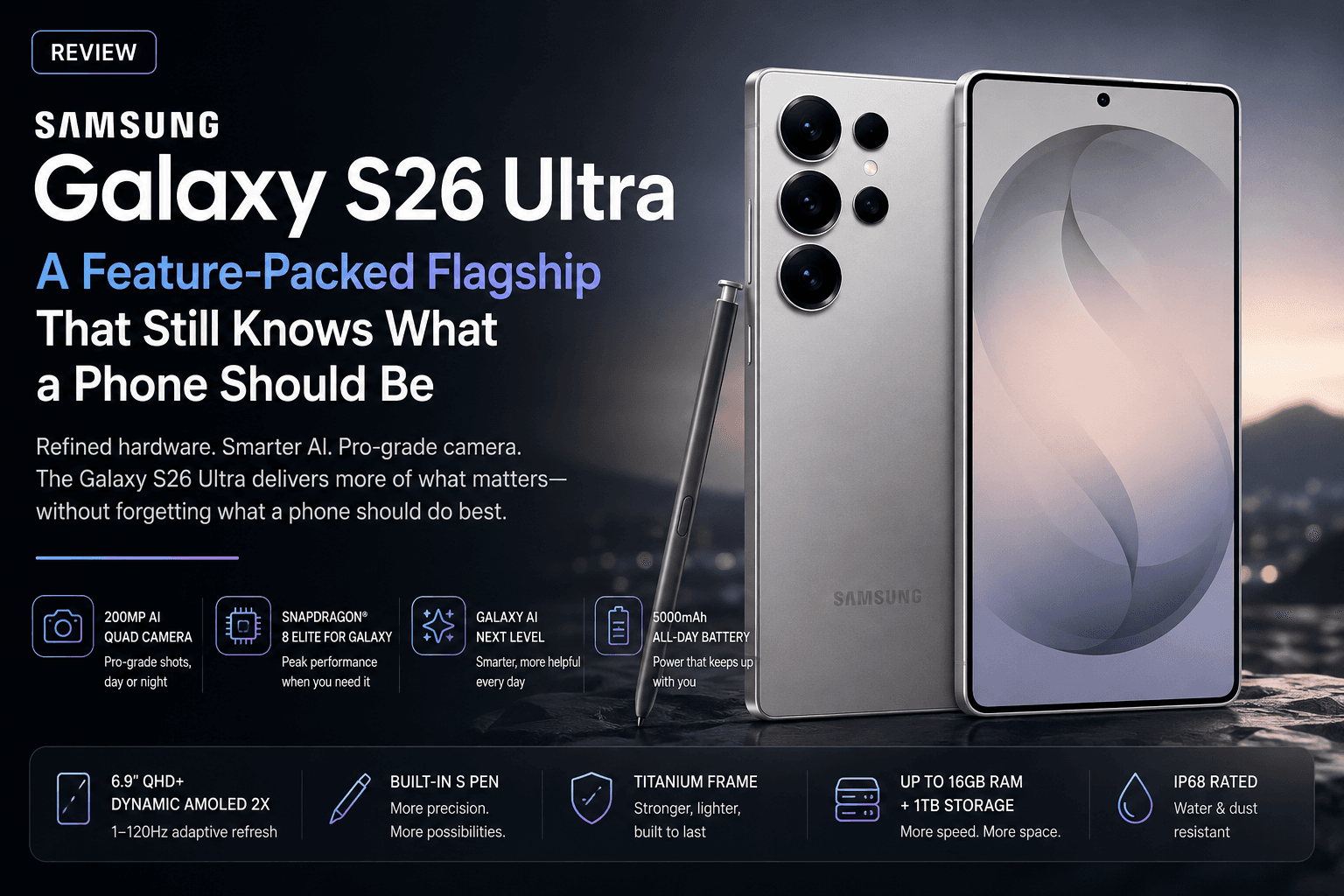
At 163.6 x 78.1 x 7.9mm and 214 grams, the S26 Ultra is very slightly slimmer and a touch lighter than the S25 Ultra it replaces, despite a marginally larger camera bump. Samsung has kept the boxy, squared-off silhouette with flat sides that has defined the Ultra line for several generations now, along with the built-in S Pen silo — still one of the few flagships to offer stylus support out of the box. The phone retains IP68 water and dust resistance, and Gorilla Glass Armor protects the front panel against scratches and glare. It's a handsome, familiar design rather than an exciting one, and buyers coming from the S23 Ultra or older will notice the refinements more than S25 Ultra owners will.
Display
The 6.9-inch Dynamic AMOLED panel with 120Hz adaptive refresh carries over largely unchanged in size and resolution, and that's not a bad thing — Samsung's displays remain among the best in the industry for brightness, color accuracy, and outdoor visibility. The real news here is Privacy Display, a new mode that narrows the viewing angle on demand to prevent people beside you from reading your screen. It's a smart, practical addition for anyone who works in public spaces or commutes with a phone in hand, and reviewers have noted it doesn't meaningfully compromise the viewing experience when switched off. It's a rare example of a genuinely new feature on a phone otherwise built on iteration.
Performance
Under the hood is Qualcomm's Snapdragon 8 Elite Gen 5 for Galaxy, a 3nm chipset paired with up to 16GB of RAM and storage options scaling to 1TB. Samsung claims roughly a 19% bump in CPU performance, a 39% jump in NPU performance, and a 24% GPU improvement over the previous generation's silicon, and in daily use that translates to a phone that simply doesn't stutter — whether that's processing 200MP photos, juggling multiple apps, or running graphically demanding games. For most users, this is more performance than they'll ever fully exploit, but it does mean the S26 Ultra should stay comfortably fast for years of software updates.
Cameras
The camera system centers on a 200MP main sensor (Samsung's ISOCELL HP2) with optical image stabilization, now paired with a slightly wider f/1.4 aperture for improved low-light gathering. Image quality remains excellent for daylight and well-lit scenarios, with sharp detail and reliable autofocus. Skin tones have improved slightly over the S25 Ultra, though in bright scenes the processing can still push highlights toward overexposure, and colors — particularly reds and blues — are sometimes rendered more vividly than reality, a long-standing Samsung tendency that purists may want to dial back in the camera settings. Video capability is strong across the board, with 8K recording and up to 4K at 120fps for smooth high-frame-rate footage. What's notably absent is a major leap in the telephoto or ultrawide hardware — this is an incremental camera update, not a reinvented one, and rivals from Xiaomi, Vivo, and Oppo are reportedly closing the gap or pulling ahead in dedicated photography comparisons.
Battery Life & Charging
Samsung has stuck with a 5,000mAh cell for another year — a decision that stands out given competitors like the Vivo X300 Pro and Oppo Find X9 Pro have moved to higher-density silicon-carbon batteries. Despite the unchanged capacity, real-world efficiency gains from the new chipset have produced a noticeable endurance improvement: in standardized web-browsing battery tests, the S26 Ultra lasted around 16 hours compared to roughly 14.5 hours for the S25 Ultra. That's solid all-day performance for typical use, though heavy gaming, GPS navigation, or running the display at maximum brightness and QHD+ resolution will eat into that margin more noticeably. Wired charging has been bumped to 60W, getting the phone to roughly three-quarters charge in about 30 minutes with compatible hardware — a meaningful improvement, though Samsung still doesn't include a charger in the box, and wireless charging speeds remain modest next to some Chinese rivals.
Software Experience
One UI continues to be one of the most polished, feature-rich Android skins available, and Samsung's long-term software support commitment remains a genuine differentiator for buyers who keep phones for several years. The S26 Ultra leans further into on-device AI tools for photo editing, text summarization, and translation — useful additions for some, entirely skippable for others, but implemented without feeling forced into every interaction. The S Pen experience is largely unchanged from previous generations, which will please existing fans but won't win over anyone who wasn't already sold on stylus functionality.
Competition
The Galaxy S26 Ultra doesn't operate in a vacuum. The Xiaomi 17 Ultra is widely regarded as offering superior camera versatility and battery life for a similar price bracket, though it comes with the usual caveats around software support and availability outside key markets. The Vivo X300 Pro and upcoming Oppo Find X9 Ultra are also pushing harder on imaging and battery capacity using newer battery chemistry. Against Apple's latest iPhone Pro Max, the comparison largely comes down to ecosystem preference — Samsung's display and multitasking flexibility versus Apple's tighter hardware-software integration and video capture consistency. For buyers firmly in the Android camp who value long software support and a mature app/accessory ecosystem, though, the S26 Ultra remains a very safe, well-rounded choice.
Who Should Buy It
This phone makes the most sense for existing Samsung users upgrading from an S23 Ultra or earlier, S Pen users who rely on stylus input for notes and sketches, and anyone prioritizing display quality, raw performance, and long-term software updates over having the absolute best camera hardware on the market. It's less compelling for S25 Ultra owners, who won't find enough new here to justify an upgrade, and for buyers chasing best-in-class battery capacity or camera versatility, where several competitors now have a real edge.
Final Verdict
The Samsung Galaxy S26 Ultra is not a dramatic reinvention, and it doesn't try to be one. It's a refinement of an already excellent formula — faster performance, smarter charging, a genuinely clever Privacy Display feature, and the continued reliability of One UI and Samsung's software support. Where it falls short is in areas competitors are actively pushing forward: battery capacity, camera innovation, and overall value at a starting price of $1,299. For most Android loyalists, though, it remains one of the most dependable, well-rounded flagships you can buy in 2026 — even if it isn't the most exciting.
Ready to Purchase?
We gather active retail prices. Click below to buy this product securely.