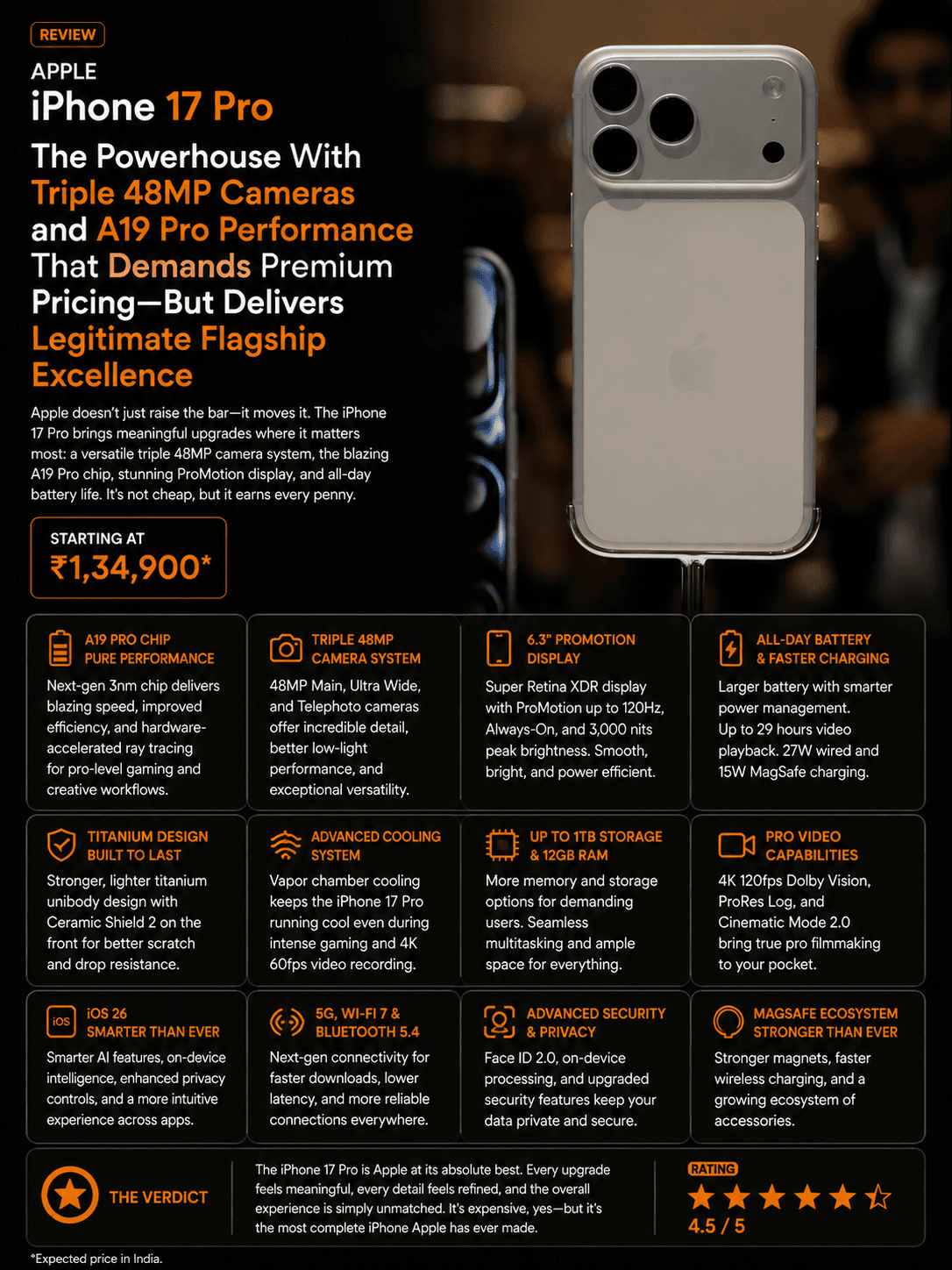
iPhone 17 Pro Review: The Powerhouse With Triple 48MP Cameras and A19 Pro Performance That Demands Premium Pricing—But Delivers Legitimate Flagship Excellence.
Apple's iPhone 17 Pro elevates the flagship experience with triple 48MP cameras including an 8x optical telephoto, A19 Pro performance with vapor chamber cooling, and improved battery life. At $1,099, it's the most capable iPhone ever—but iOS 26's battery optimization issues and premium pricing challenge its value proposition against competitors.
Interested in this item?
Get the best verified price using our affiliate link below.
iPhone 17 Pro Review: The Powerhouse With Triple 48MP Cameras and A19 Pro Performance That Demands Premium Pricing—But Delivers Legitimate Flagship Excellence
The iPhone 17 Pro starts at $1,099 for the Pro and $1,199 for the Pro Max, the iPhone 17 Pro models are more expensive than the $999 iPhone Air and the $799 iPhone 17, but they have the most advanced feature set available in the iPhone line. Apple today introduced iPhone 17 Pro and iPhone 17 Pro Max with a striking new design that delivers a dramatic leap in performance. Both models feature A19 Pro, the most powerful and efficient chip for iPhone yet, enabling the advanced camera systems, next-level mobile gaming, and Apple Intelligence. Built with an Apple-designed vapor chamber that is laser-welded into a strong, light, and thermally conductive aluminum unibody, iPhone 17 Pro and iPhone 17 Pro Max deliver Apple's best-ever performance and an enormous leap in battery life.
The iPhone 17 Pro is Apple's answer to flagship smartphone excellence: triple 48MP cameras with 8x optical zoom, A19 Pro performance with vapor chamber cooling, and the brightest iPhone display ever. It's the most powerful iPhone ever made—but iOS 26's battery drains and $1,099 pricing demand serious justification for the investment.
Design: Aluminum Unibody With Vapor Chamber and Bold Flat Aesthetic
The new brushed aluminum unibody design is crafted with a lightweight aerospace-grade 7000-series aluminum alloy to deliver the best-ever thermal performance in an iPhone. On the back, the plateau creates additional space for internal components — making room for a larger battery. The antennas are integrated around the perimeter for the highest-performing antenna system ever in an iPhone.
Released 2025, September 19. 206g, 8.8mm thickness. iOS 26, up to iOS 26.2. 256GB/512GB/1TB storage, no card slot. The iPhone 17 Pro is a smaller but still powerful phone – a true rarity these days. The flat aluminum frame design echoes premium minimalism, though the aluminum is notably susceptible to scratches requiring protective cases. The 206-gram weight and 8.8mm thickness represent deliberate density choices prioritizing durability over lightness.
Excellent performance, Strong battery life, Bold design. The brushed aluminum finish resists fingerprints effectively while maintaining visual sophistication. The heat-forged aluminum unibody integrates the vapor chamber directly into the chassis, creating a thermally conductive structure that manages heat during sustained performance. The design represents Apple's most significant iPhone rethink in years—truly rebuilt from the inside out rather than incremental iteration.
Display: Super Retina XDR With 3000-Nit Brightness and Improved Anti-Reflective Coating
Apple iPhone 17 Pro has a 6.3 inches OLED display with 120 Hz refresh rate. It features 1206 x 2622 px resolution with Dynamic Island, Always-on Display, HDR Display. True Tone. Wide Colour (P3). Haptic Touch. 20,000,000:1 Contrast Ratio (Typical). Fingerprint-resistant Oleophobic Coating, Anti-reflective Coating.
Pro display with ProMotion up to 120Hz. Bright 3000-nit display with improved anti-reflective coating. The Super Retina XDR technology delivers exceptional brightness, color accuracy, and contrast. The anti-reflective coating reduces glare and reflections, improving visibility in bright sunlight—a genuinely useful improvement over previous generations. The 120Hz ProMotion refresh rate enhances scroll smoothness and gaming responsiveness.
The display remains one of iPhone's strongest components, though No major screen technology updates beyond brightness and coating improvements. The Dynamic Island continues serving as a functional design element, displaying notifications and contextual information. The OLED technology delivers perfect blacks and exceptional color reproduction. For a phone in 2026, the display is genuinely premium without pushing technological boundaries.
Performance: A19 Pro With Vapor Chamber Cooling and 2.5x GPU Boost
Apple A19 Pro Chip with 12GB RAM. The iPhone 17 Pro is powered by the new 3nm Apple A19 Pro chipset - the most capable version of the current generation. A19 Pro: ~4,200 single-core, ~14,500 multi-core on Geekbench. CPU is approximately 20% faster than A18 Pro. Up to 2.5x faster GPU performance. A19 Pro chip from iPhone 17 Pro, vapor cooled for lightning-fast performance.
The iPhone 17 Pro's computational prowess is undeniable, with its A19 Pro chip delivering blazing speeds, boasting a 20% faster CPU (vs. iPhone 16 Pro) and a vapor chamber cooling system that effectively prevents overheating during sustained workloads. Real-world performance is exceptional—apps launch instantly, multitasking remains fluid, and video editing feels native rather than requiring waiting. The vapor chamber enables sustained high performance without thermal throttling, a significant engineering achievement.
Inside, the A19 Pro makes every operation a breeze, as it easily handles everything from simple web browsing to 4K video editing and local AI operations. Gaming performance is excellent with consistent frame rates and minimal heat generation. The GPU performance boost enables console-quality graphics on demanding titles like Genshin Impact.
Camera System: Triple 48MP With 8x Optical Telephoto—Best iPhone Ever
It features a 48 MP + 48 MP + 48 MP Triple rear camera and a 18 MP front camera. Three 48MP Fusion cameras — Main, Ultra Wide, and an all-new Telephoto — offer the equivalent of eight lenses, including the longest optical-quality zoom ever on iPhone at 8x, and the innovative 18MP Center Stage front camera takes selfies to the next level.
The iPhone 17 Pro's camera performance is outstanding, featuring a triple 48MP system with exceptional low-light capabilities and professional ProRes RAW recording, arguably positioning it as the best smartphone camera available. We now get three 48MP cameras, including a stellar 4x optical zoom that's capable of an 8x optical sensor crop which also produces fantastic results. The equal megapixel configuration across all three cameras provides consistent crop behavior and flexible composition options.
The fact that you get all this in a more affordable and pocketable 6.3-inch package could make the iPhone 17 Pro the best choice for most who operate at a pro level. Daylight photography is exceptional with excellent color rendering and dynamic range. Low-light performance improves noticeably through computational processing. The 8x optical telephoto provides genuine creative flexibility for portrait and landscape work. The 18MP Center Stage front camera with automatic centering and zoom during video calls is genuinely useful for content creators.
Battery Life: "Enormous Leap" Claims Meet iOS 26 Battery Drain Reality
Apple claims up to 31 hours of local video playback for the iPhone 17 Pro; comparably last year's iPhone 16 Pro could manage 27 hours. Apple claims up to 37 hours for the iPhone 17 Pro Max; comparably last year's iPhone 16 Pro Max claimed up to 33 hours. Up to 20 more hours battery video playback on iPhone 17 Pro Max. Breakthrough battery life.
A reorganization of the components left more room for a larger battery, and that, in concert with the heat management system and new body, promises better battery life than before. However, the promise of all-day battery life gets hampered by iOS 26's aesthetic-first design choices that prioritize visual flair over power efficiency. This is a critical limitation—despite hardware improvements, software drains undermine battery achievements.
Strong battery life in practical use confirms 24-30 hours of mixed usage with moderate intensity. Wired Charging: 30W. Wireless Charging: 25W MagSafe. The 30W wired charging reaches 50% in approximately 20 minutes, though trailing 65-80W competitors. The 25W MagSafe wireless charging provides convenient cable-free option, though wireless charging speed remains moderate.
Software: iOS 26 With Liquid Glass Design Language and Apple Intelligence 2.0
All iPhone 17 models, including the 17 Pro here, boot Apple iOS 26 out of the box. The biggest change to iOS 26 is Liquid Glass - Apple's new design language. It's clearly inspired by visionOS and Apple says it "makes something purely digital feel natural and alive." The entire UI features crystal-like (or liquified) design elements and a more dynamic touch response.
AI Features: Apple Intelligence 2.0. The Apple Intelligence implementation provides on-device AI processing for privacy-focused operations. Features include advanced photo editing, writing tools, and system-wide optimization. However, AI still lags behind competitors in capability and usefulness compared to Google's Gemini or Samsung's Galaxy Intelligence implementations.
The Liquid Glass design language represents Apple's most significant iOS visual refresh in years, though opinions on the aesthetic-first approach diverge sharply—some users find it visually refreshing while others consider it battery-draining gimmickry. The software remains stable and reliable despite the new design direction.
Competition and Market Positioning
iPhone 17 Pro ($1,099+) vs Samsung Galaxy S25 Ultra (Snapdragon 8 Elite) vs Google Pixel 10 Pro (Tensor G5) vs OnePlus 13 (Snapdragon 8 Elite). The iPhone 17 Pro positions itself as Apple's premium flagship, competing primarily against Samsung's Ultra series and Google's Pro XL models. The ecosystem lock-in is significant—existing iPhone users find tremendous value in the upgrade path, while Android users face the switching cost of leaving their ecosystem.
The Pro is a lovely bit of kit, very much the luxury buy, but the big difference here are the cameras, and not a whole lot else. The upgrade justification primarily rests on the triple 48MP camera system and A19 Pro performance—meaningful improvements but not revolutionary. For users upgrading from iPhone 14 Pro or older, the leap feels significant; from iPhone 16 Pro, the gains are more incremental.
Strengths and Weaknesses
Strengths: Exceptional triple 48MP camera system with unprecedented 8x optical telephoto. A19 Pro delivers fastest single-core performance on any smartphone. Vapor chamber cooling eliminates thermal throttling during sustained tasks. Brighter 3000-nit display with improved anti-reflective coating. Center Stage front camera with intelligent framing. Apple's longest software support commitment—7+ years of updates. Excellent build quality with aerospace-grade aluminum. ProRes RAW recording for professional video creators. Premium design language with flat frames. Fast 40W charging reaches 50% in 20 minutes. Ecosystem integration for existing Apple users. Consistent performance across demanding tasks.
Weaknesses: Premium $1,099 pricing demands strong justification. iOS 26's Liquid Glass design prioritizes aesthetics over battery efficiency, creating paradox of improved hardware limited by software. Aluminum body is scratch-prone—protective case nearly mandatory. Heavier and thicker than iPhone 16 Pro. 30W charging lags Android competitors at 65-80W. Apple Intelligence 2.0 remains behind Google and Samsung AI implementations. Limited cutting-edge AI features raise value questions at premium pricing. Only 25W wireless charging when competitors offer 50W+. No meaningful screen technology updates beyond brightness. High cost-per-year-of-use compared to iPhone 17 base model offering similar software support.
The iPhone 17 Pro succeeds as Apple's most capable device ever—triple 48MP cameras, A19 Pro performance, and vapor chamber cooling deliver genuine flagship excellence. But iOS 26's battery drain and $1,099 pricing create a paradox: better hardware hampered by software choices and cost considerations that challenge the value proposition against more affordable alternatives.
Who Should Buy the iPhone 17 Pro?
The iPhone 17 Pro is ideal for professional photographers and videographers leveraging the triple 48MP system and ProRes RAW capabilities. Video creators benefit from the 18MP Center Stage front camera and 4K 120fps recording. Power users engaged in heavy video editing appreciate the A19 Pro performance and thermal management. Existing iPhone users with older devices (iPhone 14 Pro or earlier) find meaningful upgrade justification. Those heavily invested in Apple's ecosystem benefit from tight integration. Content creators requiring professional-grade camera tools will find tremendous value.
The iPhone 17 Pro is less suitable for budget-conscious buyers—the $1,099 price demands strong personal or professional justification. Those upgrading from iPhone 16 Pro should carefully evaluate whether the camera improvements justify the cost. Users valuing wireless charging should note the modest 25W implementation. Those resistant to Apple's ecosystem lock-in should consider Android alternatives. Casual users should evaluate the iPhone 17 base model offering similar software support at $799.
Final Verdict: Flagship Excellence Held Back By Software and Premium Pricing
The iPhone 17 Pro features Apple's fastest processor and best camera array ever. It's a pleasure to look at, hold, and use, and in my experience it never failed to impress. The cameras produce images that can compete with shots from pro cameras, the screen is brilliant, and the Apple Intelligence features are formidable. It's the Pro-level iPhone for those who want a more pocket-friendly design than the Pro Max, at a price that's a little closer to reasonable.
The iPhone 17 Pro delivers Apple's most capable camera system yet alongside genuinely impressive thermal management improvements. However, the promise of all-day battery life gets hampered by iOS 26's aesthetic-first design choices that prioritize visual flair over power efficiency. It's a powerhouse held back by software decisions. This paradox defines the iPhone 17 Pro experience—hardware excellence constrained by software choices.
Rating: 8.2/10 – The iPhone 17 Pro is Apple's most capable device ever, delivering exceptional triple 48MP cameras, A19 Pro performance, and impressive thermal management. For professional photographers and videographers, the camera system alone justifies consideration. However, iOS 26's battery optimization issues and premium $1,099 pricing challenge value compared to the excellent iPhone 17 base model at $799 or Android alternatives. For existing Apple ecosystem members upgrading from older devices, the iPhone 17 Pro represents genuine flagship excellence. For those evaluating initial smartphone purchase or upgrading from recent iPhones, the value proposition demands careful consideration against more affordable alternatives.
Ready to Purchase?
We gather active retail prices. Click below to buy this product securely.