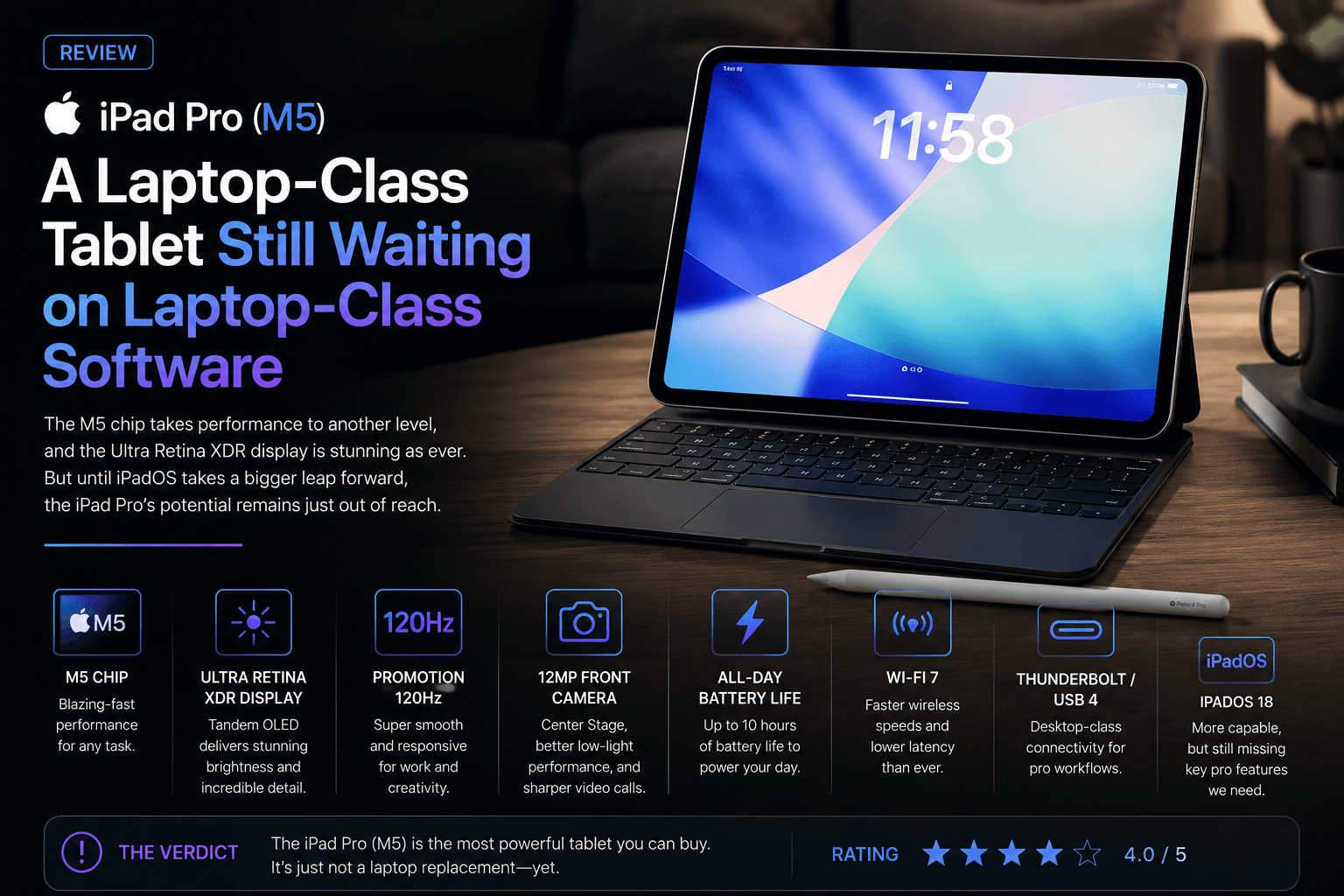
iPad Pro (M5) Review: A Laptop-Class Tablet Still Waiting on Laptop-Class Software.
Apple's M5 iPad Pro brings a faster chip, genuine fast charging, and improved battery consistency to an already excellent Tandem OLED design. It's an extraordinarily capable tablet, but for most buyers the real bottleneck remains iPadOS, not the hardware.
Interested in this item?
Get the best verified price using our affiliate link below.
Apple's iPad Pro has spent the past several generations quietly outgrowing the tablet category it technically belongs to, and the M5 refresh pushes that trend further than ever. Announced in October 2025 and now well into its market run, the iPad Pro (M5) pairs Apple's latest 3-nanometer chip with a stunning Tandem OLED display, genuine fast charging for the first time on any iPad, and a slimmer, lighter build. It's an extraordinary piece of hardware. The question, as it has been for years now, is whether iPadOS gives that hardware anywhere near enough to do.
The iPad Pro M5 is the most capable tablet Apple has ever built — the goalposts it keeps moving are for raw power and efficiency, not for what the software lets you actually do with them.
Design & Build Quality
At just 5.1mm thin, the iPad Pro remains a genuinely striking piece of industrial design, and the M5 generation carries that form factor forward with only minor internal revisions. It's available in 11-inch and 13-inch sizes, weighing 579 grams (Wi-Fi) for the larger model, and both feel remarkably light given their screen size. The four-speaker system punches well above what a device this thin should reasonably deliver, with surprisingly full, room-filling audio and a genuinely capable four-microphone array that holds up well on video calls. Thermal performance is another quiet strength — the passive cooling system keeps the tablet stable even through extended creative or gaming sessions without a fan.
Display
The new Tandem OLED panel, branded Ultra Retina XDR, is the headline hardware upgrade this generation, and it delivers true blacks, higher peak brightness, and excellent color accuracy across both sizes. The 13-inch model runs at 2752 x 2064 resolution with 120Hz ProMotion support, and the difference from the previous mini-LED panel is immediately noticeable in HDR content, gaming, and creative work, where contrast and color depth look meaningfully more immersive. OLED's inherent power efficiency also plays a role in the tablet's battery story, particularly when displaying darker interface elements.
Performance
The M5 chip is built on a more efficient 3nm process and, paired with up to 16GB of RAM on higher storage configurations, delivers performance that borders on excessive for anything most people will actually do on a tablet. In testing, the chip handled multi-stream ProRes video editing, running large language models locally, and heavy multitasking workflows without hesitation — the kind of headroom that makes the iPad Pro feel less like a tablet and more like a compact workstation. Apple has clocked the M5 slightly higher than the M4, which means peak performance draws more power under heavy load, so the efficiency gains are more about completing tasks with less energy than a dramatic overall reduction in consumption.
Battery Life & Charging
Apple rates the iPad Pro for up to 10 hours of web browsing or video playback, unchanged on paper from the M4 generation, though independent testing paints a slightly more nuanced picture. Standard usage, web browsing, and video streaming showed measurable improvement over the M4 model — outperforming even the Galaxy Tab S11 Ultra in some of those tests — while gaming battery life actually lagged behind both the previous iPad Pro and Samsung's tablet. Real-world testers reported a consistent 10 hours of use even with 5G active on cellular models, which is a strong result for a tablet this thin. The bigger story is charging: for the first time, the iPad Pro supports genuine fast charging, reaching 50% in roughly 30 minutes with a 40W Dynamic Power Adapter or any USB-C charger capable of 60W or more — a long-overdue addition that makes quick top-offs between sessions genuinely practical.
Connectivity
Cellular models gain Apple's new C1X modem, delivering up to 50% faster cellular data performance than the previous generation's modem while using up to 30% less power. For users who rely on always-on connectivity rather than hunting for Wi-Fi, that combination of speed and efficiency is a meaningful practical upgrade, even if it won't show up on a spec sheet the way the chip or display will.
Software Experience
This continues to be the iPad Pro's central tension. iPadOS 26 has brought genuine improvements to multitasking and window management, and for creative professionals working in apps built to take advantage of the M5's power — video editing, digital art, music production — the experience feels transformative compared to older iPads. But the operating system still doesn't fully unlock everything this hardware is capable of, and reviewers continue to note the peculiar mismatch between Apple's fastest-ever tablet chip and an OS that remains, in key respects, more restrictive than a laptop. Buyers coming from an iPad Pro (M4) are unlikely to find enough new here to justify upgrading; those coming from an older iPad or switching from Android are in for a far bigger leap.
Pricing
Following a price increase in June 2026, the 11-inch iPad Pro now starts at $1,199, while the 13-inch model starts at $1,499 — both figures $200 higher than at launch. Neither the Apple Pencil Pro nor the Magic Keyboard is included at that price, meaning a fully equipped setup for creative or productivity work pushes the total cost considerably higher. It's an expensive proposition, and one that increasingly invites comparison against Apple's own MacBook Air, which offers full desktop-class software for similar money.
Who Should Buy It
The iPad Pro (M5) is best suited to creative professionals working in video, photography, or digital art who can genuinely exploit the M5 chip's power, along with buyers upgrading from a significantly older iPad model who will notice every improvement immediately. It's a much harder sell for anyone whose daily workflow depends on desktop-class multitasking or file management, where a laptop remains the more practical tool, and for existing iPad Pro (M4) owners, for whom this generation offers relatively little reason to upgrade.
Final Verdict
The iPad Pro (M5) is, without much argument, the most capable tablet Apple has ever made — faster, more efficient, better connected, and finally equipped with the fast charging it should have had years ago. The hardware is essentially without peer in the tablet category. What keeps it from being an unambiguous recommendation for everyone is the same issue that's followed the iPad Pro for years: software that still hasn't fully caught up to what the silicon underneath it can do. For creative professionals who can put that power to work, it's an easy recommendation. For everyone else, it's worth asking honestly whether a less expensive iPad — or a MacBook Air — might actually suit your workflow better.
Ready to Purchase?
We gather active retail prices. Click below to buy this product securely.