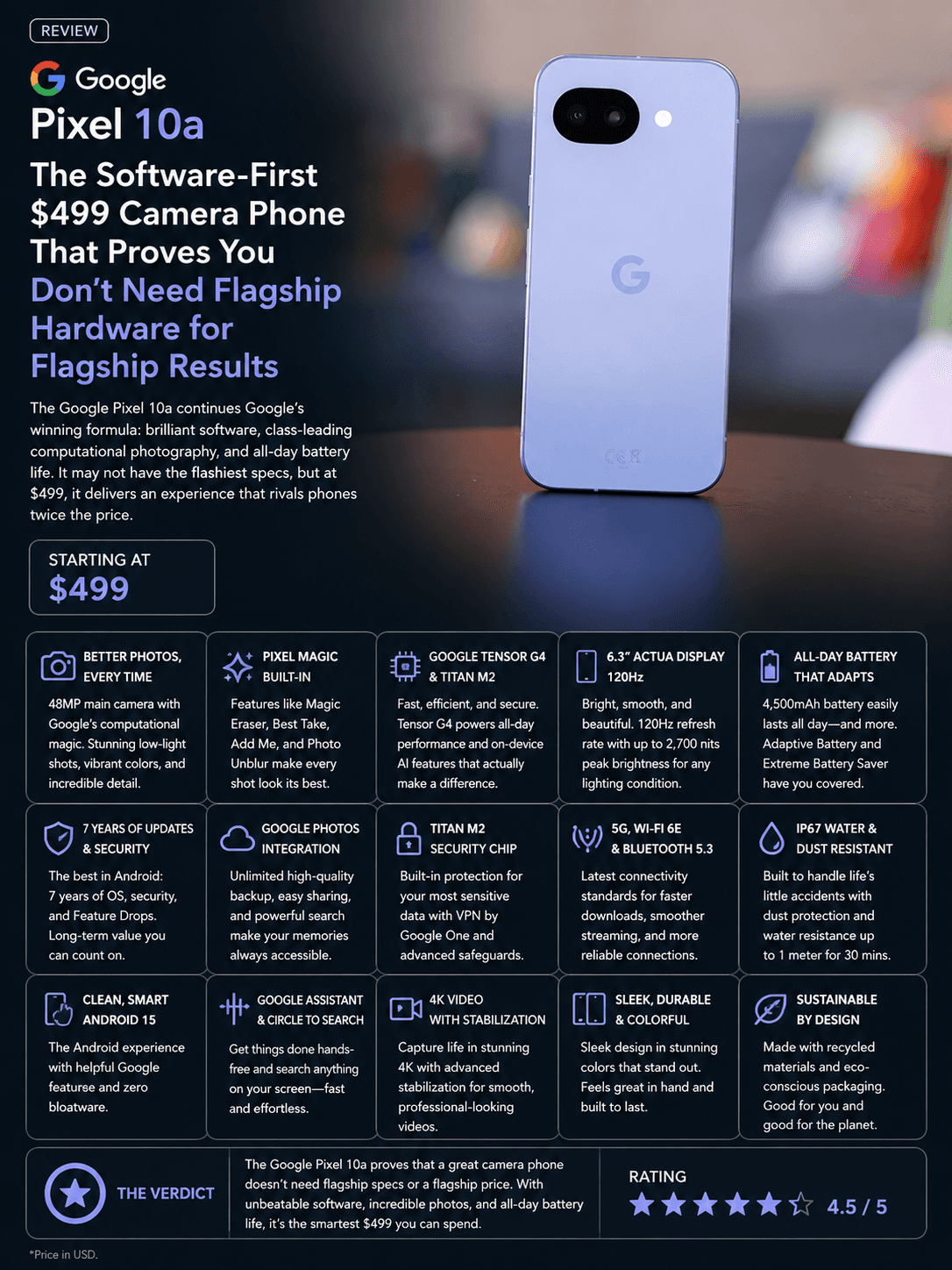
Google Pixel 10a Review: The Software-First $499 Camera Phone That Proves You Don't Need Flagship Hardware for Flagship Results.
Google's Pixel 10a doubles down on computational photography and seven-year software support while embracing the unchanged Tensor G4 processor and recycled camera sensors. For $499, it remains the best software experience in the Android segment, but limited AI features and slow charging reveal compromises.
Interested in this item?
Get the best verified price using our affiliate link below.
Google Pixel 10a Review: The Software-First $499 Camera Phone That Proves You Don't Need Flagship Hardware for Flagship Results
Google Pixel 10A is a 5G Android 16 Smartphone powered by Google Tensor G4 with 8 GB RAM and 128 GB storage, launched February 18, 2026, and available from March 5, 2026. Price starts at $489 in United States. The Google Pixel 10a sticks to the tried-and-tested Pixel A-series formula, with some welcome refinements to the design. The result is a compact, handy phone with a clean display, a reliable camera system, solid battery life, and the best software. In an era where smartphone makers obsess over specifications, Google's willingness to repeat hardware while obsessing over software represents a deliberately unconventional philosophy.
The Pixel 10a is Google's answer to a profound question: what if we stopped chasing hardware specifications and instead invested everything into software optimization, AI integration, and computational photography? Seven years of updates and the Tensor G4 prove that this philosophy can deliver exceptional value at $499.
Design: Flat, Flush, and Uncompromisingly Practical
The Pixel 10a brings a completely flush design in fun colors, great display for most tasks, and two flexible cameras. The flat frame design echoes premium flagship aesthetics while maintaining everyday practicality. The device comes completely flat, pocket-friendly design, representing a refreshing rejection of unnecessary curves and premium materials that add nothing functional.
The Pixel 10a is available in four colors–Lavender (a light purple), Berry (red/pink), Fog (a light green/gray), and Obsidian (black). Google has also emphasized sustainability in the Pixel 10a's design. The handset uses recycled cobalt, copper, gold and tungsten, along with a recycled aluminum frame and plastic back. The color palette is distinctive and expressive without being garish. The recycled materials represent Google's commitment to environmental responsibility.
The 6.3-inch display is protected by Gorilla Glass 7i, and the phone maintains IP68 water resistance rating. The completely flush rear camera module eliminates the typical camera bump, creating a genuinely elegant appearance. At 215 grams with an 8.5mm profile, the phone remains remarkably portable for its 5,100mAh battery. The design language prioritizes practicality over aesthetic excess.
Display: Bright Actua Panel That Remains Excellent
The 6.3-inch 60–120Hz Actua pOLED display reaches a claimed 3,000 nits peak brightness and is protected by Gorilla Glass 7i. The bright display remains excellent, with great viewing angles indoors and outdoors. The Actua display technology provides genuine improvements in outdoor visibility compared to standard OLED implementations.
The Bright Actua display delivers excellent outdoor visibility. The 120Hz refresh rate ensures smooth scrolling and responsive animations, though the adaptive refresh rate intelligently drops to lower frequencies during static content to preserve battery life. The 1080x2424 resolution provides crisp visuals with approximately 460 PPI density. The pOLED technology delivers perfect blacks and vibrant colors characteristic of OLED panels.
Slightly dimmer screen compared to some competitors, though outdoor visibility remains excellent in most conditions. The display represents practical excellence—not cutting-edge, but sufficient for everything except demanding games or professional color work. The flat bezels add visual sophistication without functional drawback.
Performance: Two-Year-Old Tensor G4 Proves Longevity
Google Pixel 10A is powered by Google Tensor G4 with 8 GB RAM and 128 GB storage. The Tensor G4 chip remains a limiting factor for raw performance. But for the right buyer, neither of those will be a deal-breaker. The processor represents a deliberate choice to prioritize software optimization and power efficiency over benchmark numbers.
Google's Tensor processors have long lagged behind the industry's best in CPU/GPU performance terms, where they've excelled has been in battery life. This isn't a power-hungry chip and that Google would have optimised it well over the past two years. Everyday performance is smooth and responsive—messaging, social media, video streaming, and web browsing all perform without lag. The 8GB RAM configuration is restrictive by 2026 standards but sufficient for everyday use.
Gaming performance is adequate, though gaming is still slow by 2026 standards. Casual gaming titles run acceptably, but demanding games will show compromises. The real strength is longevity—Google's software optimization ensures the Tensor G4 will remain relevant through seven years of OS updates.
Camera System: Computational Photography Over Hardware Specs
The Pixel 10a camera setup includes a Main camera: 48MP, f/1.7, Quad PD Dual Pixel, 1/2-inch image sensor size, Optical + electronic image stabilization. Ultra-wide camera: 13MP, f/2.2, 120-degree field of view, 1/3.1-inch image sensor size. Selfie camera: 13MP. Unfortunately, Google hasn't planned a camera upgrade for the Pixel 10a. We're seeing the same camera system as on the Pixel 9a.
The Pixel 10a continues Google's focus on photography, featuring a 48-megapixel main camera and a 13-megapixel ultrawide lens, supported by software tools such as Night Sight and Macro Focus. Google's A-series devices have built a reputation for delivering strong camera performance relative to price, relying heavily on software-driven image processing and AI enhancements. You get Gemini and Gemini Live, Add Me in camera, photo editing via text prompts in Google Photos, and Auto Best Take — a useful set, even if it's not the complete picture.
Best-in-class computational photography and Excellent primary camera performance. Daylight photos are sharp and detailed with natural color reproduction. The Night Sight mode delivers impressive low-light performance through aggressive computational photography. The lack of a telephoto lens is noticeable for portrait work, though the software handles zoom adequately through cropping.
Battery Life: Over 30 Hours With Intelligent Optimization
The Pixel 10a introduces Satellite SOS support to the A-series for the first time, allowing users to contact emergency services even without cellular coverage. Google claims over 30 hours of battery life. In practical usage, the Pixel 10a performs very well. Smart Battery Optimization: Google's software optimization helps reduce unnecessary background drain. Over time, adaptive battery learning improves efficiency even further.
The 5,100mAh battery carries over from the Pixel 9a, which comfortably lasted a full day in testing. Battery life here on the Pixel 10a is similarly reliable. The phone can comfortably get through a full day, leaving enough in the tank to last overnight. Real-world usage confirms the battery easily lasts through a full day of moderate use, with significant charge remaining. Adaptive Battery learns usage patterns and prioritizes power for frequently used apps.
The 5,100mAh typical battery supports up to 50% charging in about 30 minutes with a compatible 45W USB-C PPS charger. However, charging speed remains frustratingly slow by 2026 standards. The charging implementation is conservative—the 45W capability exists but charging from 0-100% takes approximately 60-70 minutes. Wireless charging is absent despite the premium positioning.
Software Experience: The Industry's Cleanest and Most Future-Proof
The slickest software experience in the Android space. The software experience is clean, you're the first to get new features, the battery lasts incredibly well, and the cameras remain great. Android 16 desktop mode is clutch, representing a genuinely useful feature for productivity enthusiasts. The desktop mode transforms Android into a desktop operating system when connected to external displays—a powerful feature for remote work.
Seven years of updates represents the industry's cleanest Android experience available. The phone is still one of the best experiences at this asking price. You're the first to get new features, and the cameras remain great – with the only real downside being a lack of any dedicated telephoto lens. Google promises Android updates through at least 2033—extraordinarily rare commit at any price point.
As brands search for ways to introduce more artificial intelligence (AI) features and services, Google's approach ends up much cleaner, as Gemini (Google's AI solution) is integrated across Android. The integration feels native rather than bolted-on, with Gemini assistance available across the OS without requiring separate applications. However, Key AI features locked out due to RAM constraints—on-device features like Advanced Magic Eraser require 12GB RAM unavailable on the 10a.
Competition and Market Positioning
The only $500 phone you should buy in 2026. At its full retail price of $650, I don't think it's worth an extra $150 over the Pixel 10a. The Pixel 10a competes against OnePlus Nord CE6, Motorola Edge 70 Fusion, Samsung Galaxy A57, and Xiaomi Redmi Note 15 Pro. The seven-year software commitment and computational photography prowess differentiate it from competitors.
Still manages a longer battery life, more AI features, and a new desktop mode that keeps it the champion of value phones for just $499. Google's positioning as the software-first value champion differentiates it from competitors emphasizing hardware specifications or display technology.
Strengths and Weaknesses
Strengths: Seven years of OS and security updates—industry-leading commitment. The cleanest, bloatware-free Android experience available. Excellent computational photography and Night Sight low-light performance. Bright Actua display with excellent outdoor visibility. Completely flush camera design is elegant and practical. Helpful Gemini AI integration throughout the OS. Strong battery life with intelligent optimization. IP68 durability provides practical protection. Satellite SOS for emergency communication without cellular. Desktop mode for productivity workflows. Recycled materials demonstrate environmental commitment. Compact and portable design despite 5,100mAh battery. Fast initial setup and updates.
Weaknesses: The Tensor G4 is two years old and shows in raw performance benchmarks. Only 8GB RAM limits multitasking and future-proofs longevity. Slow 45W charging for a 5,100mAh battery—takes 60-70 minutes full charge. No wireless charging despite premium software experience. Identical camera sensors to Pixel 9a released in 2024. No dedicated telephoto lens for portrait zoom. Key AI features locked out due to RAM constraints. Thick bezels diminish visual modernity. Slippery back panel requires protective case. No microSD card expansion. Limited gaming performance for demanding titles. Older display technology compared to AMOLED competitors at similar prices.
The Pixel 10a succeeds because Google understands that software, photography, and longevity matter more than benchmark numbers. The unchanged Tensor G4 and recycled camera sensors aren't laziness—they're confidence that optimization beats hardware specifications.
Who Should Buy the Google Pixel 10a?
The Pixel 10a is ideal for users prioritizing software experience, photography, and long-term support over hardware specifications. Google loyalists appreciate the philosophy of incremental software improvement over hardware chasing. Photography enthusiasts leveraging computational photography will find the camera system compelling. Students seeking a reliable phone that will receive updates for seven years benefit from the longevity commitment. Productivity users appreciate desktop mode integration. Those valuing privacy and bloatware-free Android will find Google's approach appealing.
The Pixel 10a is less suitable for gamers demanding strong performance. Users requiring ultra-rapid charging should evaluate alternatives. Those needing expandable storage will be disappointed. Photography professionals requiring dedicated telephoto lenses will find limitations. Power users demanding maximum RAM need more capable configurations. Those refusing to use protective cases should avoid the slippery back.
Final Verdict: The Software-First Philosophy Proven
The lack of change might seem disappointing, but this phone is still one of the best experiences at this asking price. Still one of the best mid-range Android phones. The Pixel 10a doesn't bring many upgrades over the Pixel 9a, but it still delivers where it matters most: a comfortable design, strong battery life, a bright display, and a dependable camera.
The Pixel 10a sticks to the tried-and-tested Pixel A-series formula, with some welcome refinements to the design. For the right buyer, neither of those will be a deal-breaker. Google's willingness to repeat hardware while obsessing over software represents a mature understanding of diminishing returns in specification chasing. The Tensor G4 proves that consistent optimization beats annual processor upgrades for real-world experience.
Rating: 8.1/10 – The Google Pixel 10a is a software-first triumph that proves Google's philosophy: exceptional software, seven-year longevity, and computational photography matter infinitely more than hardware specifications. The unchanged Tensor G4, recycled camera sensors, and weak charging are genuine compromises, but they're reasonable sacrifices for the industry's longest OS support commitment and cleanest Android experience. At $499, the Pixel 10a remains one of 2026's best value propositions for anyone prioritizing reliability, software quality, and photography over gaming performance and premium materials. For users upgrading from older Pixel devices or switching from aging Android phones, the seven-year commitment alone justifies the purchase.
Ready to Purchase?
We gather active retail prices. Click below to buy this product securely.