Google Pixel 10 Pro XL Review: The Most Complete Pixel Yet, With One Familiar Catch.
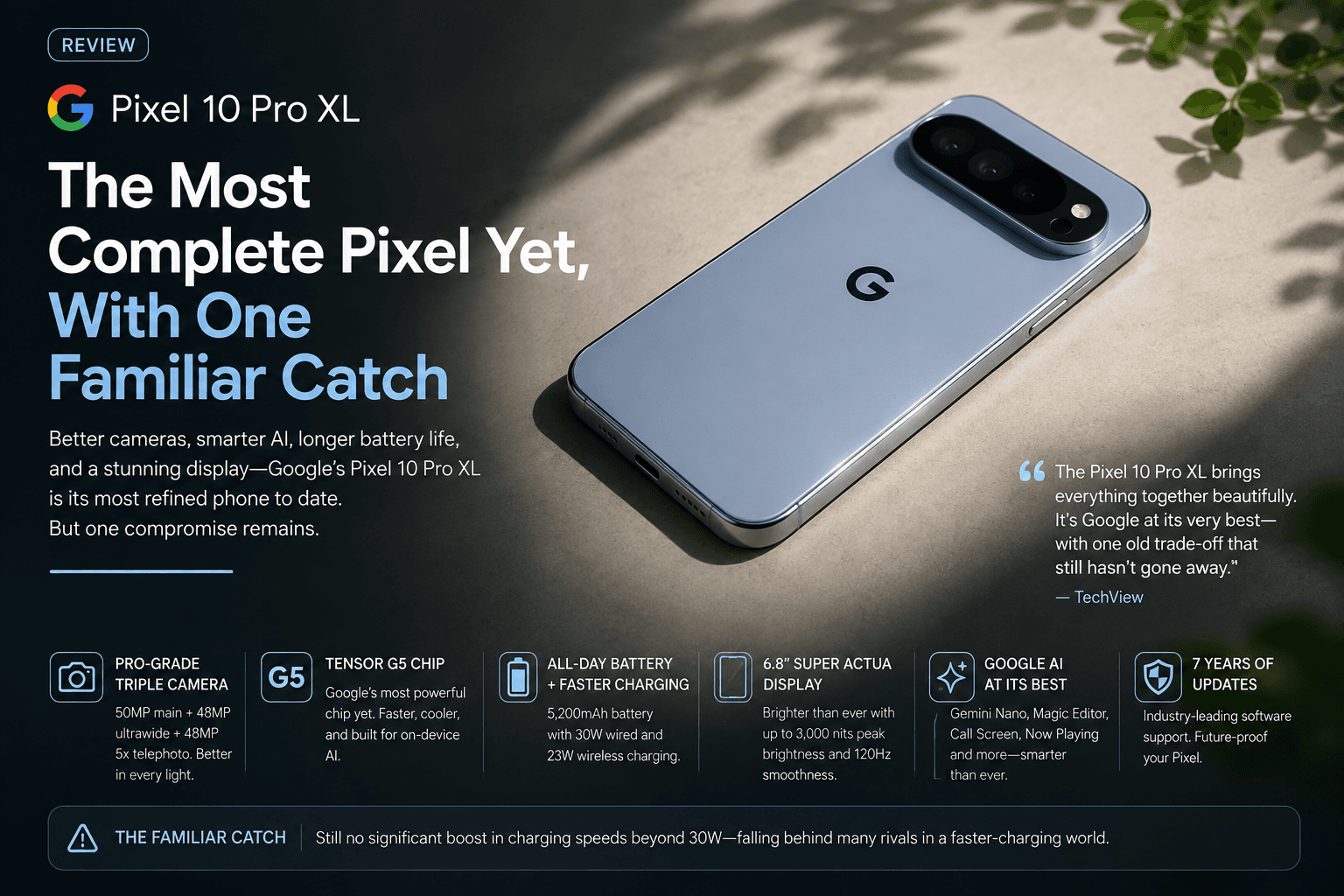
The Google Pixel 10 Pro XL refines an already excellent formula with Qi2 magnetic wireless charging, a stronger telephoto camera, and a genuinely useful AI feature set. It's Google's most polished flagship in years, held back mostly by its high starting price and a Tensor chip that still trails rivals on raw benchmarks.
Interested in this item?
Get the best verified price using our affiliate link below.
Google's Pixel 10 Pro XL doesn't try to win the smartphone conversation with a headline-grabbing redesign. Instead, it takes the camera-bar aesthetic introduced with the Pixel 9 series and quietly refines nearly everything underneath it — chip, cameras, charging, and software — into what several reviewers now consider the most complete Pixel Google has ever shipped. After extended testing, that assessment largely holds up, though the phone's asking price and Tensor chip's benchmark standing remain the two sticking points worth understanding before buying in.
The Pixel 10 Pro XL isn't chasing spec-sheet supremacy — it's chasing a coherent, dependable experience, and for the first time in years, it largely gets there.
Design & Build Quality
Visually, the Pixel 10 Pro XL sticks closely to the floating, curved camera bar design introduced with the Pixel 9 series, with only minor iterative tweaks this generation. That continuity might disappoint anyone hoping for something visually new, but it's hard to argue with the decision — the design remains one of the more distinctive and well-regarded in the Android space. Build quality is solid throughout, with Gorilla Glass Victus 2 on the back and an IP68 rating for dust and water resistance. At 232 grams and with dimensions of roughly 162.8 x 76.6 x 8.5mm, it's a large phone, squarely aimed at buyers who want maximum screen real estate.
Display
The 6.8-inch AMOLED panel remains one of the best in the business, with reviewers praising its rich colors and excellent fine detail. Google has nudged peak brightness slightly higher than the already industry-leading levels of the previous generation, an improvement that's most noticeable in direct sunlight. By default, the display runs at a lower 1080 x 2404 resolution to conserve battery, a strategy that proved effective in testing without any real loss in perceived sharpness for most day-to-day use — though users who want maximum resolution can switch it manually.
Performance
The new Tensor G5 chipset headlines the internal changes, though as has been the case for several Pixel generations, it isn't a chip built to top raw benchmark charts against Qualcomm or Apple silicon. Day-to-day performance is smooth and responsive for typical use — browsing, messaging, social media, and moderate multitasking all feel fluid — but demanding games and sustained heavy workloads can expose the chip's limitations more than on Snapdragon-powered rivals. Where the Tensor G5 does shine is in on-device AI processing, which underpins many of the Pixel's signature software features and remains a genuine strength of the platform.
Cameras
Camera performance continues to be the Pixel line's calling card, and the 10 Pro XL builds on that reputation with a quietly upgraded telephoto lens alongside its 48MP supporting sensors. The 5x optical zoom delivers genuinely usable reach for everyday shooting, while the phone's 100x digital zoom is better suited to occasional framing shots than preserving fine detail — a realistic assessment that matches how most users will actually use it. Video capability extends to 8K recording at 30fps and 4K at 60fps, with the 1080p mode reaching a smooth 240fps for slow-motion capture. The 42MP front camera holds up well for both vlogging and video calls, rounding out a camera system that reviewers consistently rank among the best on any current smartphone.
Battery Life & Charging
The 5,200mAh battery represents only a modest capacity bump over last year's model, and its impact on longevity has been described by some reviewers as debatable in direct generational comparisons. That said, real-world impressions have generally been positive: multiple testers reported the phone comfortably lasting a full day of heavy use, with some estimates ranging from 18 to 24 hours depending on usage intensity. Historically, Tensor-powered Pixels have trailed the best iPhones and Samsung flagships on pure battery endurance, and that pattern persists here, though it's no longer the liability it once was. The bigger news is charging: 45W wired charging can reach roughly 70% in about 30 minutes, and the phone introduces Qi2 wireless charging with embedded alignment magnets — Google's answer to MagSafe — enabling easier accessorizing and 25W wireless charging speeds.
Software Experience
This remains one of the Pixel's strongest selling points. The software is clean, free of bloatware, and backed by Google's industry-leading update commitment — seven years of both Android OS and security updates, a figure that now matches or exceeds most competitors. AI features are woven throughout the experience in ways that feel genuinely useful rather than gimmicky, from Circle to Search to computational photography tools like Best Take and Zoom Enhance. A minor but persistent frustration noted by longtime users is that focus modes still don't sync reliably across Pixel devices, a small inconsistency in an otherwise cohesive software ecosystem.
Competition
Positioned against the Samsung Galaxy S26 Ultra, the Pixel 10 Pro XL trades Samsung's S Pen versatility and marginally stronger raw performance for a cleaner software experience and what many consider a more consistently excellent camera system, particularly for computational photography. Against the Xiaomi 17 Ultra, the Pixel can't match the camera versatility or charging speed, but it counters with far better software longevity and none of the import complications tied to buying a phone not officially sold in certain markets. For buyers already invested in the Google ecosystem, or those who prioritize a clean, AI-forward Android experience above all else, it remains a compelling, if not unbeatable, option.
Who Should Buy It
The Pixel 10 Pro XL is best suited to buyers who want a large-screen flagship with a best-in-class camera and clean, bloatware-free software, particularly those already using other Google services and devices. It's a strong pick for anyone prioritizing long-term software support over having the absolute fastest chip on the market. It's a tougher recommendation for mobile gamers or anyone who regularly pushes sustained heavy workloads, where Snapdragon-powered rivals still hold a performance edge.
Final Verdict
The Google Pixel 10 Pro XL doesn't win on any single dramatic new feature, but the sum of its quiet refinements — a stronger telephoto camera, Qi2 magnetic charging, improved battery consistency, and continued software polish — adds up to what several reviewers now call the most complete Pixel to date. It isn't cheap, and the Tensor G5 chip still won't top a benchmark chart, but for buyers who value camera quality, clean software, and long-term support over raw specs, it remains one of 2026's easiest flagships to recommend.
Ready to Purchase?
We gather active retail prices. Click below to buy this product securely.