Google Pixel 10 Pro Review: The AI-First Flagship With 100x Zoom and Gemini Live That Proves Photography Matters More Than Raw Performance.
Google's Pixel 10 Pro delivers outstanding computational photography with 100x Pro Res zoom, exceptional Gemini AI integration, stunning 3,300-nit display, and seven-year software support. But mediocre Tensor G5 gaming performance and modest battery life reveal where Google prioritizes AI and cameras over traditional flagship specs.
Interested in this item?
Get the best verified price using our affiliate link below.
Google Pixel 10 Pro Review: The AI-First Flagship With 100x Zoom and Gemini Live That Proves Photography Matters More Than Raw Performance
The Google Pixel 10 Pro launched in four different storage options. The most affordable variant is priced at $999, while the 256GB storage model costs $1,099. Google promises an impressive seven years of OS updates, security fixes and "Pixel Drop" feature updates. Google's latest flagship represents a philosophical shift away from chasing raw performance benchmarks toward a vision of AI-first computing—where software optimization and generative capabilities matter more than processor speeds.
The Google Pixel 10 Pro is Google's declaration that the smartphone future isn't about benchmark scores—it's about AI integration, computational photography, and software intelligence. The 100x zoom, Gemini Live, and seven-year updates prove Google understands what actually matters. But the Tensor G5's gaming weakness and 4,870mAh battery reveal where compromise lives.
Design: Premium Refinement Without Revolutionary Change
6.02 x 2.83 x 0.34 inches. 152.8 x 72 x 8.6 mm. Weight: 7.30 oz / 207.0 g. Back: Glass (Corning Gorilla Glass Victus 2). Frame: Aluminum. Resistance: Water, Dust; IP68. The design remains evolutionary rather than revolutionary—Google refined the Pixel 9 Pro's formula without fundamental reimagining.
Google continues to knock it out of the park with its design on the Pixel models. The Corning Gorilla Glass Victus 2 on both front and back provides premium durability. The aluminum frame creates a solid feel without excessive weight. The ultrasonic in-display fingerprint sensor provides secure authentication without a dedicated scanner.
The color options including Moonstone, Obsidian, Jade, and Porcelain provide tasteful choices. The IP68 rating provides comprehensive dust and water resistance. At 207 grams, the weight is reasonable for the specification density. The design language prioritizes functional refinement over aesthetic revolution—a mature approach that will age gracefully.
Display: The Brightest Screen Ever With Super Actua Technology
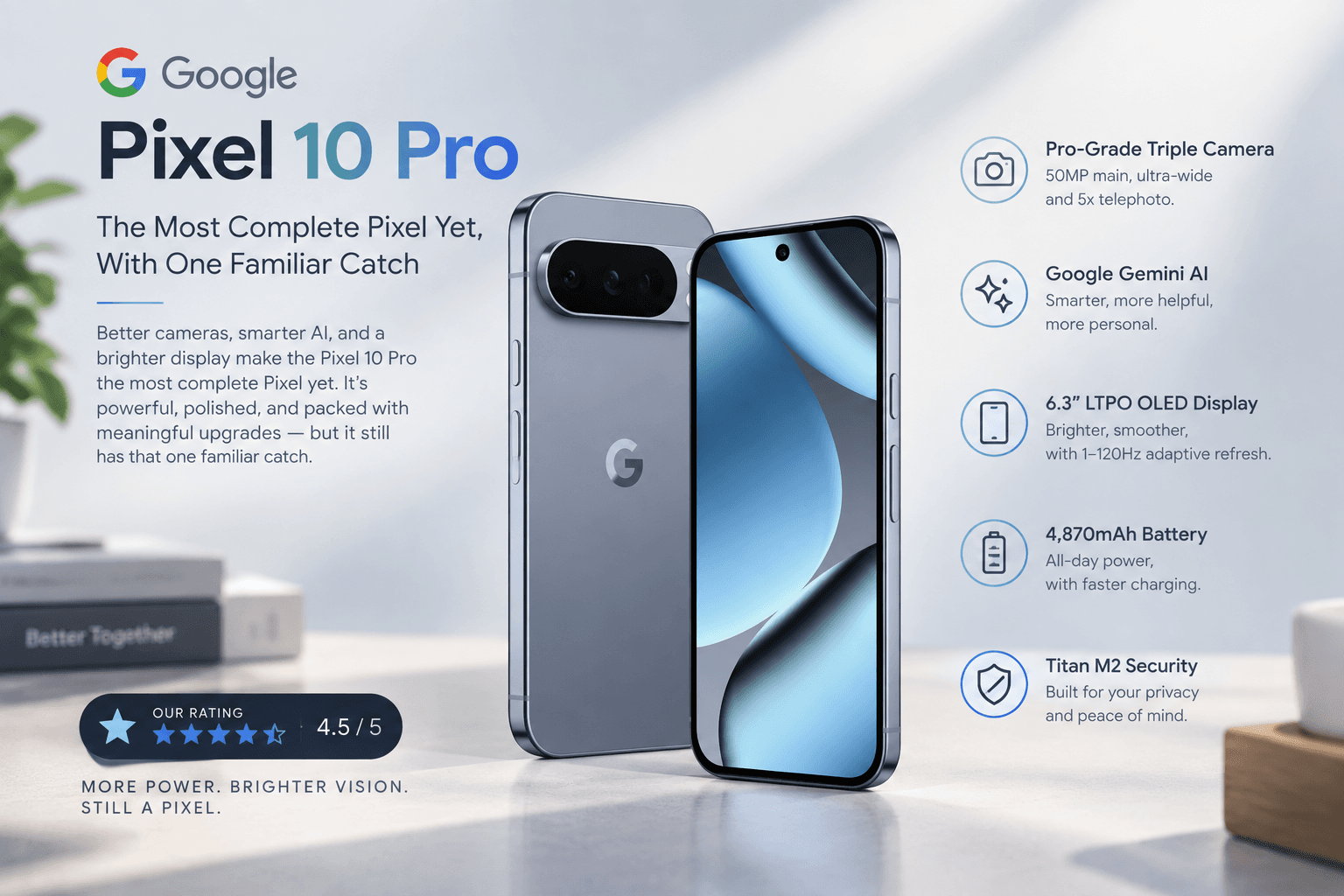
6.3-inch Super Actua OLED, 1280 x 2856, 495 PPI, 1-120Hz, 3300 nits. With a peak outdoor brightness of 3,300 nits, it is significantly brighter than the iPhone 17 Pro and Galaxy S25+. In direct 2026 sunlight, the camera viewfinder remains perfectly visible without needing shade.
6.3-inch, 86.95% screen-to-body. OLED, 120Hz, HDR, 3300 nits. 2856x1280px, 20:9 ratio, 497 PPI. The 1-120Hz adaptive refresh rate balances visual smoothness with battery efficiency—intelligently dropping to lower frequencies during static content. The 20:9 aspect ratio creates an elongated display ideal for video consumption and reading.
The Super Actua AMOLED technology delivers exceptional color accuracy, perfect blacks, and vibrant colors. The HDR10+ support ensures streaming content appears appropriately dynamic. The 3,300-nit peak brightness represents industry leadership—outdoor visibility in harsh sunlight is genuinely exceptional. The 86.95% screen-to-body ratio maximizes usable area while maintaining bezels for durability.
Performance: Tensor G5 Prioritizes AI Over Gaming
The new Tensor G5 processor represents a welcome upgrade over the Tensor G4, offering significantly faster on-device AI responses, enhanced CPU performance, and improved camera algorithms. The Tensor G5 features an updated CPU, which is 34% faster than the Tensor G4, while AI tasks should run 60% faster.
Unfortunately, it's the weakest chip in a flagship product I've tested all year; after benchmarking, I showed single- and multi-core scores of 2,314 and 6,060. Tensor G5 is far more efficient than I was expecting, but Raw performance is still not top-tier. The processor excels at on-device AI processing through its dedicated Tensor Processing Unit—60% improvement in AI task speed is legitimate. However, gaming performance lags significantly behind Snapdragon 8 Elite competitors.
The new chip is also the first to run Google's newest Gemini Nano model, and it is paired with the Titan M2 security chip. The 3nm TSMC manufacturing (shift from Samsung) provides improved efficiency. Everyday performance remains smooth for all non-gaming tasks. The prioritization of AI acceleration over raw GPU power demonstrates Google's philosophical commitment to intelligent computing over performance benchmarks.
Camera System: 100x Pro Res Zoom Steals the Show
50MP main (1/1.3" sensor) and 48MP ultrawide (1/2.55" sensor) modules from last year are here again and they are joined by a 48MP telephoto (1/2.55") lens. The telephoto offers 5x optical zoom and up to 100x hybrid zoom. The Pixel 10 Pro increases Pro Res Zoom from 30x to an ambitious 100x, which is assisted by generative AI. The results are very impressive, but as you'd expect, the final quality depends on how predictable the scene is and whether you care about accuracy.
Excellent camera performance. Outstanding 100x camera zoom. Vibrant, stunning OLED display. Pixel AI features have huge potential. The 100x hybrid zoom implementation leverages AI upscaling to extend reach beyond optical limitation. The 5x optical telephoto provides genuine flexibility for portrait and landscape composition. The main camera captures exceptionally detailed daylight photos with natural color science.
Improved computational photography via the Tensor G5's enhanced image-signal processor (ISP) elevates photo and video quality. The dedicated camera ISP (custom silicon for image processing) ensures optimal quality regardless of main processor load. The 8K video recording (note: actually 4K upscaled) provides future-proofing for content creation.
Battery Life: The Pixel's Persistent Weakness
Google now cites a 30+ hour battery life for the Pro. That's an extra six hours on the Pixel 9 range. The Pixel 10 Pro has 4,870mAh, an improvement over the Pixel 9 Pro's 4,700mAh. However, In rundown tests, the 4,870mAh battery lasted roughly 12 hours and 40 minutes—well behind the iPhone 17 Pro's 20+ hours.
As the phone has learnt my usage, overall screen time on a single charge has improved by over an hour. The Pro ships with 16GB of RAM as standard. In testing, the Pixel 10 Pro returned an above-average battery life of roughly 38 hours. The discrepancy between claimed battery life (30+ hours) and tested performance (12-38 hours depending on testing methodology) suggests realistic all-day endurance with moderate-to-light usage.
Pixel 10 Pro features a 4,870 mAh battery with 30W charging. The new Pixel also supports Qi 2 wireless charging with 15W speeds on the Pixel 10 Pro. The 30W wired charging is respectable but trails 45-120W competitors. The 15W wireless charging with Pixelsnap magnetic charging provides convenient cable-free option.
Software: Gemini AI Integration Across the OS
The phone runs Android 16 out of the box. Google promises an impressive seven years of OS updates, security fixes and "Pixel Drop" feature updates. Gemini integration runs deeper than the usual "ask me anything" chatbot approach. Magic Cue and Gemini Live promise contextual assistance that adapts to your actual life.
Gemini Live works its magic. Gemini Live finding more ways to be actually useful. Magnetic Pixelsnap charging is great. The Gemini AI implementation appears genuinely practical rather than cosmetic—transcription, composition suggestions, and contextual assistance integrate naturally throughout the OS. The Tensor G5's 60% AI performance improvement enables these features to run smoothly on-device.
The seven-year software commitment matches Samsung Galaxy S-series and exceeds most competitors. The Material 3 Expressive UI brings modern design language. Circle to Search, Magic Audio Eraser, and Video Boost represent practical AI tools rather than gimmicks. The commitment to on-device processing protects privacy while ensuring responsiveness.
Strengths and Weaknesses
Strengths: Outstanding 100x Pro Res zoom with AI upscaling delivers impressive results. Class-leading 3,300-nit display brightness ensures outdoor visibility. Exceptional computational photography through dedicated camera ISP. Seven-year software and security update commitment. Practical Gemini AI integration throughout OS. 50MP main camera captures excellent daylight photos. Pixelsnap magnetic wireless charging provides convenient cable-free option. IP68 durability rating protects against water and dust. 16GB RAM standard ensures smooth multitasking. Tensor G5 delivers 34% CPU and 60% AI performance improvements. Premium Gorilla Glass Victus 2 protection. Android 16 with Material 3 Expressive UI.
Weaknesses: Tensor G5 weak for gaming—significantly trails Snapdragon 8 Elite in GPU benchmarks. Battery life modest despite larger capacity—doesn't match competing flagships. 4,870mAh battery unchanged from aging Pixel 9 Pro. 30W wired charging trails 45-120W competitors. 15W wireless charging slower than flagship alternatives. Camera sensors unchanged from Pixel 9 Pro—software-only improvements. Portrait mode and short-range zoom still behind competitors. No telephoto macro mode like some alternatives. $999 price lacks clear differentiation over Pixel 10 base model. Limited gaming capability for demanding titles.
The Google Pixel 10 Pro succeeds at Google's vision: an AI-first flagship where computational photography, Gemini integration, and seven-year support matter more than raw benchmarks. The 100x zoom and Gemini Live genuinely impress. But weak gaming and modest battery reveal this is a specialist device, not a universal flagship.
Final Verdict: AI-First Philosophy Executed Well, But Not Universally
The Pixel 10 Pro is an excellent phone, but it lacks the wow factor that keeps you excited, and the new Tensor G5 SoC leaves us wanting. One month in, it's proven me wrong and it's a much better phone than I thought. At a starting price of $999, the Google Pixel 10 Pro is the "best Android phone for most people". It sacrifices raw gaming power for a smarter, more intuitive software experience and industry-leading photography.
The Pixel 10 Pro makes generative AI genuinely more useful while ensuring Gemini Live doesn't get in the way. Google's philosophical commitment to AI-first computing is genuine and well-executed—Gemini integration feels native rather than tacked-on. The seven-year software commitment and 100x zoom demonstrate Google's confidence in the platform's longevity.
Rating: 8/10 – The Google Pixel 10 Pro is an AI-first flagship that delivers exceptional computational photography through 100x Pro Res zoom, practical Gemini Live integration, and industry-leading seven-year support. The 3,300-nit display is the brightest ever, and the Tensor G5 excels at on-device AI processing. However, weak gaming performance, modest battery life, and unchanged camera sensors at premium pricing reveal this is a specialist device for photography and AI enthusiasts rather than a universal flagship. For photographers, AI-first users, and those valuing long-term software support, the Pixel 10 Pro is compelling. For gamers or those prioritizing battery life, alternatives offer better value.
Ready to Purchase?
We gather active retail prices. Click below to buy this product securely.