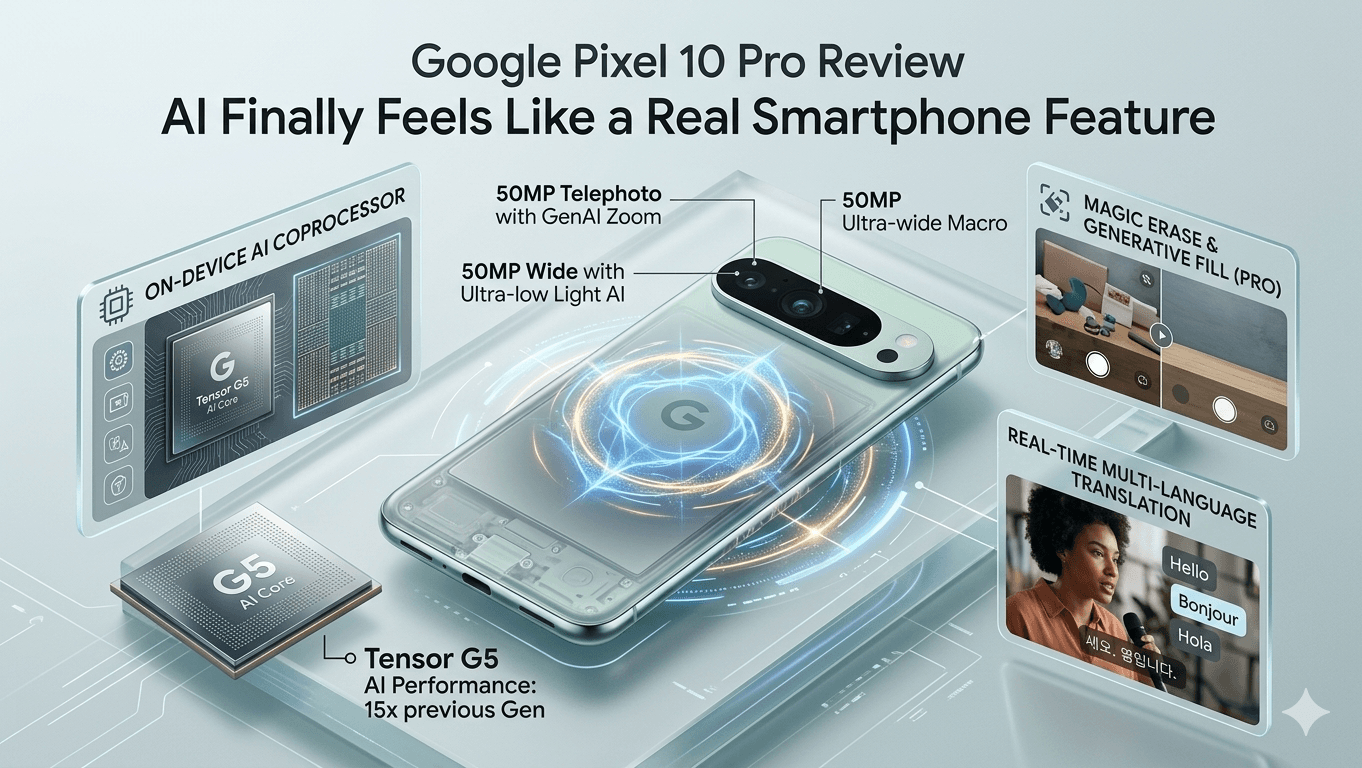
Google Pixel 10 Pro Review: AI Finally Feels Like a Real Smartphone Feature.
The Google Pixel 10 Pro blends Google’s AI-first vision with premium hardware, refined cameras, and a polished Android experience. Featuring the latest Tensor platform, upgraded computational photography, a brighter LTPO display, and deeper on-device AI capabilities, the Pixel 10 Pro aims to prove that smartphone intelligence can be more than marketing jargon. For users who prioritize software experiences as much as hardware, Google may finally have found the right balance.
Smartphones have reached an interesting stage. Raw performance improvements continue every year, displays keep getting brighter, and camera hardware becomes increasingly sophisticated. Yet for many users, daily experiences rarely feel dramatically different. Increasingly, companies are searching for meaningful software innovations rather than relying solely on hardware specifications.
Google has been pushing that idea longer than most competitors. The Pixel lineup has consistently treated AI as a central product philosophy instead of a side feature, and with the Google Pixel 10 Pro, the company appears to be doubling down on that strategy. Early industry reports position the Pixel 10 Pro among the strongest AI-focused Android devices currently available. :contentReference[oaicite:1]{index=1}
The Pixel 10 Pro enters a market crowded with premium alternatives from Samsung, Apple, Xiaomi, and OnePlus. Competition is stronger than ever, and buyers increasingly expect premium cameras, long software support, fast performance, and genuinely useful intelligence features instead of flashy marketing terms.
After reviewing launch discussions, industry analysis, and community reactions, one thing becomes clear: the Pixel 10 Pro is less focused on chasing benchmark leadership and more focused on creating a smarter overall experience. :contentReference[oaicite:2]{index=2}
Design & Build
Google has gradually refined Pixel design over multiple generations, and the Pixel 10 Pro continues that familiar identity. The camera bar remains distinctive while becoming more integrated into the overall chassis design.
Premium materials, slimmer bezels, and improved ergonomics help the phone feel more mature compared to earlier Pixel generations. Instead of redesigning everything, Google appears to have focused on refinement and comfort.
- Premium flagship construction
- Minimal Pixel design language
- IP-rated durability
- Improved grip and ergonomics
- Refined camera bar integration
The result feels familiar, but familiarity is not necessarily a weakness when the overall execution becomes cleaner and more refined.
Display Experience
Reports surrounding Google's latest flagship suggest significant improvements to display quality and brightness. Premium smartphones increasingly compete through display experiences, and Google appears determined to close every remaining gap. :contentReference[oaicite:3]{index=3}
The LTPO OLED panel supports adaptive refresh rates and improved outdoor visibility. Navigation, gaming, scrolling, and media consumption all benefit from smoother transitions and richer visuals.
Content creators and media enthusiasts especially benefit from better color reproduction and stronger brightness performance. Flagship displays have become excellent across the industry, but the Pixel 10 Pro appears ready to compete directly with the very best.
For users spending hours each day looking at their screen, these improvements matter more than benchmark charts.
Performance & Daily Usage
The newest Tensor platform powering the Pixel 10 Pro continues Google's philosophy of balancing performance with AI acceleration rather than chasing synthetic benchmark leadership. Community expectations surrounding Pixel devices increasingly focus on practical experiences rather than raw processing numbers. :contentReference[oaicite:4]{index=4}
Daily usage remains where Pixel devices traditionally shine. Navigation feels fluid, application switching remains fast, and Google's software optimization creates a polished experience that often feels smoother than specifications alone would suggest.
The Pixel 10 Pro feels like a device designed around user experience first and hardware specifications second.
AI remains central here. Live assistance, contextual suggestions, enhanced voice interactions, and image editing tools increasingly move beyond gimmicks into features users might actually adopt regularly.
Google’s challenge has never been innovation. It has always been making innovation feel useful. The Pixel 10 Pro may represent one of the company's strongest attempts yet.
Camera Performance
Pixel phones have long maintained a reputation for computational photography, and expectations around the Pixel 10 Pro remain high. Google’s camera processing pipeline continues receiving industry praise for image consistency and intelligent scene handling. :contentReference[oaicite:5]{index=5}
Improvements to portrait processing, low-light performance, and AI-assisted editing tools appear to be major priorities this generation. Features like intelligent object removal and advanced editing continue strengthening the Pixel identity.
Community discussions frequently mention camera quality as one of the biggest reasons users upgrade from mid-range phones to premium devices. :contentReference[oaicite:6]{index=6}
Instead of producing exaggerated or overly saturated images, Google continues favoring a cleaner and more natural visual style that many users appreciate.
Battery Life & Software Experience
Battery performance continues improving across flagship smartphones, and software efficiency increasingly matters as much as battery size itself. Google's software optimization and AI-assisted resource management play an important role here.
Android on Pixel devices remains one of Google's strongest advantages. Minimal visual clutter, rapid updates, and long-term support contribute heavily to the overall ownership experience.
Industry discussions increasingly highlight long-term software support as a critical buying factor, particularly as smartphones become more expensive. :contentReference[oaicite:7]{index=7}
Combined with AI-powered experiences and Google's ecosystem integration, the Pixel 10 Pro feels positioned as a device users can comfortably keep for years.
Final Verdict
The Google Pixel 10 Pro represents an interesting direction for flagship smartphones. Rather than competing solely on processor numbers or camera megapixels, Google continues building a product centered around intelligent software experiences.
Premium design, strong cameras, refined Android software, and practical AI capabilities combine to create a device that feels distinct from many competitors.
The Pixel 10 Pro may not win every benchmark comparison, but flagship smartphones increasingly involve more than raw specifications alone.
For users who value software experiences just as much as hardware power, the Pixel 10 Pro feels like one of Google's most compelling smartphones yet.