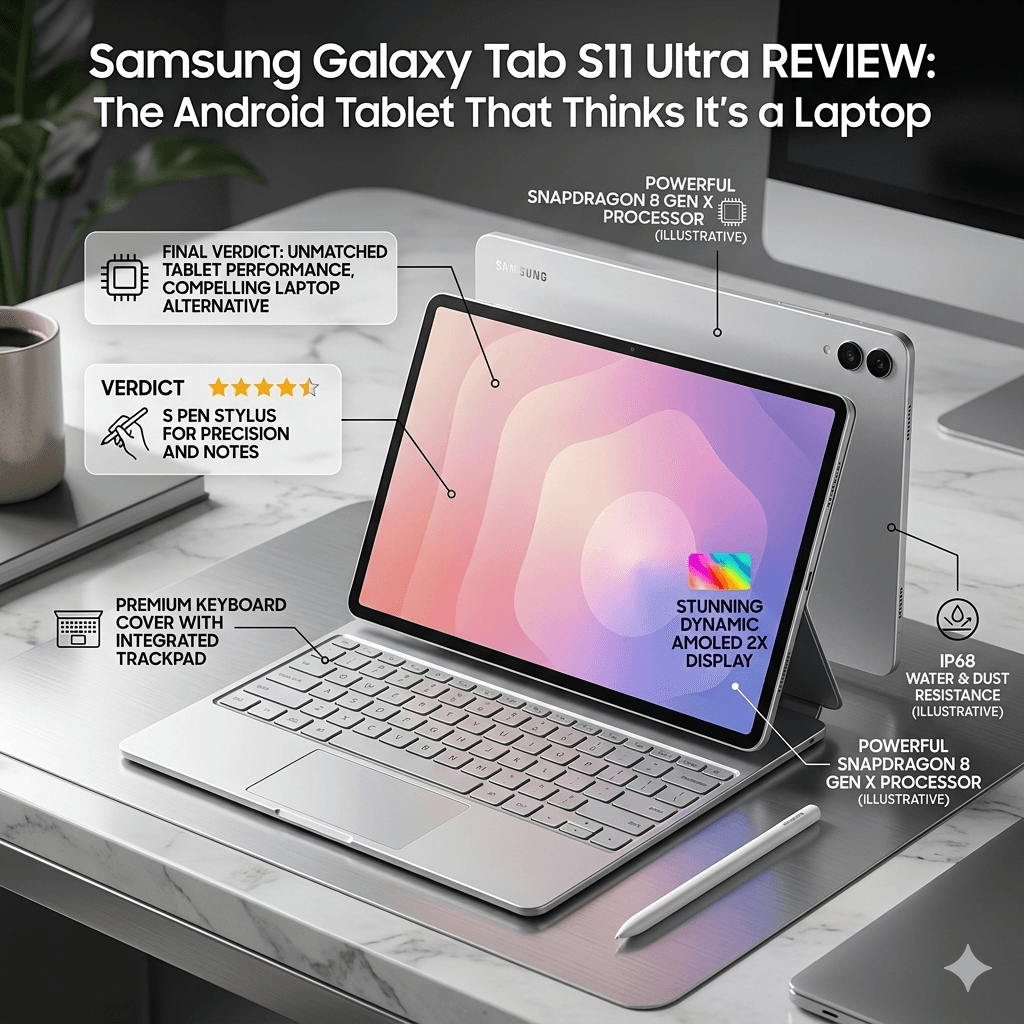
Samsung Galaxy Tab S11 Ultra Review: The Android Tablet That Thinks It's a Laptop.
The Samsung Galaxy Tab S11 Ultra arrives with a Dimensity 9400+ chipset, a slimmer 5.1mm chassis, an 11,600mAh battery, and Galaxy AI baked into its massive 14.6-inch AMOLED display. At $1,199, it's the most powerful Android tablet you can buy — but the gap between its ambitions and its software reality is impossible to ignore.
Interested in this item?
Get the best verified price using our affiliate link below.
Samsung Galaxy Tab S11 Ultra — At a Glance
Starting price: $1,199 (12GB/256GB Wi-Fi) | Available: September 4, 2025 | OS: One UI 8.5, Android 16
The Galaxy Tab S11 Ultra is the most capable Android tablet ever made. It is also a reminder that raw hardware alone cannot make a tablet ecosystem. The experience is exceptional in bursts — and occasionally frustrating in practice.
Introduction
Samsung unveiled the Galaxy Tab S11 Ultra at IFA Berlin in September 2025, continuing its tradition of fielding the most aggressively specced Android tablet on the market. The device launched on September 4, 2025, to a reception that was genuinely enthusiastic — and legitimately complicated. On paper, this is a tablet that punches at laptop-level ambitions: a near-15-inch screen, a 3nm flagship chipset, a redesigned S Pen in the box, an IP68 rating, and Galaxy AI threaded throughout. On the desk, it stretches the definition of portable. In the hands, it reframes what a tablet is supposed to feel like. And in actual daily use, it delivers enough brilliance to justify its price — while also revealing the persistent fault lines in Android's tablet software story that Samsung alone cannot resolve. This is a review of the best Android tablet of 2025 and early 2026, and also an honest account of what buying one will actually feel like.
Design & Build Quality
The most striking physical achievement of the Tab S11 Ultra is just how thin and light Samsung has made it given the scale of the display. At just 5.1mm thick, it is among the thinnest tablets available at any size, and it tips the scales at 692 grams — meaningfully lighter than the previous generation while also housing a slightly larger battery. The unibody aluminum construction feels premium and solid, with no flex and very little panel wobble despite the large screen area. The frame houses a redesigned octagon-shaped S Pen stylus in an integrated silo, which is a quality-of-life detail that owners of competing tablets — including iPad Pro users reaching for their separately purchased Apple Pencil — will genuinely appreciate every single day. IP68 water and dust resistance is present and remains rare for tablets at any price, making this a meaningfully more durable device than most of its competitors. The front camera has moved to a single lens replacing last year's dual-camera notch setup, which gives the display area a slightly cleaner look. Available in Grey and Silver colorways, the Tab S11 Ultra is understated for a device this large — more boardroom than bedroom, and that tonal choice fits its professional positioning well. Physically, this is an exceptional engineering achievement. The challenge, as always, is what happens inside the software.
Display
The 14.6-inch Dynamic AMOLED 2X display is the centerpiece of the Tab S11 Ultra experience, and it remains largely unchanged from its predecessor — a decision that is far easier to accept when the predecessor's screen was already excellent. Running at a 2960×1848 resolution with a 16:10 aspect ratio and 239 ppi, the panel is crisp, vivid, and exceptionally well-suited to both media consumption and creative work. The 120Hz adaptive refresh rate ensures smooth scrolling throughout One UI's interface, and HDR10+ support means streaming content from compatible services looks genuinely cinematic on this scale. Peak brightness in testing reaches approximately 1,457 nits — bright enough for comfortable outdoor use in most conditions, though it trails the iPad Pro 13-inch's tandem OLED technology in raw luminance and black-level depth. That distinction matters if you are a photographer or colorist doing precision work. For most users — gaming, productivity, content consumption, digital art — the Tab S11 Ultra's display is a delight to spend time with. The sheer scale of 14.6 inches makes split-screen multitasking feel genuinely spacious rather than cramped, and it elevates the tablet's DeX desktop mode experience considerably. The display is not without trade-offs: at 239 ppi, it is not as sharp as the iPad Pro 13-inch, and the AMOLED panel, while vivid, cannot match a high-end OLED for absolute contrast. But in the context of Android tablets, this screen sets the standard.
Performance
The step up from the Dimensity 9300+ to the 9400+ chipset brings approximately 30% better CPU and GPU performance over the Tab S10 Ultra, according to both MediaTek's own claims and real-world testing. In practice, this manifests as a noticeably more confident device under load: demanding games like EA Sports FC 26 maintain smooth, consistent frame rates where the previous generation occasionally struggled, and multitasking across multiple productivity apps in Samsung DeX no longer produces the occasional stutter that characterized the S10 Ultra under pressure. The Dimensity 9400+ is built on TSMC's 3nm process and features an octa-core layout headlined by a single Cortex-X925 prime core running at 3.62GHz, three Cortex-X4 performance cores, and four efficiency cores — a topology that handles bursty and sustained workloads with equal composure. Memory configurations span from 12GB RAM and 256GB storage up to 16GB RAM and 1TB storage, and the generous memory allowances mean aggressive RAM management is not the battery-life tax it can be on lesser Android devices. The under-display optical fingerprint sensor is reliable and acceptably fast. One important caveat: the performance gap between the Tab S11 Ultra and the iPad Pro 13-inch remains substantial when measured in benchmarks. Apple's M4 chip in the iPad Pro consistently outperforms the Dimensity 9400+ in both CPU and GPU tests. In real-world Android app use, however, this gap is largely academic — most tablet software does not come close to saturating either chip.
S Pen & Productivity
The redesigned S Pen is one of the most compelling additions this generation. The new octagonal form factor is more comfortable to grip than its predecessor for extended writing or illustration sessions, and Samsung has improved both latency and pressure sensitivity in the tip response. For note-taking, sketching, and handwriting-to-text conversion, the S Pen experience on the Tab S11 Ultra is the best in the Android ecosystem — and it remains more refined than the Apple Pencil Pro for traditional pen-on-paper use cases, partly because Samsung has had more time to optimize its software around stylus input. Galaxy AI's stylus-aware features include Sketch to Image, Creative Studio for AI-assisted illustration, and handwriting recognition that is accurate enough to feel like a genuine productivity tool rather than a party trick. For digital artists and designers, the large canvas, precise stylus, and AI tools combine to create a legitimately compelling creative workstation. Samsung DeX, activated via a keyboard or desktop monitor connection, transforms the tablet into a surprisingly functional desktop-like computing environment, with windowed apps, a taskbar, and drag-and-drop file management. It is not a full desktop OS, but for document editing, spreadsheets, email, and web browsing, it gets remarkably close.
Battery Life & Charging
The 11,600mAh battery is one of the Tab S11 Ultra's most practical upgrades over its predecessor, which drew criticism for underwhelming endurance. In real-world mixed use — a combination of browsing, productivity work, video streaming, and moderate gaming — the Tab S11 Ultra comfortably manages a full day and a half on a single charge, and lighter users running it primarily for media and note-taking may stretch to two days before needing to plug in. Gaming sessions will accelerate drain considerably, as the Dimensity 9400+ runs warm under sustained GPU load. The elephant in the room is charging speed: the Tab S11 Ultra supports a maximum of 45W wired charging, which takes a meaningful amount of time to replenish a battery this large from empty. Competitors in this price bracket — particularly on the Windows side — often support 65W or higher. Samsung does not include a charger in the box, which, at a $1,199 price point, is a frustration that reviewers and buyers have consistently flagged. Wireless charging is not supported, reflecting the practical engineering limits of housing an 11,600mAh cell in a 5.1mm chassis.
Software & Galaxy AI
The Tab S11 Ultra shipped with One UI 8 on Android 16, and has since received the One UI 8.5 stable update, which refines the interface and expands Galaxy AI capabilities. Samsung's One UI remains the most tablet-optimized Android skin available, offering genuinely useful split-screen multitasking, a desktop-class taskbar, drag-and-drop support, and deep S Pen integration that Apple's iPadOS struggles to match at the system level. Galaxy AI features tailored for the larger display include screen sharing in Gemini Live, Sketch to Image, and Circle to Search — which is one of the most practically useful AI tools in any mobile device. The persistent tension, however, lies beyond Samsung's software itself: the broader Android tablet app ecosystem remains inconsistent. Many popular third-party applications — social platforms, banking apps, productivity tools from non-Google developers — continue to present phone-optimized interfaces rather than properly scaled tablet layouts, creating an experience where Samsung's excellent system software is frequently undercut by apps running in letterboxed phone mode. This is not a problem Samsung can solve alone, and it has improved meaningfully over the past two years. But it remains a genuine gap between the Android tablet experience and what iPadOS delivers with its more curated, tablet-optimized app library.
Cameras
The Tab S11 Ultra sports a 13MP rear camera and a single 12MP front-facing camera — an improvement over the previous generation's dual-selfie-camera notch setup. Camera expectations on a flagship tablet have always differed from those on a flagship phone: few people use a 14.6-inch slate as their primary photography device, and the Tab S11 Ultra's cameras reflect that reality. The rear shooter is capable enough for document scanning, occasional snapshots, and whiteboard capture, with good detail in well-lit conditions. Low-light performance is unremarkable. The 12MP front camera, positioned for landscape video calling — which is the primary use case on a tablet of this size — handles video calls on Zoom, Teams, and Google Meet with clarity and decent automatic exposure. Center Stage-style auto-framing is available and works reliably. Neither camera is a reason to buy this tablet, and neither is a reason to avoid it. They are functional, competent, and appropriately backgrounded in the overall value proposition.
The Galaxy Tab S11 Ultra beats the iPad Pro 13-inch on screen size, S Pen inclusion, multitasking flexibility, and price parity at the base tier. The iPad Pro wins on display quality, app ecosystem depth, chip performance headroom, and long-term software support commitment. Which matters more depends entirely on what you need to do with it.
Competition
The Galaxy Tab S11 Ultra's most direct rival is the Apple iPad Pro 13-inch (M4), which starts at $1,299 — a $100 premium over the base Tab S11 Ultra. The iPad Pro's tandem OLED display is brighter and delivers deeper blacks; its M4 chip outperforms the Dimensity 9400+ in every benchmark metric; and its App Store tablet ecosystem, while not perfect, is considerably more mature than Android's. The iPad Pro does not, however, include a stylus: the Apple Pencil Pro costs $129 separately. Samsung's S Pen inclusion is therefore a meaningful value differentiator, particularly for note-takers, students, and artists. Within the Android space, no other tablet comes close to challenging the Tab S11 Ultra at its price point. The Tab S11 (11-inch) offers a compelling, more portable alternative for those who do not need the larger canvas. The OnePlus Pad Go 2 is a standout mid-range performer at a far lower price. If you want the absolute best Android tablet without compromise, the Tab S11 Ultra holds the field largely to itself — at least until the rumored Samsung Galaxy Tab S12 Ultra, expected in September 2026, arrives to replace it.
Who Should Buy It?
The Galaxy Tab S11 Ultra is made for power users who live in the Android ecosystem and want the most screen, the most performance, and the most productivity tools that platform can offer. It is an excellent choice for digital artists and designers who want a large canvas and a precision stylus without paying for an iPad Pro. It suits professionals who want a DeX-powered laptop alternative for travel, and gamers who want the largest possible display for mobile gaming. It is less suited to users who depend on third-party apps with no tablet optimization, users who need a charger in the box, or buyers who are cross-shopping seriously with the iPad Pro and prioritize app ecosystem depth and display quality over screen size and Android flexibility. For Samsung ecosystem users — those already using Galaxy phones, Galaxy Watch, and Galaxy Buds — the integration and continuity features make the Tab S11 Ultra an exceptionally coherent upgrade.
Final Verdict
The Samsung Galaxy Tab S11 Ultra is the pinnacle of Android tablet hardware in 2025 and remains so heading into mid-2026. Its 14.6-inch AMOLED display is immersive at a scale no other Android tablet can match. Its Dimensity 9400+ chipset handles every task Android currently demands of it with ease. Its redesigned S Pen, included in the box, makes it the best value premium tablet for stylus users in absolute terms. And at $1,199 with an IP68 rating, a 5.1mm profile, and Samsung's seven-year software support commitment, it is built to last. The software ecosystem gap is real, and the 45W charging ceiling is a legitimate limitation. But for the right user — an Android power user who wants the biggest, most capable, most productively flexible tablet available today — there is nothing on the Android side that comes close. The Galaxy Tab S11 Ultra earns its flagship status the hard way: by delivering on nearly every hardware promise it makes.
Score: 8.7 / 10 | Reviewed on a Wi-Fi Galaxy Tab S11 Ultra (12GB/256GB) running One UI 8.5 on Android 16.
Ready to Purchase?
We gather active retail prices. Click below to buy this product securely.