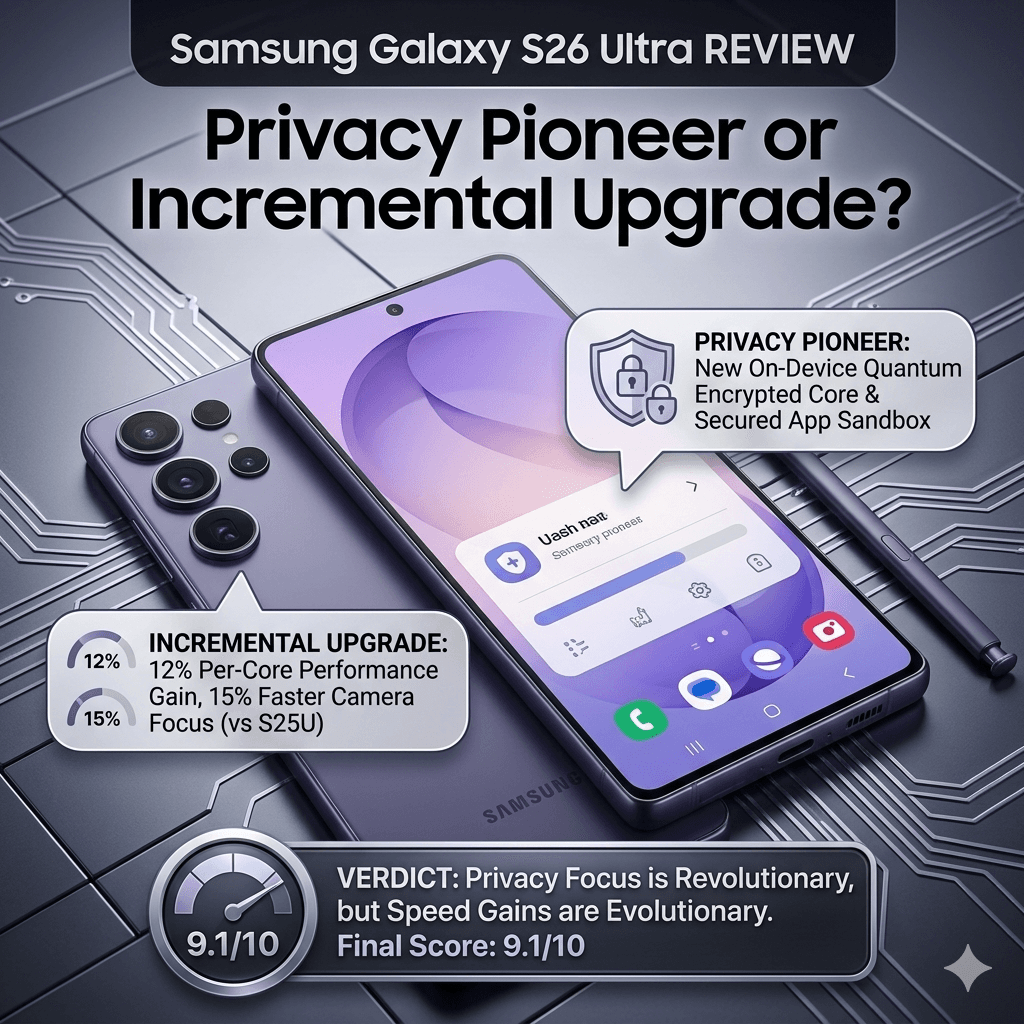
Samsung Galaxy S26 Ultra Review: Privacy Pioneer or Incremental Upgrade?.
The Samsung Galaxy S26 Ultra arrives in 2026 with a world-first hardware Privacy Display, the powerful Snapdragon 8 Elite Gen 5, and a refined 200MP camera system — but faces stiffer competition than ever from Chinese flagships. At $1,299, it remains the most complete Android phone for most users, though it isn't without compromise.
Samsung Galaxy S26 Ultra — At a Glance
Starting price: $1,299 (12GB/256GB) | Available: March 11, 2026 | OS: Android 16, One UI 8
The Galaxy S26 Ultra is the most refined Samsung flagship yet — and also the one facing its toughest competition. The Privacy Display is a genuine innovation. The rest? Solid, dependable, and increasingly challenged.
Introduction
Every year, Samsung's Ultra series arrives bearing the unofficial title of "the Android phone to beat." The Galaxy S26 Ultra, announced at Unpacked in February 2026 and launched on March 11, carries that weight again — but this time, the competitive landscape has fundamentally shifted. Chinese flagship phones from Xiaomi, Oppo, and vivo are no longer niche players; they're credible rivals shipping larger batteries, bigger sensors, and more aggressive pricing. Into this arena, Samsung has introduced the world's first hardware-level Privacy Display, a lighter aluminum chassis, Super Fast Charging 3.0, and the company's most capable chip yet. The result is a phone that is undeniably excellent, but also one that asks you to weigh what "best" really means to you.
Design & Build Quality
The most controversial design change on the S26 Ultra is the switch from titanium back to aluminum for the frame — a reversal of the premium move Samsung made with the S24 Ultra in 2024. Samsung justifies this by citing better heat dissipation and shock absorption properties for aluminum, and the resulting device is notably slimmer (7.9mm) and lighter (214g) than its predecessor. In practice, the difference in in-hand feel is less dramatic than spec sheets suggest. The aluminum is warm and has sufficient grip, and the rounded corners make the 6.9-inch body easier to manage one-handed than you might expect. The back retains Corning Gorilla Glass Victus 2, while the new Gorilla Armor 2 on the front brings improved anti-reflective properties. Samsung's IP68 rating is unchanged — dust-tight and waterproof up to 1.5 meters — which feels slightly conservative as competitors push IP69K certifications. The new Camera Island unified module gives the rear a cleaner, more architectural look, replacing the angular floating-lens design of previous Ultras. Available in Black, Cobalt Violet, Sky Blue, White, and two Samsung.com exclusives — Pink Gold and Silver Shadow — the S26 Ultra is understated but undeniably premium.
Display
Samsung's 6.9-inch Dynamic LTPO AMOLED 2X panel produces a Quad HD+ resolution of 1440×3120 pixels at a crisp 505 ppi, with an adaptive 1–120Hz refresh rate and a peak brightness of 2,600 nits. In direct sunlight, it's among the most readable screens available. Colors are vivid without being overdone in the default calibration, and HDR10+ content on streaming platforms genuinely pops. But the headline story is the Privacy Display — and it earns its billing as the most exciting display feature in a decade. Using directional light-shaping technology, it restricts the visible viewing angle so that only the person directly in front of the screen can see its content. Shoulder-surfers at coffee shops, airports, or on the metro are effectively blocked out. It can be toggled on and off and even customized in intensity. It's the sort of feature that, once you have it, you won't want to live without. One caveat: the Privacy Display does make the screen appear marginally more reflective and slightly less punchy compared to the S25 Ultra's panel when it is active, but the tradeoff is negligible in normal use.
Performance
Under the hood, U.S. models run the Snapdragon 8 Elite Gen 5 for Galaxy — Qualcomm's latest silicon with a custom Samsung-tuned configuration. The numbers are impressive: Geekbench 6 multi-core scores of around 10,713, and GPU scores of 24,611. Day-to-day performance is exactly what you'd expect from a 2026 flagship: seamless multitasking, instant app launches, buttery scrolling at 120Hz, and a fingerprint sensor (ultrasonic, under-display) that remains the fastest and most reliable in the Android ecosystem. Gaming performance has improved noticeably this generation, thanks partly to a revised vapor chamber and the aluminum chassis's improved thermal dissipation. Sustained loads hold up better in benchmarks, and popular titles run at maximum settings without throttling in typical play sessions. The 12GB of RAM on the base and mid-tier models is sufficient for heavy use, while the top-end 1TB model bumps to 16GB. International markets outside the US, China, and Japan receive Samsung's in-house Exynos 2600, which we have not reviewed in this article.
Cameras
The S26 Ultra's camera quad-array is headlined by a 200MP main sensor with a notably wide F1.4 aperture — a meaningful upgrade that makes a real difference in low-light photography. Night shots are brighter, more detailed, and more naturally colored than the S25 Ultra's output. The 12MP ultrawide is wide-angle capable and dependable. Samsung retains its 5x periscope telephoto and adds a 3x optical zoom lens to round out the system — though reviewers have broadly flagged the 10MP, F2.4 3x telephoto as the weakest link in the setup, feeling dated compared to the Adaptive Pixel systems Chinese rivals are shipping. At 30x and even 50x Space Zoom, the phone produces usable, intelligible shots, and Samsung's image processing pipeline continues to mature, delivering more natural color science than previous generations. Nightography video has also improved, with noticeably cleaner footage in low light versus the S25 Ultra. The 12MP front camera handles selfies and video calls with typical Samsung polish. This is not the best camera phone of 2026 in isolation — the Xiaomi 17 Ultra and likely the Oppo Find X9 Ultra will outperform it in key metrics — but for most users in most conditions, the S26 Ultra's cameras are outstanding.
Battery Life
The S26 Ultra retains the 5,000mAh battery that Samsung has shipped in the Ultra line for several generations, forgoing the silicon-carbon anode technology that competitors have used to pack more capacity into similar-sized cells. Real-world endurance is described as solid-but-unremarkable: reviewers consistently report around 7–7.5 hours of screen-on time under moderate to heavy use, and Samsung claims up to 31 hours of video playback. That's perfectly fine for most users to get through a full day — but Xiaomi and vivo flagship rivals now routinely offer 6,000mAh+ batteries. What saves Samsung from a bigger criticism here is its first meaningful charging upgrade in years: Super Fast Charging 3.0 supports up to 60W wired, getting you to roughly 75% in 30 minutes. Wireless charging hits 25W, and reverse wireless charging for accessories is supported. Qi2 compatibility is absent natively, which is a frustration for users in a growing Qi2 ecosystem.
Software Experience
One UI 8 on top of Android 16 is polished, feature-rich, and — by most accounts — the most mature Android skin available. Samsung's commitment to seven years of OS updates and seven years of security patches remains a significant long-term value differentiator. Galaxy AI continues to evolve with features like AI-powered photo editing, Now Brief contextual suggestions, and Photo Assist, now covering 41 languages. These tools are more useful than flashy, though the overall Galaxy AI suite is still described by reviewers as "forgettable" in daily routine compared to its marketing prominence. The S Pen experience remains a defining aspect of the Ultra, but its feature set has been gradually trimmed — features like Air Actions have been reduced, and those coming from the S23 Ultra generation will notice the regression. For Samsung ecosystem users, Quick Share now supports cross-platform AirDrop integration, and Samsung DeX capabilities remain available for desktop-mode productivity.
Competition
The S26 Ultra at $1,299 faces a more difficult competitive picture than any previous Ultra. The Xiaomi 17 Ultra, widely reviewed as the best camera phone of early 2026, outperforms it in image quality and battery life — though it comes with its own software ecosystem trade-offs for Western buyers. The Oppo Find X9 Ultra and vivo X300 Ultra are strong competitors with larger sensors and IP69K ratings. Apple's iPhone 17 Pro Max remains the primary alternative for users in the Apple ecosystem, with comparable sustained performance and class-leading video capabilities. Notably, the Galaxy S25 Ultra remains a compelling buy in 2026 — it's available at a lower price and, with Samsung's long software support, will remain relevant for years. The incremental nature of the S26 Ultra's upgrade means owners of the S25 Ultra have limited incentive to switch unless the Privacy Display or faster charging are must-haves.
The Privacy Display is the kind of hardware innovation that makes you realize how overdue it was. No other flagship offers it. That alone may justify the price of admission for professionals and frequent travelers.
Who Should Buy It?
The Galaxy S26 Ultra is the right phone for users who want the most complete, reliable, and well-supported Android flagship available — and who value ecosystem integration, the S Pen, and the groundbreaking Privacy Display. It's ideal for professionals handling sensitive information in public settings, Samsung ecosystem users already invested in Galaxy wearables and tablets, and buyers who want seven years of guaranteed software support. It is not the obvious choice if maximizing camera performance, battery capacity, or raw value are your primary criteria — in each of those individual categories, Chinese alternatives now lead. If you already own an S25 Ultra and don't travel frequently or handle confidential data in public, the Privacy Display alone may not be enough to justify an upgrade.
Final Verdict
The Samsung Galaxy S26 Ultra is an excellent phone navigating an increasingly crowded field. Its Privacy Display is a first-of-its-kind hardware innovation that will likely define a new category norm — just as OLED displays and high-refresh-rate screens eventually became standard. The Snapdragon 8 Elite Gen 5 delivers the performance benchmarks you'd expect, One UI 8 is the most capable Android skin on the market, and the 200MP F1.4 main camera genuinely raises the bar for low-light photography from Samsung. But the unchanged 5,000mAh battery, the conservative 3x telephoto, the return to aluminum, and the mounting competition from Chinese phones mean this is the first Ultra in several years that isn't an automatic recommendation for every premium buyer. It's the best phone Samsung has made. Whether it's the best phone you can buy at $1,299 in 2026 depends entirely on what you prioritize — and that, more than anything, is a sign of just how competitive this segment has become.
Score: 8.5 / 10 | Reviewed on a 12GB/256GB Snapdragon 8 Elite Gen 5 unit running One UI 8 on Android 16.