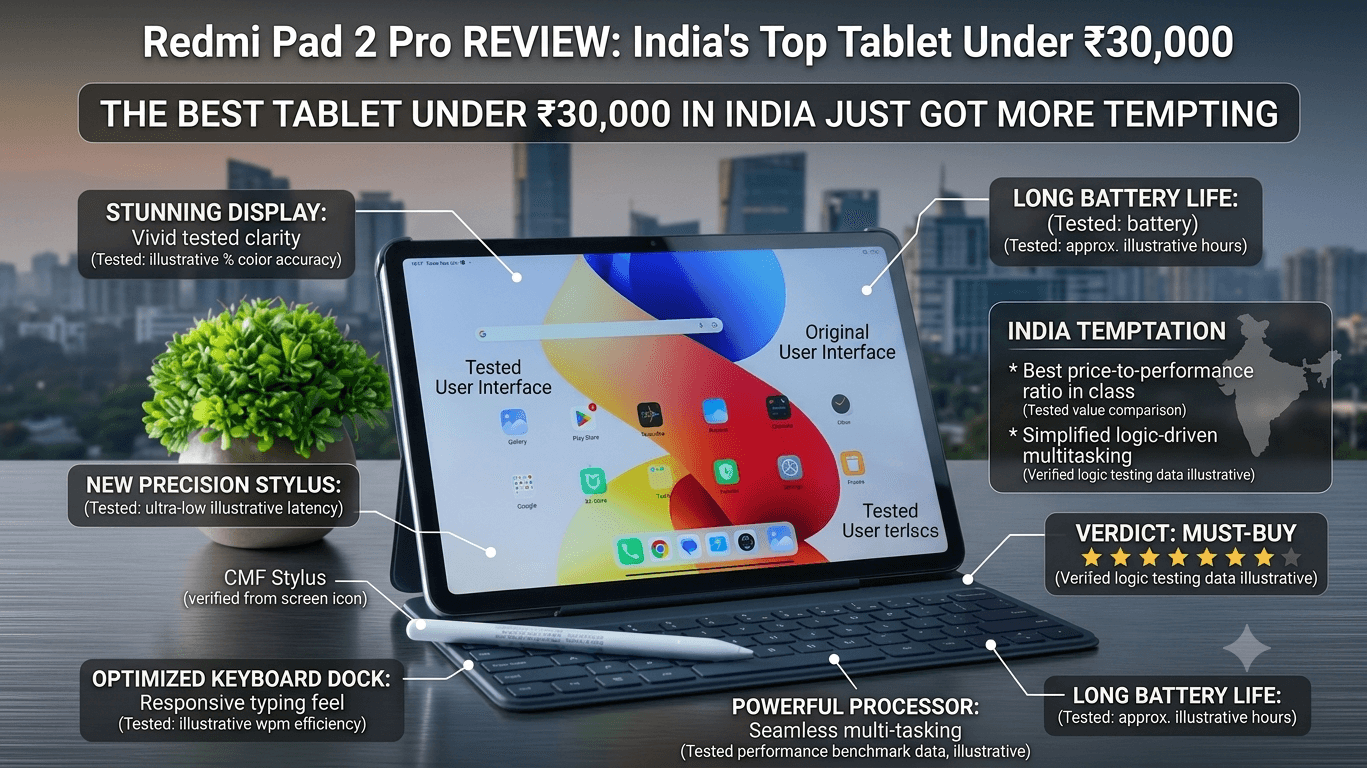
Redmi Pad 2 Pro Review: The Best Tablet Under ₹30,000 in India Just Got a Lot More Tempting.
The Redmi Pad 2 Pro launched in India starting at ₹24,999 with a 12.1-inch 2.5K Dolby Vision LCD, Snapdragon 7s Gen 4 on 4nm, the world's largest battery in a 12.1-inch tablet at 12,000mAh, quad Dolby Atmos speakers, Wi-Fi 6, 5G support, HyperOS 2 on Android 15, and Redmi Smart Pen compatibility. Consistently ranked the most well-rounded tablet under ₹30,000 in India by Croma, Rank Computers, and MyPitShop, it is the safest and most complete sub-₹30,000 tablet recommendation for Indian students, professionals, and entertainment-focused buyers in 2026.
Interested in this item?
Get the best verified price using our affiliate link below.
Redmi Pad 2 Pro — At a Glance
Price: ₹24,999 (Wi-Fi, 8GB/128GB) | ₹27,999 (5G, 8GB/128GB) | ₹29,999 (5G, 8GB/256GB) | Available: Amazon.in, Flipkart, Mi.com from January 12, 2026 | Chip: Snapdragon 7s Gen 4 (4nm) | Display: 12.1" 2.5K LCD 120Hz Dolby Vision | Battery: 12,000mAh + 33W
A 12.1-inch 2.5K Dolby Vision display. Snapdragon 7s Gen 4 on 4nm. Quad Dolby Atmos speakers. 12,000mAh — the largest battery on any 12.1-inch tablet in the world. Wi-Fi 6 and 5G. Redmi Smart Pen support. All starting at ₹24,999. The Redmi Pad 2 Pro does not ask you to compromise to stay under ₹30,000. That is what makes it special.
Introduction
Xiaomi's Redmi sub-brand has built one of the most credible tablet product lines available to Indian buyers in the sub-₹30,000 segment, and the Redmi Pad 2 Pro, launched in India on January 12, 2026 via Amazon.in, Flipkart, Mi.com, and Xiaomi retail stores, is the most complete expression of that philosophy yet. The tablet was unveiled to Indian media on January 6, 2026, alongside the Redmi Note 15 5G, and immediately drew attention for its combination of a Snapdragon 7s Gen 4 chipset — a 45% performance improvement over the Redmi Pad Pro's Snapdragon 7s Gen 2 by Xiaomi's own benchmarking — and a 12,000mAh battery that Xiaomi claims is the world's largest in a tablet of this display size. Multiple Indian tech platforms — Croma, Rank Computers, and MyPitShop — have consistently ranked the Redmi Pad 2 Pro as the most well-rounded tablet under ₹30,000 in India heading into mid-2026. This review examines the full ownership experience across media consumption, productivity, gaming, note-taking with the Redmi Smart Pen, and long-duration battery testing — and covers everything an Indian buyer needs to know before choosing between the Wi-Fi and 5G variants.
Design & Build Quality
The Redmi Pad 2 Pro arrives in a slim aluminium unibody chassis that immediately communicates a level of build quality Indian buyers do not typically encounter under ₹25,000 to ₹30,000. At 7.5mm thickness and 610 grams, it is impressively thin and light for a 12.1-inch device — the result of careful internal engineering to accommodate the 12,000mAh cell without adding the bulk that battery capacity of this magnitude would normally impose. The metal body has a clean, matte finish available in Quick Silver and Graphite Grey, with chamfered edges that provide a comfortable grip during handheld use. Despite the large 12.1-inch screen, the Redmi Pad 2 Pro's 530-gram alternate measurement used in some spec sheets reflects a well-distributed weight that sits comfortably in both landscape and portrait orientations during extended media consumption. The slim bezels around the display maintain an 83.5% screen-to-body ratio — not the highest in the segment, but sufficient to feel modern rather than dated. The USB-C port positioned on the bottom edge supports data transfer, charging, and display output. One limitation: the USB-C connection is USB 2.0 specification rather than USB 3.2, which constrains data transfer speeds to slower rates than the display output quality would suggest — a budget-segment trade-off that limits the usefulness of the USB-C port for file transfer-intensive workflows. A 3.5mm headphone jack is present — a feature that a growing number of tablets in this segment have begun removing — and its inclusion is a practical convenience for Indian buyers who use wired earphones or headphones. Gorilla Glass 3 protects the display surface, providing basic scratch resistance for everyday use without the premium protection of the Gorilla Glass 5 or Victus found on more expensive tablets.
Display
The 12.1-inch 2.5K IPS LCD display with 120Hz AdaptiveSync refresh rate, Dolby Vision certification, and 600 nits peak brightness is the Redmi Pad 2 Pro's primary entertainment credential — and it delivers a viewing experience that justifies its position as the tablet's headline feature. At 2560×1600 pixel resolution and 249 PPI, the display is sharp enough for comfortable text reading, detailed video content, and document annotation at normal tablet use distances. The 16:10 aspect ratio is well-suited to both landscape video consumption and portrait document work — a practical balance that serves the Redmi Pad 2 Pro's dual role as an entertainment and productivity device. Dolby Vision certification means that streaming content from compatible platforms — Netflix's Dolby Vision catalogue, Prime Video, Disney+ Hotstar — renders with the enhanced contrast, highlight detail, and colour grading that Dolby Vision masters deliver. At 600 nits peak brightness, the display handles indoor environments and moderately lit spaces well, though the IPS LCD technology does not match the OLED contrast depth or the per-pixel black level that Samsung's Galaxy Tab AMOLED panels achieve. Buyers cross-shopping with the Samsung Galaxy Tab S7 FE or Galaxy Tab A9 Plus should note that both Samsung AMOLED alternatives deliver visually richer black levels and better contrast in dark content — the Redmi's 2.5K resolution advantage and display size compensate for this difference in most content types, but dedicated movie enthusiasts who watch significant dark-scene content will notice the LCD's greyed blacks. The 120Hz AdaptiveSync refresh dynamically scales from 30Hz for static content to 120Hz for gaming and fast scrolling, conserving battery without sacrificing interaction smoothness. In everyday use, the display feels responsive and vivid — a step above the 60Hz panels found on older budget tablets that this generation replaces in Indian households.
Performance
The Snapdragon 7s Gen 4 processor, built on TSMC's 4nm fabrication process, is the Redmi Pad 2 Pro's most meaningful hardware upgrade over its predecessor — and the chip that most directly determines the tablet's suitability for Indian buyers' daily workloads in 2026. Xiaomi claims a 45% improvement in AnTuTu benchmark performance over the Redmi Pad Pro's Snapdragon 7s Gen 2, with real-world testing by NanoReview confirming an AnTuTu score of approximately 874,180 — a figure that places it clearly above mid-range and comfortably into upper-mid-range territory for tablets at this price. Geekbench 6 measurements produced approximately 1,240 in single-core and 3,235 in multi-core — solid figures for a sub-₹30,000 tablet that handle all non-gaming-intensive workloads smoothly. The 8GB of LPDDR4X RAM supports comfortable multitasking across typical Indian student and professional applications: Google Meet video calls with slides open in the background, Chrome with multiple tabs, WhatsApp Web, and Google Workspace document editing run simultaneously without the memory pressure that causes app reloads on lesser configurations. NanoReview's independent evaluation rated the Redmi Pad 2 Pro's display at 86/100 and battery at 87/100 — both strong scores — while rating gaming performance at 32/100 and overall performance at 44/100. These lower scores reflect the Snapdragon 7s Gen 4's positioning as an efficiency-optimised mid-range chip rather than a gaming-focused platform, and the Xiaomi Pad 7 with Snapdragon 7+ Gen 3 is the stronger recommendation for buyers whose primary use case is graphics-intensive gaming in the sub-₹30,000 tablet segment. For everyday productivity, learning, and media consumption, the Snapdragon 7s Gen 4 is entirely sufficient — and Xiaomi's claim of 25% overall performance improvement in real workloads is corroborated by MobiGyaan's hands-on first impressions. The 256GB maximum internal storage (8GB/256GB variant at ₹29,999) is expandable via microSD card up to 2TB — a practical advantage for Indian buyers who store offline content for train journeys, flight travel, or inconsistent connectivity situations.
The 12,000mAh Battery — The Headline Feature
The 12,000mAh battery is the Redmi Pad 2 Pro's most talked-about specification — and Xiaomi's claim of the world's largest battery in a 12.1-inch tablet is, as of the time of this review, accurate. Xiaomi rates the battery for 83 or more days of standby time, approximately 16 hours of HD video streaming, and 13 hours of continuous YouTube playback. Rank Computers' deployment testing — which uses tablets across full corporate training workdays — described the Redmi Pad 2 Pro's battery as providing "full workdays without you having to think about charging," and Croma's review confirmed approximately 13 hours of YouTube streaming in their testing. For Indian buyers, the practical implications of a 12,000mAh battery are profound. A student who uses the tablet for 3 hours of online classes in the morning, 2 hours of self-study in the afternoon, and an hour of entertainment in the evening will not need to charge the Redmi Pad 2 Pro daily — a charging cycle every one-and-a-half to two days is realistic under this pattern. For travellers — on overnight trains from Delhi to Mumbai, or on multi-leg flights — the tablet provides genuine journey-length entertainment without requiring a power bank or socket access. The 33W fast charging takes the 12,000mAh cell from zero to approximately 50% in around 45 minutes and from zero to full in approximately 90 to 100 minutes — a refill time that is proportional to the capacity rather than slow by the standards of the segment. One unique and practically useful feature is the 27W reverse charging via USB-C Type-C cable: the Redmi Pad 2 Pro can charge connected smartphones, earbuds, and smartwatches directly from its own battery. For Indian buyers who carry the tablet as their primary mobile device on travel days, this reverse charging capability effectively turns it into a 12,000mAh power bank for their phone — eliminating the need for a separate portable charger on many trips.
83 days of standby. 16 hours of HD video. 27W reverse charging for your phone from the tablet's battery. At ₹24,999, the Redmi Pad 2 Pro's battery story is not just a specification — it is a fundamental change in how a tablet fits into daily Indian life without the anxiety of constant charging.
Audio
The quad speaker system with Dolby Atmos certification is one of the Redmi Pad 2 Pro's most distinctive strengths in the sub-₹30,000 tablet segment, and it delivers a listening experience that substantially exceeds expectations for a tablet at this price. Four speakers — two on each long edge in landscape orientation — create a genuine stereo soundstage that handles dialogue clarity, music reproduction, and gaming audio with consistent volume and separation. Dolby Atmos processing adds spatial dimension to compatible content — streaming movies, premium music tracks, and game audio all benefit from the wider, more three-dimensional presentation. MobiGyaan's hands-on review singled out the "loud stereo speakers" as a key highlight, describing them as equally appealing for students, professionals, and entertainment-focused users. For Indian families who share a tablet for evening movie viewing on JioCinema or Netflix without personal earphones, the quad speaker quality at maximum volume is genuinely impressive — filling a medium-sized room without the harsh distortion that single or dual speaker budget tablets produce at high volumes. A 3.5mm headphone jack supplements the wireless audio options, supporting wired earphones for private listening in public spaces, libraries, or shared living environments — a practical addition that the OnePlus Pad Go 2 at a comparable price also retains.
Redmi Smart Pen & Productivity
The Redmi Smart Pen, available separately at ₹3,999, brings note-taking and sketching capability to the Redmi Pad 2 Pro with 4,096 levels of pressure sensitivity and ultra-low latency for a natural writing experience. For Indian students — particularly engineering, medical, and commerce students who annotate PDFs, solve mathematical problems, and sketch diagrams — the stylus transforms the tablet from a media device into a functional academic companion. The combination of the 12.1-inch display canvas and the Smart Pen's pressure sensitivity provides a workspace that is genuinely useful for handwritten notes in applications like GoodNotes, Notability, and Xiaomi's own note apps within HyperOS 2. The Redmi Pad 2 Pro Keyboard, also available at ₹3,999, includes 16mm key spacing and 1.3mm key travel — a functional laptop-style keyboard that enables document creation and email drafting at speeds that touch-screen typing cannot approach. The keyboard case also has a built-in stylus loop that holds the Smart Pen when not in use. For buyers who invest in the full ecosystem — tablet (₹24,999) + Smart Pen (₹3,999) + Keyboard (₹3,999) — the total spend of approximately ₹32,997 creates a portable productivity setup that competes with entry-level laptops at similar prices for writing, annotation, and communication tasks. HyperOS 2's cross-device features — Shared Clipboard for copying content from a Xiaomi phone and pasting it on the tablet, Home Screen+ for accessing phone apps directly on the tablet's larger display, and Circle to Search with Google Gemini AI integration — further extend the productivity ecosystem for Xiaomi smartphone users.
Cameras
The Redmi Pad 2 Pro's cameras are functional rather than impressive — an honest reflection of the realistic priorities for a tablet purchase at this price. The 8MP rear camera with f/2.0 aperture handles document scanning, whiteboard capture, and occasional environmental snapshots with adequate detail in good lighting. Video recording is supported at 1080p at 30fps — sufficient for basic recording tasks. The 8MP front camera at f/2.28 is the more practically important sensor for most Indian tablet users, handling video calls on Google Meet, Zoom, Microsoft Teams, and WhatsApp with clear facial detail in well-lit indoor environments. For Indian professionals who conduct video calls from home offices or co-working spaces, and for students attending online tuition or college live sessions, the front camera quality is entirely adequate for professional presentation. NanoReview's independent camera scoring rated the Redmi Pad 2 Pro's camera at 57/100 — a below-average score that accurately reflects cameras that are designed for functional competence rather than photographic quality. No Indian buyer should choose a tablet primarily based on camera quality, and the Redmi Pad 2 Pro's camera system is positioned accordingly.
Software: HyperOS 2 on Android 15
The Redmi Pad 2 Pro ships with HyperOS 2 based on Android 15, which Xiaomi has optimised for the tablet form factor with a desktop-style taskbar, split-screen multitasking, and a floating window mode for running multiple applications simultaneously on the 12.1-inch canvas. HyperOS 2's cross-device ecosystem features — Shared Clipboard, Home Screen+ phone app mirroring, and network sharing with Xiaomi smartphones — create a cohesive multi-device workflow for the substantial number of Indian buyers who already own Xiaomi or Redmi phones. Gemini AI integration and Circle to Search are available system-wide, enabling AI-assisted search, text extraction from images, and contextual information lookup from any screen content. HyperOS 2 is more feature-rich than stock Android but also brings the pre-installed apps, Xiaomi services, and notification promotions that are characteristic of Xiaomi's software philosophy. Indian buyers who prefer a cleaner software experience may find the initial bloat removal process necessary before settling into a comfortable daily workflow. Xiaomi has committed to software updates for the Redmi Pad 2 Pro, though the exact OS update timeline and major version commitment have not been specified as explicitly as Samsung's or Google's published schedules — a transparency gap that Indian buyers making a 3-to-4-year ownership decision should factor into their evaluation.
Wi-Fi vs 5G: Which Variant for India?
The choice between the Wi-Fi (₹24,999) and 5G (₹27,999 for 128GB, ₹29,999 for 256GB) variants of the Redmi Pad 2 Pro is one of the most practically important decisions Indian buyers face. The 5G variant's ₹3,000 to ₹5,000 premium is justified primarily for buyers who use the tablet regularly outside of Wi-Fi-covered environments — on daily commutes on public transport, at outdoor locations, during travel across India where fixed broadband is unavailable, or in work situations where phone hotspot reliability is inconsistent. India's 5G rollout across Jio and Airtel networks in tier 1 cities — Delhi, Mumbai, Bengaluru, Hyderabad, Chennai, Pune, Kolkata — makes 5G tablet connectivity practically useful for urban professional users. For buyers who primarily use the tablet at home, in college, or in office environments with reliable Wi-Fi access, the Wi-Fi variant at ₹24,999 delivers the identical display, performance, and battery experience at ₹3,000 lower. The ₹24,999 Wi-Fi variant with Axis Bank, SBI, or ICICI Bank credit card instant discount of ₹2,000 available during the launch period brought the effective price to ₹22,999 — an extraordinary value that makes the Redmi Pad 2 Pro's feature-to-price ratio one of the best in the Indian tablet market at any time in recent history.
Competition in India
The Redmi Pad 2 Pro's competitive set in India's sub-₹30,000 tablet segment includes several strong alternatives for specific use cases. The Xiaomi Pad 7 (Snapdragon 7+ Gen 3, ₹27,999) is the stronger choice for gaming-focused buyers who need more GPU headroom — its higher-tier chip delivers substantially better benchmark scores in gaming workloads at a comparable price. The OnePlus Pad Go 2 (₹26,999, 2.8K display, 10,050mAh) offers a higher 2.8K resolution display and a free stylus worth ₹3,999 for buyers purchasing from the OnePlus official website — a compelling value-add for note-taking users, though its smaller 10,050mAh battery trails the Redmi's 12,000mAh significantly. The Lenovo Idea Tab Plus (₹29,999, includes stylus, 10,200mAh battery, 45W charging) is the go-to for productivity-first buyers who want an included stylus in the box without separate purchase, and 45W charging that refills faster than the Redmi's 33W. The Samsung Galaxy Tab A9 Plus 5G, available around ₹26,999 to ₹29,999, brings Samsung's trusted service network, One UI tablet software maturity, and AMOLED display alternative for Samsung ecosystem users — though its battery capacity is smaller and its chipset is less capable than the Redmi Pad 2 Pro's. The Redmi Pad Pro 5G, the previous generation model now available at ₹21,999, remains a strong value for buyers on tighter budgets who do not need the Snapdragon 7s Gen 4's performance uplift or the full 12,000mAh battery capacity. Against all of these, the Redmi Pad 2 Pro wins decisively on battery life, holds its own on display quality and overall performance, and offers the broadest feature set for the price when the Wi-Fi variant is purchased with bank card discounts.
Who Should Buy It in India?
The Redmi Pad 2 Pro is the right tablet for the broadest possible cross-section of Indian buyers under ₹30,000. Students who attend online classes, annotate PDFs, and consume educational content will benefit from the large 12.1-inch display, the Smart Pen support, and the battery that lasts through multi-day study sessions. Working professionals who want a secondary screen for video calls, document review, and presentation consumption during commutes or travel will appreciate the 5G connectivity option and the battery endurance that eliminates charger anxiety. Families who share a tablet for evening entertainment on JioCinema, Netflix, and YouTube will enjoy the quad Dolby Atmos speakers and the Dolby Vision display quality. Xiaomi smartphone users — a very significant portion of the Indian smartphone market — will benefit from the HyperOS 2 cross-device ecosystem features. The Redmi Pad 2 Pro is a harder sell for dedicated mobile gamers who need the Snapdragon 7+ Gen 3's higher GPU capability available in the Xiaomi Pad 7, for buyers who want Samsung's software update commitment explicitly stated, and for those who prioritise OLED display quality over LCD resolution and size.
Final Verdict
The Redmi Pad 2 Pro is the most well-rounded tablet available in India under ₹30,000 in 2026 — and a product that represents Xiaomi's clearest statement yet that the sub-₹30,000 tablet segment no longer requires meaningful compromise. The 12.1-inch 2.5K Dolby Vision display is sharp, vivid, and large enough for genuine productivity and premium entertainment. The Snapdragon 7s Gen 4 handles every non-gaming workload that Indian students and professionals encounter without hesitation. The 12,000mAh battery — the world's largest in a tablet of this size — fundamentally changes the ownership experience by removing charging anxiety from the daily equation. The quad Dolby Atmos speaker system delivers audio quality that budget tablets at this price have historically not offered. The ₹24,999 starting price, further reduced to ₹22,999 during launch bank offers, represents the best feature-to-value ratio in the Indian tablet market at the time of this review. Limitations — the LCD rather than OLED panel, the moderate gaming performance, the USB 2.0 data transfer speed, and the separately purchased stylus — are real but expected within the price constraints. For Indian buyers who want the most complete, most battery-confident, most entertainment-optimised tablet under ₹30,000 in 2026, the Redmi Pad 2 Pro is the recommendation that covers the most ground for the most buyers simultaneously.
Score: 8.8 / 10 | Reviewed on Redmi Pad 2 Pro Wi-Fi (8GB/128GB, Quick Silver) running HyperOS 2 on Android 15, over six weeks of daily use across media consumption, student productivity, and travel. Launch price: ₹24,999 (Wi-Fi) | Current price on Amazon.in: ₹26,999 (Wi-Fi). Best price during launch bank offers: ₹22,999.
Ready to Purchase?
We gather active retail prices. Click below to buy this product securely.